
1. INTRODUCTION
Mushrooms are macrofungi that have long been recognized as valuable food resources due to their unique flavors, rich nutritional profiles, and functional properties. They are low in calories and fats but contain significant amounts of proteins, dietary fibers, vitamins, and minerals [1,2]. In addition, mushrooms are enriched with a wide range of bioactive compounds such as polysaccharides, terpenoids, phenolic compounds, and sterols, which contribute to their health-promoting effects [3,4]. Beyond their nutritional value, mushrooms have gained economic importance globally, not only as food and nutraceuticals but also as valuable raw materials for pharmaceutical, cosmetic, and biotechnological industries [5-7]. Their dual role as functional food and source of therapeutic compounds underscores their relevance in both local and international markets. The biological properties of mushrooms have been extensively studied, with particular attention to their antioxidant, antidiabetic, and neuroprotective activities. Mushroom-derived antioxidants, including phenolics and polysaccharides, play a crucial role in mitigating oxidative stress by neutralizing free radicals, thereby protecting cells from damage linked to aging and chronic diseases [8,9]. Several mushroom extracts have also demonstrated the ability to regulate glucose metabolism, inhibit α-glucosidase activity, and improve insulin sensitivity, making them promising agents for diabetes management [10,11]. Furthermore, some mushrooms exhibit acetylcholinesterase (AChE) inhibitory activity, which has implications in the prevention and management of neurodegenerative disorders such as Alzheimer’s disease [12]. These multifaceted bioactivities make mushrooms attractive candidates for the development of functional foods and therapeutic agents.
Recognizing the promising nutraceutical and pharmacological potential of mushrooms, it is essential to optimize its cultivation parameters to achieve maximal biomass yield. Submerged fermentation (SmF) has emerged as a powerful tool in mushroom biotechnology, offering controlled and efficient production of mycelial biomass and extracellular metabolites [13]. Unlike solid-state cultivation, SmF provides a reproducible and scalable system for the production of bioactive compounds under optimized conditions. Mycelial biomass produced through this method is a rich source of primary and secondary metabolites, whereas exopolysaccharides (EPSs) are secreted into the culture medium [14-17]. Submerged production of mycelium of Ganoderma lucidum, Pleurotus cystidiosus, Volvariella volvacea, and Schizophyllum commune has been investigated as a potential source of bioactive lipids [13]. A critical review has shown that plenty of basidiomycetes can grow in submerged cultures and produce bioactive compounds helpful in various applications [18].
The Family Sarcoscyphaceae (order Pezizales, class Pezizomycetes) comprises brightly pigmented, cup- to disc-shaped ascomycetes, commonly referred to as “cup fungi”, which are primarily saprotrophic on decaying wood, plant litter, or soil. Among its well-known genera are Sarcoscypha, Phillipsia, and Cookeina, which are distributed across temperate and tropical regions. Cookeina mushrooms have attracted increasing attention due to their ethnomedicinal relevance and biotechnological potential. Ethnomycological records indicate that in Cameroon, Cookeina species are traditionally employed in the treatment of ear infections [19], whereas in Indonesia, C. speciosa, C. sulcipes, and C. tricholoma are commonly consumed and integrated into indigenous medicinal practices [20]. However, Jiménez-Zárate et al. [21] reported that Phillipsia domingensis exhibited strong antioxidant activity, limited antifungal effects, and showed promising potential as an anthelmintic agent. Moreover, Piljac-Zegarac et al. [22] demonstrated the promising antioxidant potential of Sarcoscypha austriaca water extract, with a reducing power of 17.22 mmol Fe2+/kg in the FRAP assay and an EC50 value of 15.8 in the 2,2-diphenyl-1-picrylhydrazyl (DPPH) assay.
Despite the increasing recognition of mushrooms as sources of functional and therapeutic compounds, cup fungi remain poorly studied in terms of cultivation potential and biological activities. Addressing this knowledge gap is essential for expanding the pool of underutilized mushroom resources with potential health benefits. Therefore, this study aims to investigate the mycelial biomass production and EPS yield of three species under Sarcoscyphaceae in SmF, alongside the analysis of biochemical compositions and evaluation of their antioxidant, antidiabetic, and AChE inhibitory activities. This study not only contributes to the scientific understanding of these underexplored fungi but also paves the way for their possible applications in functional food and pharmaceutical industries.
2. MATERIALS AND METHODS
2.1. Basidiocarp Collection and Tissue Culture
Wild basidiocarps of cup fungi [Figure 1] were collected from Gabaldon, Nueva Ecija, Philippines. Each mushroom species was placed in a properly labeled brown paper bag and brought to the laboratory for processing. A small tissue from the internal part of the basidiocarp was cut using a scalpel and inoculated onto a potato dextrose agar plate using an inoculating needle and incubated at 28°C for 7 days.
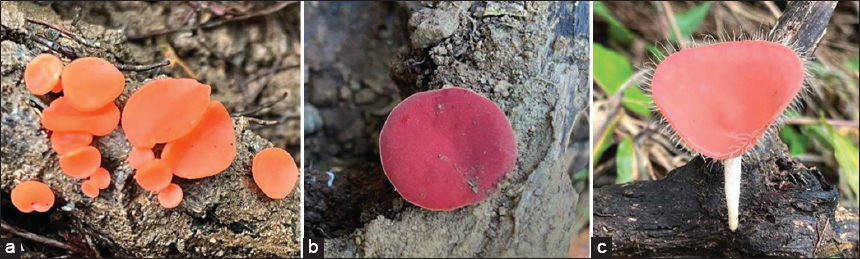 | Figure 1: Fruiting body/ies of (a) Sarcoscypha spp., (b) Phillipsia domingensis, and (c) Cookeina tricholoma growing in their natural habitat. [Click here to view] |
2.2. Optimization of Submerged Culture Requirements
Four liquid culture media (potato sucrose broth [PSB], corn grit broth [CGB], rice bran broth [RBB], and coconut water [CW]) in triplicate were prepared, sterilized, inoculated with a 10-mm-diameter mycelial disc, and incubated at 28°C. Mycelia from the 10-day-old cultures were harvested, oven-dried, and weighed to determine the most favorable medium. The best medium at varying pH levels from pH 4.0 to 8.0 was evaluated in order to identify the optimum pH. For temperature evaluation, cultures with the best medium and pH were incubated in refrigerated (10°C), air-conditioned (20°C), and room temperature (30°C). For agitation, cultures were placed in static or shaking incubators at 100 rpm and 150 rpm. The effect of incubation periods on the mycelial biomass production was also investigated. All treatments were replicated 3 times. The mycelial biomass yield was recorded. The best culture requirement and condition for each optimization parameter were based on the mycelial biomass yield of mushrooms.
2.3. Biomass Production and Extraction
Fifty culture bottles for each cup of mushrooms were prepared for the mass production of mycelia and EPS. The 15- or 20-day-old mycelia (depending on the mushroom) were harvested, air-dried, and extracted following the ethanol extraction protocol of Dulay et al. [23]. Culture spent was used to extract the EPS following the protocol of El-Mahdy et al. [24].
2.4. Mycochemical Screening
Mycochemical screening of ethanol extracts from 15- and 20-day-old mycelial cultures was performed following the protocol of Guevara [25]. Extracts were redissolved with ethanol and were then subjected to preparative silica gel thin-layer chromatography (TLC). Extracts were spotted onto the same 250 μm-silica plate. TLC was performed in a vertical glass chamber with ethyl acetate-chloroform (7:3) solvent system. The compounds were visualized under ultraviolet (UV) light and/or using specific spray reagents such as vanillin-sulfuric acid for phenols, sterols, fatty acids, triterpenes, and essential oils; methanolic KOH for anthraquinones, coumarins, and anthrones; potassium ferricyanide–ferric chloride for phenolics and tannins; Dragendorff’s reagent for alkaloids; and antimony (III) chloride for flavonoids.
2.5. DPPH Radical Scavenging Assay
The method of Baliyan et al. [26] on the DPPH radical scavenging activity determination was followed with modifications. A stock solution was prepared by dissolving 24 mg of DPPH in 100 mL of ethanol. In each test tube, 3 mL of DPPH in 100 solutions was mixed with 100 mL of mushroom extract. A 3 mL solution containing DPPH in 100 mL of ethanol was used as a standard. The tubes were kept in total darkness for 30 min. The absorbance was then measured at 517 nm. Each extract was tested in triplicate. The percentage radical scavenging activity (%RSA) was calculated using the formula:
% RSA = ([Ac – As]/Ac) × 100,
where Ac represents the absorbance of the control and As denotes the absorbance of the sample.
2.6. Alpha-Glucosidase Inhibition Assay
The antidiabetic activity of the mycelial extracts was evaluated using an α-glucosidase inhibition assay, which depends on the enzymatic hydrolysis of the substrate to release p-nitrophenol, correlated with the activity of the sample in comparison to the negative control. Stock substrate solution, p-nitrophenyl-α-D-glucopyranoside, with a concentration of 1.86 mM, and stock enzyme solution with a concentration of 120 mU/mL were prepared. Samples at 100 μg/mL final concentration were also prepared. The samples were homogenized in DMSO using a vortex mixer, followed by centrifugation. In separate wells of a 96-well microtiter plate, 190 μL of 50 mM sodium phosphate buffer solution (pH 6.8) containing NaCl (0.1 M) was mixed with 10 μL of the sample to make a sample concentration of 15 μg/mL. This was followed by the addition of 50 μL of the enzyme solution to the mixture, which was incubated for 10 min at 37°C. After which, 50 μL of the substrate was added, making a total volume of 300 μL in each well. Each test sample solution has two trials and two replicates (n = 2, t = 2). Absorbance of the liberated p-nitrophenol was measured every 30 sec for 30 min at 405 nm using UV VIS Spectrophotometer. The inhibitory activity of the samples and the positive control was determined based on the average slope of each replicate using the equation:
% Inhibitory activity = ([Slopeuninhibited – Slopeinhibited]/Slopeuninhibited) × 100
2.7. AChE Inhibition Assay
For the AChE inhibition assay, a sample stock solution of 10,000 μg/mL and a working solution of 2,000 μg/mL were prepared. Samples were homogenized using a vortex mixer, sonicated, and centrifuged. In a 96-well plate, the reaction mixture consists of 180 μL of 100 mM phosphate buffer at pH 8.0, 10 μL of 1.0 U/mL Electrophorus electricus AChE enzyme solution, 80 μL of buffered Ellman’s reagent (10.0 mM DTNB and 17.9 mM sodium bicarbonate (NaHCO3) at pH 7.0), and 15 μL of each working solution sample/100 μg/mL positive control/negative control (methanol). Each test sample solution has two trials and two replicates (n = 2, t = 2). The sample, positive, and negative controls have a solvent well concentration of 5% methanol. After incubation for 15 min at 25°C, 15 μL of 2.87 mM acetylthiocholine iodide (AChI) was added, and the absorbance was monitored at 420 nm using Multiskan (Thermo Scientific) for 31 readings with 25-s intervals. The inhibitory activity of the sample and the positive control was determined based on the average slope of each replicate using the equation:
% Inhibitory activity = ([Slopeuninhibited – Slopeinhibited]/Slopeuninhibited) × 100
2.8. Statistical Analysis
One-factor-at-a-time optimization study was laid out in a completely randomized design with three replicates per treatment. Data were analyzed using analysis of variance (ANOVA) in a one-way classification analysis and compared using Tukey’s HSD at 5% significance level. A t-test was used to compare the two treatments in the evaluation of illumination.
3. RESULTS AND DISCUSSION
3.1. Optimal Submerged Biomass Production
In recognizing the promising nutraceutical and pharmacological potential of unexplored and underutilized mushrooms, it is essential to optimize their cultivation requirements, such as culture media, pH, temperature, illumination, agitation, and period of incubation, in order to achieve maximal biomass yield. SmF represents a viable approach for producing mushroom biomass in the form of mycelia. Although less commonly employed in mushroom cultivation, SmF offers a practical and innovative method for the production of mycelial biomass and bioactive metabolites of mushrooms.
The most important cultivation requirement of mushrooms is the culture media, which serve as the sole source of nutrients for their growth and development. Four culture media were evaluated in this study, and the mycelial biomass yields of the three cup fungi are presented in Table 1. RBB significantly produced the highest mycelial biomass yield for Sarcoscypha spp. and P. domingensis, whereas CW yielded the highest mycelial biomass of C. tricholoma. PSB and CGB showed lower mycelial biomass production of the three mushrooms. This indicates that mushrooms exhibit species-specific responses to different culture media. Similarly, the maximum mycelial biomass of Lentinus sajor-caju and Lentinus tigrinus was significantly achieved in a RBB [14]. However, CW produced the luxuriant mycelial growth of P. cystidiosus and Coprinopsis cinerea [27]. In addition, CW and RBB were identified as the most suitable culture media for mycelial biomass production of V. volvacea and S. commune, respectively [15].
Table 1: Mycelial biomass yields of Sarcoscypha spp., P. domingensis, and C. tricholoma as influenced by liquid culture media, pH, temperature, agitation, and incubation period.
| Factors | Treatments | Mycelial biomass yield (mg d.w. 100/mL) | ||
|---|---|---|---|---|
| Sarcoscypha spp. | P. domingensis | C. tricholoma | ||
| Culture media | PSB | 28.0±10.03d | 144.8±48.98c | 146.5±13.30c |
| CGB | 161.0±14.76c | 69.5±38.00d | 155.8±46.13c | |
| RBB | 326.3±29.34a | 342.3±34.94a | 205.5±39.69b | |
| CW | 206.8±59.12b | 222.3±21.64b | 312.0±37.16a | |
| pH | pH 4 | 160.3±24.21c | 177.3±9.57c | 142.0±25.07c |
| pH 5 | 235.0±30.50b | 242.3±29.50b | 242.8±11.67b | |
| pH 6 | 368.0±20.99a | 316.0±42.78a | 367.8±20.14a | |
| pH 7 | 155.3±20.17c | 104.3±12.01d | 136.0±23.76c | |
| pH 8 | 38.3±4.27d | 25.7±5.85e | 120.8±26.70c | |
| Temperature | 10°C | 0.0±0.00c | 0.0±0.00c | 0.0±0.0c |
| 20°C | 434.5±29.65a | 408.5±28.90a | 242.3±36.06b | |
| 30°C | 224.0±62.67b | 170.5±22.16b | 416.8±52.58a | |
| Agitation | Static | 522.0±36.94c | 600.8±8.50c | 243.8±38.10c |
| 100 rpm | 844.8±54.66b | 796.0±59.89b | 639.5±57.75b | |
| 150 rpm | 916.5±49.82a | 996.3±13.48a | 950.0±50.60a | |
| Incubation period | 10 days | 916.5±49.8d | 996.3±13.5c | 960.0±50.6d |
| 15 days | 1249.0±45.7c | 1228.0±19.2b | 1314.0±53.1a | |
| 20 days | 1585.0±20.6a | 1293.0±36.4a | 1179.0±62.4b | |
| 25 days | 1473.0±61.7b | 1225.0±68.8b | 1096.1±26.6c | |
Values are expressed as mean±SD. In each column and factor, means with different letters of superscript indicate a significant difference (P<0.05). P. domingensis: Phillipsia domingensis, C. tricholoma: Cookeina tricholoma, PSB: Potato sucrose broth, CGB: Corn grit broth, RBB: Rice bran broth, CW: Coconut water
The superiority of RBB and CW could be accounted for by their nutritional attributes. According to USDA FoodData Central [28], rice bran is rich in carbohydrates (49.7 g), dietary fiber (21 g), total sugars (0.9 g), sucrose (0.5 g), glucose (0.2 g), fructose (0.2 g), minerals such as potassium (1480 mg), magnesium (781 mg), calcium (57 mg), iron (18.5 mg), zinc (6.04 mg), manganese (14.2 mg), and copper, and vitamins. CW, on the other hand, contains carbohydrates (3.71 g), dietary fiber (1.1 g), total sugars (2.61 g), minerals such as potassium (250 mg), magnesium (25 mg), calcium (24 mg), iron (0.29 mg), zinc (0.1 mg), manganese (0.142 mg), and copper, and vitamins. These nutrient compositions play a critical role in the morphogenesis, growth, development, and physiology of fungal cells. Among sugars, fructose, sucrose, and starch have been identified as the preferred carbon sources for the mycelia of Lentinus strigosus, L. tigrinus, and L. swartzii, respectively [29]. Sugars serve not only as primary energy sources but also as precursors for the synthesis of structural biomolecules, being converted into polysaccharides, lipids, and the carbon skeletons of amino acids in vegetative mycelium [30,31].
Potassium is the most abundant mineral in the composition of rice bran and CW. Potassium regulates osmotic balance, maintains cellular hydration, and activates enzymes involved in protein and carbohydrate metabolism, thereby promoting vigorous mycelial expansion [32,33]. Magnesium acts as an enzymatic cofactor and supports polysaccharide biosynthesis, whereas calcium contributes to pH stabilization, enhances extracellular enzyme activities, and stimulates polysaccharide metabolism in species such as Pleurotus and Flammulina [34,35]. Trace elements, including copper, zinc, iron, and manganese, though required in smaller amounts, are also critical as cofactors in metabolic pathways; for example, copper induces laccase activity in Pleurotus ostreatus, facilitating lignin degradation and substrate colonization [34]. Vitamins are also important components of the two media. Supplementation of vitamins in culture media has been shown to enhance mycelial growth, enzymatic activity, and overall metabolic efficiency in species such as G. lucidum and Pleurotus ostreatus [36,37].
Mushroom species have different pH requirements; thus, the appropriate pH level of culture medium should be considered for the optimal growth and production of their mycelia [38]. pH regulates the uptake of sodium ions and essential molecules from the culture medium into individual cells, directly influencing their nutrient absorption capacity, upon which mycelial growth performance depends [39]. In the present study, the mycelial biomass yield of cup mushrooms cultivated in their best medium at varying pH levels was evaluated. The three mushrooms produced the highest biomass yield in the medium with an initial pH of 6.0 [Table 1]. In contrast, the medium at pH 4.0 demonstrated the lowest yield of mycelia. When pH is too acidic or too basic, mushroom mycelia experience physical stress that disrupts cell wall integrity, membrane stability, and hyphal turgor, resulting in reduced hyphal extension, abnormal branching, or growth inhibition. The findings of this study are in agreement with those of Fabros et al. [40], who reported that Lentinus species can tolerate a broad pH range from 4.5 to 8.0, but exhibit optimal mycelial growth in slightly acidic conditions, particularly at pH 5.0 to 6.0. In addition, the results also align with those of Kalaw et al. [41], who observed that pH levels between 5.0 and 8.0 are generally favorable for the growth of Lentinus species, with L. strigosus demonstrating a distinct preference for pH values around 6.0 to 7.5. Moreover, Cordyceps militaris favors pH 6 for maximum biomass production, which suggests the species-specific nature of pH preference in fungal cultivation [42].
In the evaluation of temperature, the most suitable medium with the best pH was used. As shown in Table 1, the highest biomass yield was achieved at 20°C for both Sarcoscypha spp. and P. domingensis, and 30°C for C. tricholoma. Contrastingly, no mycelial growth was observed at 10°C. These results suggest that temperature requirements are species-specific, reflecting the conditions that best support their metabolic and developmental processes. The temperature preference of the first two species is comparable to Lentinula edodes, which grows best at 23°C but exhibits reduced growth under refrigeration (4°C) [43]. Meanwhile, C. tricholoma aligns more closely with Lentinus species, which are generally classified as tropical mushrooms [38]. Similarly, Aguilar et al. [44] reported comparable temperature preferences for Cyathus striatus and Xylaria hongkongensis. The absence of growth at the lowest temperature tested in this study could be attributed to reduced enzyme activity and impaired metabolic processes at extremely low temperatures, which cause hyphal deformation, reduced extension, cellular shrinkage, or mycelial death [45].
Agitation is another physical factor that significantly impacts the overall yield of mushrooms in SmF. The effect of agitation was evaluated by incubating the culture bottles in agitated (100 and 150 rpm) and static conditions. Agitation at 150 rpm yielded significantly the highest mycelial biomass yield, followed by those at 100 rpm [Table 1]. The results of the present study showed that agitation is a crucial factor that improves the growth of the mycelia of the three cup fungi. The observed increase in biomass production under 150 rpm can be attributed to improved oxygen transfer and uniform nutrient distribution, which promote more efficient mycelial growth [46]. Similar favorable responses to agitation have been reported in G. lucidum, Polyporus tricholoma, and L. strigosus [47,48]. In contrast, certain mushroom species, including P. cystidiosus, V. volvacea, and S. commune, exhibit better growth under static conditions [13]. However, high agitation physically affects mushroom mycelia by imposing mechanical stress that can fragment hyphae, alter branching patterns, disrupt mycelial networks, and reduce pellet or mat formation, depending on agitation intensity.
After establishing the optimal nutritional and physical conditions for biomass production, the effect of varying periods of incubation was evaluated [Table 1]. It can be seen that the maximum biomass yield was achieved after 20 days of fermentation for both Sarcoscypha spp. and P. domingensis, and after 10 days of fermentation for C. tricholoma. These results indicate that extending the fermentation for a certain period can be beneficial for maximizing fungal biomass. This progressive increase in biomass can be attributed to the continuous accumulation of fungal cells as the mycelia efficiently utilize available nutrients for growth. Similarly, Auricularia polytricha exhibited enhanced cell mass when fermentation was prolonged to 20 days [49]. In addition, Devi et al. [50] reported that the optimum incubation period for mycelial biomass production of three Auricularia species (A. delicata, A. polytricha, and A. auricula) was 20–25 days in SmF; however, a longer incubation period of 30–40 days resulted in a decrease in the biomass yield. The mycelial biomass of the three mushrooms was mass-produced using the optimal submerged culture conditions. The EPS of each mushroom was also extracted from the culture spent.
3.2. Biochemical Composition of Cup Mushrooms
Mushrooms are well-recognized producers of secondary metabolites that contribute to their diverse biological and functional activities. TLC analysis revealed the presence of essential oils, coumarins, and anthrones in all three mushroom species analyzed [Table 2]. Both P. domingensis and C. tricholoma contained triterpenes and sterols, whereas alkaloids were detected only in Sarcoscypha spp. and P. domingensis. Steroids were detected in Sarcoscypha spp. and C. tricholoma but were absent in P. domingensis. Interestingly, P. domingensis was the only species that tested positive for phenols, tannins, and flavonoids. Anthraquinones were not detected in any of the samples. Collectively, nine distinct mycochemicals were detected in P. domingensis, whereas Sarcoscypha spp. and C. tricholoma contained five and six, respectively. Bioactive compounds derived from the mycelia and fruiting bodies of mushrooms, including coumarins, anthrones, triterpenes, sterols, steroids, alkaloids, phenols, tannins, and flavonoids, contribute to their wide-ranging health benefits [18,10]. Coumarins are a natural class of occurring compounds with benzopyrone structure found in fungi, plants, and microorganisms that exhibit different bioactivities such as antioxidants, anti-inflammatory, antimicrobial, and antiviral properties [51]. Terpenes derived from Basidiomycetes are referred to as terpenoids or isoprenoids, and they have been associated with various biological activities such as antioxidant, anticancer, and anti-inflammatory effects [52]. Phenolic compounds, though commonly found in plants, are also abundant in mushrooms [52], and their presence is closely associated with the antioxidant activity of these fungi. Polyporus pinicola and P. volvatus have been found to contain significant phenolic content and hence display antioxidant capabilities [53]. Compounds from mushrooms, such as alkaloids, terpenoids, flavonoids, polysaccharides, tannins, steroids, glycoproteins, phenols, ergosterols, sesquiterpenes, and lactones [54] have been associated with many pharmacological properties, including antioxidant, antibacterial, anticancer, anti-inflammatory, and antidiabetic effects [55,56]. Moreover, polysaccharides, phenols, tocopherols, flavonoids, glycosides, and organic acids have often been described as contributors to antioxidant properties [57]. The presence of key metabolites underscores the potential therapeutic significance of cup mushrooms. Given the well-documented pharmacological properties of these compounds, the findings support the growing evidence that mushrooms serve as promising sources of natural agents with antioxidant, antimicrobial, anti-inflammatory, and other health-promoting activities. This emphasizes the importance of further biochemical and pharmacological investigations to explore their functional and medicinal applications fully.
Table 2: Biochemical constituents of the ethanolic extract of mycelia of S. minuta, P. domingensis, and C. tricholoma.
| Mycochemical | S. minuta | P. domingensis | C. tricholoma |
|---|---|---|---|
| Alkaloids | Present | Present | Not detected |
| Anthraquinones | Not detected | Not detected | Not detected |
| Anthrones | Present | Present | Present |
| Coumarins | Present | Present | Present |
| Essential oil | Present | Present | Present |
| Flavonoids | Not detected | Present | Not detected |
| Phenols | Not detected | Present | Not detected |
| Steroids | Present | Not detected | Present |
| Sterols | Not detected | Present | Present |
| Tannins | Not detected | Present | Not detected |
| Triterpenes | Not detected | Present | Present |
S. minuta: Sarcoscypha minuta, P. domingensis: Phillipsia domingensis, C. tricholoma: Cookeina tricholoma
3.3. Antioxidant Activity of Cup Mushrooms
The antioxidant activities of mycelial extracts and EPS of the three cup mushrooms were evaluated using the DPPH radical scavenging assay. Table 3 presents the percentage of DPPH radical scavenging activities (RSA) of the tested samples. The mycelial extracts and EPS exhibited RSA values ranging from 17.17% to 57.42% and 40.96% to 53.20%, respectively. Among these, the mycelial extract of Sarcoscypha spp. showed higher RSA than its EPS, whereas the EPS of P. domingensis and C. tricholoma demonstrated greater activity than their respective mycelial extracts. Although all RSA values were lower than that of ascorbic acid, the results still indicate promising antioxidant potential, particularly for Sarcoscypha spp. mycelial extract and P. domingensis EPS, both exceeding 50% RSA. Notably, the maximum RSA values observed in this study were higher than those reported for the acetonitrile extracts of L. tigrinus (39.2%) and P. djamour (32.8%) [58]. Similar findings have been documented in other mushroom species. For instance, Acharya et al. [59] reported that the methanolic extract of O. canarii basidiocarp exhibited strong antioxidant potential (EC50 = 0.912 μg), primarily attributed to phenols, flavonoids, ascorbic acid, β-carotene, and lycopene. Likewise, among five Pleurotus species, P. flabellatus 5013 showed the highest antioxidant activity, with its methanolic extract exhibiting 24.9 mg TE/g in the DPPH assay and 63.9 mg TE/g in the ORAC assay, a property attributed in part to ergothioneine (ERG), a water-soluble thiol derivative of histidine with well-documented antioxidant effects in vitro and in vivo [60,61]. Furthermore, the methanolic extract of Dictyophora indusiata at 6.4 mg/mL exhibited 92.1% DPPH radical scavenging activity [62]. Collectively, the present results, together with previous studies, underscore that medicinal and edible mushrooms are valuable sources of natural antioxidants. During oxidative stress, excessive free radicals can damage cellular components such as DNA, RNA, and proteins, leading to apoptosis and diseases including cancer, diabetes, cardiovascular disorders, and age-related conditions [63]. Consequently, antioxidant interventions that neutralize free radicals hold significant potential in mitigating these health risks.
Table 3: DPPH radical scavenging activity of mycelial extract and EPS of the three mushrooms.
| Mushroom isolate | DPPH radical scavenging (%) | |
|---|---|---|
| Mycelial extract | EPS | |
| S. minuta | 57.42±6.78b | 40.96±5.56d |
| P. domingensis | 30.30±6.48c | 53.20±6.01b |
| C. tricholoma | 17.17±9.17d | 47.96±9.94c |
| Ascorbic acid | 90.71±0.79a | |
Values are expressed as mean±SD. Means with different letters of superscript indicate significant difference (p<0.05). Mycelial extract (1000 µg/mL) and EPS (1000 µg/mL) of each mushroom and ascorbic acid (1000 µg/mL) were compared using Tukey’s HSD. S. minuta: Sergentomyia minuta, P. domingensis: Phillipsia domingensis, C. tricholoma: Cookeina tricholoma, EPS: Exopolysaccharide, DPPH: 2,2-diphenyl-1-picrylhydrazyl
3.4. Alpha-glucosidase Inhibitory Activity of Cup Mushrooms
Several mushroom species have been reported to alleviate diabetes-related symptoms, including G. lucidum, Cordyceps sinensis, Agaricus subrufescens, Coprinus comatus, Agaricus bisporus, Phellinus linteus, Poria cocos, Inonotus obliquus, Pleurotus species, and Sparassis crispa [64]. In the present study, the α-glucosidase inhibitory activities of the mycelial extracts and EPSs of the three cup mushrooms were evaluated to assess their antidiabetic potential [Table 4]. Among the tested samples, the mycelial extract of Sarcoscypha spp. exhibited the highest inhibitory activity against α-glucosidase, whereas the other samples demonstrated none to very low inhibition. The limited α-glucosidase inhibitory activities observed in the mycelial extracts and EPSs of the three mushrooms could be attributed to the concentration of the samples tested and the extraction solvent used. The concentration employed in this study may not have been sufficient to elicit strong enzyme inhibition. Furthermore, the bioactive compounds responsible for α-glucosidase inhibition may not have been efficiently extracted using ethanol. Supporting this, Deveci et al. [65] reported that hexane extracts of P. ostreatus, M. procera, P. schweinitzii, L. gentianeus, and P. pini exhibited higher α-glucosidase inhibitory activities than their corresponding methanol extracts, whereas the methanol extracts of T. pubescens and G. adspersum showed greater activity than their hexane counterparts. Moreover, Ji et al. [66] revealed that the α-glucosidase inhibitory activity of mushroom polysaccharides depends on their monosaccharide composition, molecular weight, higher-order structure, and the type and position of glycosidic bonds. To establish more conclusive findings, further investigations should evaluate varying extract concentrations, different extraction solvents and methods, and the structural characteristics of the bioactive compounds involved.
Table 4: α-glucosidase inhibitory activity of mycelial extract and EPS of the three mushrooms.
| Mushroom isolate | α-glucosidase inhibition (%) | |
|---|---|---|
| Mycelial extract | EPS | |
| Sarcoscypha spp. | 23.03±2.77b | 2.36±0.93b |
| P. domingensis | 0.00±0.00c | 0.16±1.77c |
| C. tricholoma | 2.70±1.78c | 0.90±0.88c |
| Acarbose | 91.92±0.53a | |
Values are expressed as mean±SD. Means with different letters of superscript indicate significant difference (P<0.05). Mycelial extract (10 μg/mL) and EPS (10 μg/mL) of each mushroom and acarbose (1000 μg/mL) were compared using Tukey’s HSD. P. domingensis: Phillipsia domingensis, C. tricholoma: Cookeina tricholoma, EPS: Exopolysaccharide
3.5. AChE Inhibitory Activity of Cup Mushrooms
AChE inhibition is a key therapeutic strategy in neuroprotection, particularly in the management of neurodegenerative disorders such as Alzheimer’s and Parkinson’s diseases [67]. AChE is responsible for hydrolyzing acetylcholine, a neurotransmitter essential for learning, memory, and cognitive processing. Overactivity of this enzyme leads to decreased acetylcholine levels, contributing to impaired synaptic transmission and cognitive decline. Thus, compounds that inhibit AChE are of significant interest for their potential to preserve neurotransmitter function and mitigate the progression of neurodegeneration. In this study, the AChE inhibitory activities of the mycelial extracts and EPS of three cup mushroom isolates were assessed [Table 5]. The mycelial extracts of Sarcoscypha spp. and P. domingensis exhibited higher inhibitory activity than their corresponding EPS, suggesting that AChE-active metabolites in these species are more abundant or more potent in the mycelial matrix. In contrast, the EPS of C. tricholoma demonstrated greater AChE inhibition than its mycelial extract, indicating that its bioactive components may be concentrated in the EPS. Among the three species, P. domingensis showed consistently low inhibitory effects in both extract types. Although the mushroom isolates exhibited low to mild AChE inhibition compared to the positive control, the activity observed in Sarcoscypha spp. and C. tricholoma highlights their potential as sources of neuroprotective compounds. These findings support further purification, structural characterization, and in vivo evaluation to explore their possible applications in preventing or managing neurodegenerative diseases.
Table 5: Acetylcholinesterase inhibitory activity of mycelial extract and EPS of the three mushrooms.
| Mushroom isolate | Acetylcholinesterase inhibition (%) | |
|---|---|---|
| Mycelial extract | EPS | |
| Sarcoscypha spp. | 12.74±3.99b | 8.35±1.42c |
| P. domingensis | 6.38±1.50b | 4.51±1.24c |
| C. tricholoma | 5.91±0.83c | 10.98±2.06b |
| Galantamine | 98.29±0.12a | |
Values are expressed as mean±SD. Means with different letters of superscript indicate significant difference (P<0.05). Mycelial extract (10 μg/mL) and EPS (10 μg/mL) of each mushroom and galantamine (10 μg/mL) were compared using Tukey’s HSD. P. domingensis: Phillipsia domingensis, C. tricholoma: Cookeina tricholoma, EPS: Exopolysaccharide
4. CONCLUSION
This study highlights the biotechnological potential of cup mushrooms as valuable sources of functionally important bioactive compounds, underscoring their relevance in the development of natural antioxidants, antidiabetics, and neuroprotective agents. By establishing the optimal cultural conditions for efficient biomass and metabolite production, the findings provide a practical foundation for sustainable cultivation and future utilization of these species in health-promoting products. The demonstrated biological activities suggest that these mushrooms can serve as promising candidates for nutraceutical and pharmaceutical research, particularly for addressing lifestyle and neurodegenerative diseases that continue to pose major public health challenges. Moving forward, it is recommended that large-scale fermentation and controlled bioprocessing be pursued to increase yield and consistency, followed by the targeted isolation and characterization of the active compounds to identify those responsible for the observed therapeutic effects. The specific type and molecular size of EPS responsible for enzyme inhibition activities should also be thoroughly characterized. In addition, further mechanistic, toxicological, and in vivo studies are essential to validate stability, efficacy, and safety, which will help support the eventual formulation of functional food supplements or drug leads derived from these cup fungi.
5. AUTHORS’ CONTRIBUTIONS
All authors made substantial contributions to conception and design, acquisition of data, or analysis and interpretation of data; took part in drafting the article or revising it critically for important intellectual content; agreed to submit to the current journal; gave final approval of the version to be published; and agree to be accountable for all aspects of the work. All the authors are eligible to be author as per the International Committee of Medical Journal Editors (ICMJE) requirements/guidelines.
6. FUNDING
There is no funding to report.
7. CONFLICTS OF INTEREST
The authors report no financial or any other conflicts of interest in this work.
8. ETHICAL APPROVALS
The study protocol was approved by the Institutional Ethics Review Committee of College of Science, Central Luzon State University, Science City of Muñoz, Philippines (Approval No.: ERC 2025-1131).
9. DATA AVAILABILITY
The data that was used in this study will be given to the corresponding author upon a fair request.
10. PUBLISHER’S NOTE
All claims expressed in this article are solely those of the authors and do not necessarily represent those of the publisher, the editors and the reviewers. This journal remains neutral with regard to jurisdictional claims in published institutional affiliation.
11. USE OF ARTIFICIAL INTELLIGENCE (AI)-ASSISTED TECHNOLOGY
The authors declare that they have not used artificial intelligence (AI)-tools for writing and editing of the manuscript, and no images were manipulated using AI.
REFERENCES
1. Martínez-Medina GA, Chávez-González ML, Verma DK, Prado-Barragán LA, Martínez-Hernández JL, Flores-Gallegos AC, et al. Bio-functional components in mushrooms, a health opportunity: Ergothionine and huitlacoche as recent trends. J Funct Foods. 2021;77:104326. [CrossRef]
2. Beelman RB, Kalaras MD, Richie JP Jr. Micronutrients and bioactive compounds in mushrooms: A recipe for healthy aging? Nutr Today. 2019;54:16-22. [CrossRef]
3. Sánchez C. Reactive oxygen species and antioxidant properties from mushrooms. Synth Syst Biotechnol. 2017;2:13-22. [CrossRef]
4. Elkhateeb WA, Daba GM, Thomas PW, Wen TC. Medicinal mushrooms as a new source of natural therapeutic bioactive compounds. Egypt Pharm J. 2019;18:88-101.
5. Badalyan SM, Zambonelli A. The potential of mushrooms in developing healthy food and biotech products. In: Satyanarayana T, Deshmukh SK, editors. Fungi and Fungal Products in Human Welfare and Biotechnology. Singapore: Springer;2023. 307-44. [CrossRef]
6. Singh R, Kumar M, Mittal A, Mehta PK. Microbial metabolites in nutrition, healthcare and agriculture. 3 Biotechnology. 2017;7:15. [CrossRef]
7. Wu Y, Choi MH, Li J, Yang H, Shin HJ. Mushroom cosmetics: The present and future. Cosmetics. 2016;3(3):22. [CrossRef]
8. Vieira Gomes DC, Barros De Alencar MV, Campinho Dos Reis A, Torres De Lima RM, Oliveira Santosa JV, Da Mata AM, et al. Antioxidant, anti-inflammatory and cytotoxic/antitumoral bioactives from the phylum Basidiomycota and their possible mechanisms of action. Biomed Pharmacother. 2019;112:108643. [CrossRef]
9. Miyano R, Matsuo H, Mokudai T, Noguchi Y, Higo M, Nonaka K, et al. Trichothioneic acid, a new antioxidant compound produced by the fungal strain Trichoderma virens FKI-7573. J Biosci Bioeng. 2020;29(4):508-13. [CrossRef]
10. Khursheed R, Singh SK, Wadhwa S, Gulati M, Awasthi A. Therapeutic potential of mushrooms in diabetes mellitus: Role of polysaccharides. Int J Biol Macromol. 2020;164:1194-205. [CrossRef]
11. Elkhateeb WA, Galappaththi MA, Elghwas DE, Daba GM. The anti-diabetic potential of mushrooms: A review. Curr Trends Biotechnol Pharm. 2023;17(4):1415-24. [CrossRef]
12. Wattanalaorsomboon S, Mansalai P, Payaka A, Baiya S, Sansenya S. The inhibition effect of oleamide for acetylcholinesterase and β-glucosidase from edible wild mushroom by in vitro, in silico and fluorescence analysis. Int J Biol Macromol. 2025;308(4):142681. [CrossRef]
13. Dulay RMR, Ray K, Hou CT. Optimization of liquid culture conditions of Philippine wild edible mushrooms as potential source of bioactive lipids. Biocatal Agric Biotechnol. 2015;4:409-15. [CrossRef]
14. Dulay RM, Flores KS, Tiniola RC, Marquez DH, Dela Cruz AG, Kalaw SP, et al. Mycelial biomass production and antioxidant activity of Lentinus tigrinus and Lentinus sajor-caju in indigenous liquid culture. Mycosphere. 2015;6(6):659-66. [CrossRef]
15. Dulay RM, Vicente JJ, Dela Cruz AG, Gagarin JM, Fernando W, Kalaw SP, et al. Antioxidant activity and total phenolic content of Volvariella volvacea and Schizophyllum commune mycelia cultured in indigenous liquid media. Mycosphere. 2016;7(2):131-8. [CrossRef]
16. Hou CT, Lin JT, Dulay RM, Ray K. Identification of the molecular species of acylglycerols containing hydroxy fatty acids in wild edible mushroom Ganoderma lucidum. Biocatal Agric Biotechnol. 2017;10:411-9. [CrossRef]
17. Diaz JC, Valentino MJ, Dulay RM, Kalaw SP. Phytohormone induced submerged fermentation for mycelia biomass and exopolysaccharide production of Agrocybe cylindracea (DC.) Maire and Pleurotus djamor (Rumph. Ex Fr.) Boedijn. Asian J Mycol. 2025;8(1):12-24.
18. Dudekula UT, Doriya K, Devarai SK. A critical review of submerged production of mushrooms and their bioactive metabolites. 3 Biotech. 2020;10(8):337. [CrossRef]
19. Zeng M, Gentekaki E, Hyde KD, Zhao Q, Mato?ec N, Kušan I. Phylogeny and morphology of novel species and new collections related to Sarcoscyphaceae (Pezizales, Ascomycota) from Southwestern China and Thailand. Biology. 2023;12(1):130. [CrossRef]
20. Putra IP, Murung HG. Distribution of genus Cookeina and ethnomycology in Indonesia. Rumphius Pattimura Biol J. 2025;7(1):9-18. [CrossRef]
21. Jiménez-Zárate J, Garibay-Orijel R, Yahia EM, Esquivel-Naranjo EU, First record of the edibility of Phillipsia domingensis Berk. (Pezizales:Ascomycota): nutritional aspects and biological activity. Scientia Fungorum. 2020;50:e1254. [CrossRef]
22. Piljac-Zegarac J, Samec D, Piljac A, Mesic A, Tkalcec Z. Antioxidant properties of extracts of wild medicinal mushroom species from Croatia. Int J Med Mushrooms. 2011;13(3):257-63. [CrossRef]
23. Dulay RM, Arenas MC, Kalaw SP, Reyes RG, Cabrera EC. Proximate composition and functionality of the culinary-medicinal tiger Sawgill mushroom, Lentinus tigrinus (Higher basidiomycetes), from the Philippines. Int J Med Mushrooms. 2014;16(1):85-94. [CrossRef]
24. El-Mahdy OM, Mohamed HI, El-Ansary AE. Optimisations of exopolysaccharide production by Fusarium nygamai strain AJTYC1 and its potential applications as an antioxidant, antimicrobial, anticancer, and emulsifier. BMC Microbiol. 2023;23(1):345. [CrossRef]
25. Guevara BQ. A Guidebook to Plant Screening: Phytochemical and Biological. Philippines, PA:UST Publishing House;2004.
26. Baliyan S, Mukherjee R, Priyadarshini A, Vibhuti A, Gupta A, Pandey RP, et al. Determination of antioxidants by DPPH radical scavenging activity and quantitative phytochemical analysis of Ficus religiosa. Molecules. 2022;27(4):1326. [CrossRef]
27. Kalaw SP, Alfonso DO, Dulay RM, De Leon AM, Undan JQ, Undan JR, et al. Optimization of culture conditions for secondary mycelial growth of wild macrofungi from selected areas in Central Luzon, Philippines. Curr Res Environm Appl Mycol. 2016;6(4):277-87. [CrossRef]
28. USDA FoodData Central;2019. Available from: https://fdc.nal.usda.gov/food-details/169713/nutrients [Last accessed on 2025 Aug 15].
29. Dulay RM, Cabrera EC, Kalaw SP, Reyes RG, Hou CT. Nutritional requirements for mycelial growth of three Lentinus species from the Philippines. Biocatal Agric Biotechnol. 2020;23:101506. [CrossRef]
30. Patyshakuliyeva A, Jurak E, Kohler A, Baker A, Battaglia E, De Bruijn W, et al. Carbohydrate utilization and metabolism is highly differentiated in Agaricus bisporus. BMC Genomics. 2013;14:663. [CrossRef]
31. Madigan MT, Martinko JM, Parker J. Brock Biology of Microorganisms. State of New Jersey:Pearson Education;2008.
32. Kala?P. Trace element contents in European species of wild-growing edible mushrooms: A review for the period 2000-2009. Food Chem. 2010;122(1):2-15. [CrossRef]
33. Sun Y, Wu J, Liu X, Zhang H, Wang J, Zhang Y. Effect of mineral nutrients on mycelial growth and fruiting body development of medicinal mushrooms. J Fungi. 2002;8(11):1183. [CrossRef]
34. Adebayo EA, Oloke JK, Majolagbe ON, Bora T. Comparative study on mineral composition of cultivated edible mushrooms and their growth substrates. J Adv Biol Biotechnol. 2018;18(3):1-9. [CrossRef]
35. Mleczek M, Siwulski M, Rzymski P, Budka A, Jasi?ska A, Kala? P, et al. Content of selected elements and phenolic compounds in edible mushrooms:A review. Int J Environ Res Public Health. 2021;18(16):8881. [CrossRef]
36. Soh E, Saeidi N, Javadian A, Hebel DE, Le Ferrand H. Effect of common foods as supplements for the mycelium growth of Ganoderma lucidum and Pleurotus ostreatus on solid substrates. PLoS One. 2021;16(1):e0260170. [CrossRef]
37. Holt RR, Munafo JP, Salmen J, Keen CL, Mistry BS, Whiteley JM, et al. Mycelium: A nutrient-dense food to help address world health challenges. J Agric Food Chem. 2023;71(8):2921-32. [CrossRef]
38. Dulay RM, Cabrera EC, Kalaw SP, Reyes RG. Optimization of submerged culture conditions for mycelial biomass production of fourteen Lentinus isolates from Luzon Island, Philippines. Biocatal Agric Biotechnol. 2021;38:102226. [CrossRef]
39. Elisashvili V. Submerged cultivation of medicinal mushrooms: Bioprocesses and products (review). Int J Med Mushrooms. 2012;14(3):211-39. [CrossRef]
40. Fabros J, Dulay RM, De Leon, AM, Kalaw SP, Reyes RG. Distribution, cultivation, nutritional composition, and bioactivities of Lentinus (Polyporaceae, Basidiomycetes): A review. Curr Res Environ Appl Mycol. 2022;12(1):170-219. [CrossRef]
41. Kalaw SP, Dulay RM, Damaso EJ, Ramos JC, Del Rosario MA, Abon MD, et al. Optimization of mycelial culture conditions and fructification of Lentinus species using rice straw and sawdust-based substrates. Stud Fungi. 2021;6(1):519-30. [CrossRef]
42. Park JP, Kim SW, Hwang HJ, Yun JW. Optimization of submerged culture conditions for the mycelial growth and exo-biopolymer production by Cordyceps militaris. Lett Appl Microbiol. 2001;33(1):76-81. [CrossRef]
43. Quaicoe EH, Amoah C, Obodai M, Odamtten GT. Nutrient requirements and environmental conditions for the cultivation of the medicinal mushroom (Lentinula edodes (Berk.)) in Ghana. Int J Sci Technol Res. 2014;3(12):45-50.
44. Aguilar JS, Dulay RM, Kalaw SP, Reyes RG. Optimal submerged culture conditions and bioactivities of mycelia of wild mushrooms, Cyathus striatus (Hudson) Wildenow, and Xylaria hongkongensis (AMC Tang, RYC Lam and MWK Leung). J Int Soc Southeast Asian Agric Sci. 2023;29(1):120-34.
45. Hao H, Zhang J, Wu S, Bai J, Zhuo X, Zhang J, et al. Transcriptomic analysis of Stropharia rugosoannulata reveals carbohydrate metabolism and cold resistance mechanisms under low-temperature stress. AMB Express. 2022;12(1):56. [CrossRef]
46. Peng J, Lee C, Tsai Y. Effect of rice bran on the production of different king oyster mushroom strains during bottle cultivation. J Agric Res China. 2000;49(3):60-7.
47. Vargas-Isla R, Ishikawa NK. Optimal conditions of in vitro mycelial growth of Lentinus strigosus, an edible mushroom isolated in the Brazilian Amazon. Mycoscience. 2008;49(3):215-9. [CrossRef]
48. Agudelo-Escobar LM, Gutiérrez-López Y, Urrego-Restrepo S. Effects of aeration, agitation and pH on the production of mycelial biomass and exopolysaccharide from the filamentous fungus Ganoderma lucidum. DYNA. 2017;84(200):72-9. [CrossRef]
49. Hassan FRH, Medany GM. Studies on submerged culture conditions for mycelial biomass production of wood ears mushroom (Auricularia polytricha). Middle East J Agric Res. 2012;1(1):33-9.
50. Devi MB, Singh SM, Singh NI. Biomass production in Auricularia spp. (Jew's ear) collected from Manipur, India. Int J Curr Microbiol Appl Sci. 2015;4:985-9.
51. Elmusa F, Elmusa M. Mini-review on coumarins: Sources, biosynthesis, bioactivity, extraction and toxicology. J Turk Chem Soc Section A. 2024;11(3):933-44. [CrossRef]
52. Zhou Y, Chu M, Ahmadi F, A?ar OT, Barrow CJ, Dunshea FR, et al. A comprehensive review on phytochemical profiling in mushrooms: Occurrence, biological activities, applications and future prospective. Food Rev Int. 2023;40(3):924-51. [CrossRef]
53. Orhan ?, Üstün O. Determination of total phenol content, antioxidant activity and acetylcholinesterase inhibition in selected mushrooms from Turkey. J Food Compos Anal. 2011;24(3):386-90. [CrossRef]
54. Bhambri A, Srivastava M, Mahale VG, Mahale S, Karn SK. Mushrooms as potential sources of active metabolites and medicines. Front Microbiol. 2022;13:837266. [CrossRef]
55. Gargano ML, Van Griensven LJ, Isikhuemhen OS, Lindequist U, Venturella G, Wasser SP, et al. Medicinal mushrooms: Valuable biological resources of high exploitation potential. Plant Biosyst Int J Deal All Aspects Plant Biol. 2017;151(3):548-65. [CrossRef]
56. Dulay RM, Batangan JN, Kalaw SP, De Leon AM, Cabrera EC, Kimura K, et al. Records of wild mushrooms in the Philippines: A review. J Appl Biol Biotechnol. 2023;11(2):11-32. [CrossRef]
57. Zade S, Tarun Kumar Upadhyay TK, Rab SO, Sharangi AB, Lakhanpal S, Alabdallah NM, et al. Mushroom-derived bioactive compounds, pharmacological properties, and cancer targeting:A holistic assessment. Discov Oncol. 2025;16:654. [CrossRef]
58. Dulay RM, Miranda LA, Malasaga JS, Kalaw SP, Reyes RG, Hou CT. Antioxidant and antibacterial activities of acetonitrile and hexane extracts of Lentinus tigrinus and Pleurotus djamour. Biocatal Agric Biotechnol. 2017;9:141-4. [CrossRef]
59. Acharya K, Nandi S, Dutta AK. Microanatomical and physicochemical characterisation and antioxidative activity of methanolic extract of Oudemansiella canarii (Jungh.) Höhn. Turk J Pharm Sci. 2019;16(1):76-81. [CrossRef]
60. Stastny J, Marsik P, Tauchen J, Bozik M, Mascellani A, Havlik J, et al. Antioxidant and anti-inflammatory activity of five medicinal mushrooms of the genus Pleurotus. Antioxidants (Basel). 2022;11:1569. [CrossRef]
61. Halliwell B, Cheah IK Tang RM. Ergothioneine - a diet-derived antioxidant with therapeutic potential. FEBS Lett. 2018;592:3357-66. [CrossRef]
62. Mleczek M, Rzymski P, Budka A, Siwulski M, Jasinska A, Kala?c P, et al. Elemental characteristics of mushroom species cultivated in China and Poland. J Food Compos Anal. 2018;66:168-78. [CrossRef]
63. Ma-On C, Sanpavat A, Whongsiri P, Suwannasin S, Hirankarn N, Tangkijvanich P, et al. Oxidative stress, indicated by elevated expression of Nrf2 and 8-OHdG, promotes hepatocellular carcinoma progression. Med Oncol. 2017;34(4):904-19. [CrossRef]
64. Shamim MZ, Mishra AK, Kausar T, Mahanta S, Sarma B, Kumar V, et al. Exploring edible mushrooms for diabetes: Unveiling their role in prevention and treatment. Molecules. 2023;28(6):2837. [CrossRef]
65. Deveci E, Çayan F, Tel-Çayan G, Duru ME. Inhibitory activities of medicinal mushrooms on a-amylase and a-glucosidase enzymes related to type 2 diabetes. S Afr J Bot. 2020;137:19-23. [CrossRef]
66. Ji X, Guo J, Cao T, Zhang T, Liu Y, Yan Y. Review on mechanisms and structure-activity relationship of hypoglycemic effects of polysaccharides from natural resources. Food Sci Hum Well. 2020;12:1969-80. [CrossRef]
67. Lee W, Fujihashi A, Govindarajulu M, Ramesh S, Deruiter J, Majrashi M, et al. Role of mushrooms in neurodegenerative diseases. In: Medicinal Mushrooms: Recent Progress in Research and Development. Berlin: Springer;2019. p223-249. [CrossRef]