
1. INTRODUCTION
In recent decades, the interest in optimizing bioprocesses has grown considerably, driven by the need to improve the efficiency and sustainability of industrial production. This phenomenon has become particularly relevant in a world facing increasing challenges in resource utilization and environmental sustainability. In this context, substitution of traditional production processes by biotechnological solutions emerges as a promising alternative toward the consolidation of bioeconomic production models [1]. However, the scalability of biotechnological processes presents significant challenges when transferring the optimal conditions observed in the laboratory to an industrial setting.
In large-scale bioreactors, it is common to experience lower process performance compared to the results obtained at laboratory scale due to the assumption of ideal mixing not met in several industrial bioprocesses [2]. This leads to localized gradients, changes in solubilities, and inefficient mixing, exposing cells to fluctuating microenvironmental conditions repeatedly, which in turn results in low productivity, conversion yield, and selectivity [3-5]. Actually, the process of scaling-up processes involves such adaptation to the larger volumes, with the consequent transport limitations, and both, substrate and product variability. These scale-dependent complications require higher engineering and financial efforts, highlighting the importance of investigating the underlying mechanisms governing bioprocess performance at different scales [6-8].
As an alternative to address these issues, scale-down simulations have been developed to replicate large-scale process conditions in a laboratory environment. Scale-down simulators provide valuable tools for studying and optimizing bioprocess behavior, offering insights into mixing dynamics, oxygen transfer, and other key parameters that affect performance [8,9]. By emulating industrial conditions in a controlled lab-scale system, scale-down approaches allow researchers to identify and mitigate potential problems before large-scale implementation, leading to a more cost-efficient bioprocess development pathway [6,7,9]. This approach has been used not only for studying novel bioprocess looking the technological transfer to industry, but also in well-established processes aimed to optimize the performance and, in the last term, the economy of bioprocesses [8,9].
As observed in Figure 1, different experimental setups have been developed to implement scale-down strategies in bioreactors, each designed to reproduce the heterogeneities encountered at industrial scale. The most common configurations are based on stirred-tank reactors (STRs) operated in series or in combination with plug-flow reactors (PFRs), which allow the simulation of spatial gradients of dissolved oxygen (DO), pH, and nutrients [6,8]. Two-compartment systems, such as STR–PFR or STR–STR setups, are widely used to alternate between well-mixed conditions and zones of nutrient or oxygen limitation, thereby mimicking the cyclic exposure experienced by cells in large fermenters. More complex three-compartment systems extend this principle by incorporating an additional reactor or zone, enabling the simulation of multiple stress factors simultaneously (e.g., sequential variations in oxygen, pH, and substrate availability) [6,8]. In addition, fed-batch and membrane bioreactor setups allow the study of dynamic substrate fluctuations typical of large-scale feeding strategies, while microtiter plates and disposable mini-bioreactors provide high-throughput options to introduce oscillatory regimes and test multiple conditions in parallel.
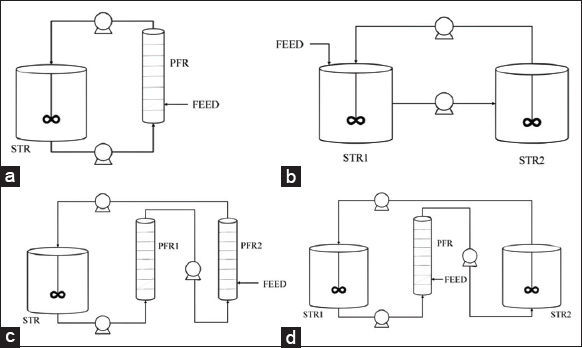 | Figure 1: (a-d) Scale-down configurations used to study bioreactor inhomogeneities. [Click here to view] |
In recent years, bibliometric approaches have emerged as valuable instruments for analyzing the structure of scientific domains, detecting research gaps, and orienting future studies [10-12]. Unlike conventional narrative reviews, bibliometric analysis offers both quantitative and qualitative insights into patterns of publication, co-citation linkages, and thematic trends, thereby yielding a more evidence-driven perspective on how knowledge evolves.
This study focuses on investigating the accumulated scientific production behind the scale-down approach applied to bioprocessing, between 1997 and 2024, using the Scopus database as one of the most reliable scientific indexing services. This work is the first bibliometric study on bioreactors scale-down and complements the literature in the topic, as the previous reviews by Neubauer and Junne (2010) and Arulrajah et al., which primarily focused on the conceptual and technical aspects of scale-down modeling. The present analysis provides a broader, data-driven perspective and emerging research directions. The study also reveals persistent regional disparities in research and the concentrated output on microorganisms of industrial interest.
2. MATERIALS AND METHODS
On July 12, 2025, a search was conducted in the Scopus database, limiting the search to articles and reviews as the valid document types. The search range was set from 1997 to 2024. After some preliminary query, the terms in the search equation used were “scale down” AND “bioprocess” OR “simulator”, aiming to encompass the maximum number of documents focusing on scale-down types, whether experimental or computational studies. To confirm the effectiveness of this equation, a bibliometric mapping was performed using the VOSviewer software tool [13]. Data were processed in Microsoft Excel v16.0. Consideration was given to the locations where this type of study had been most extensively researched, relevant authors, and keywords [1,14,15]. The bibliometric methodology was followed as described elsewhere [14,15].
Scopus is a large and multidisciplinary database indexing over 90 million records of peer-reviewed literature in science, technology, medicine, social sciences, and arts and humanities. The use of Scopus as the primary data source in this bibliometric analysis offers several advantages in terms of data quality, citation tracking, and coverage of peer-reviewed literature. Nevertheless, some inherent limitations of the database are acknowledged, such as the underrepresentation of regional journals (non-indexed), grey literature, and non-English language publications. Although bibliometric search based on keywords is a standard and wide-spread procedure, the reliance on keyword-based searches can result in the exclusion of relevant articles that employ divergent terminologies or discipline-specific vocabulary, affecting particularly interdisciplinary or emerging fields.
This study employed an iterative approach to keyword selection and validation. After verification, the document selection was carried out based on titles and abstracts. Documents containing the terms scale-down, “Computational Fluid Dynamics (CFD)” and the type of cultivation performed, whether focused on metabolites or biomass, were accepted. Finally, the articles selected based on their abstracts were thoroughly reviewed, ensuring they specifically studied the effect of DO. Figure 1 summarizes the methodology used in this study.
3. RESULTS AND DISCUSSION
3.1. Evolution of Scientific Output Related to the Scale-down Approach in Bioprocesses
After applying the search-and-selection algorithm depicted in Figure 2, a total of 189 documents were screened, with 86.2 and 13.8% being articles and reviews, respectively. Figure 2 shows the number of documents, countries, and the number of journals in which they were published over the years. It is evident in Figure 3, three significant growth phases are associated to the interest in the topic, starting in 2007, although a significant increase was not observed until 2010. The highest peak in publications per year occurred in 2023, totalling 16. In terms of countries, a similar trend is evident, with a total of 36 countries showing interest in the topic in that year. In terms of countries, Germany participated in 57 published documents, followed by the United Kingdom with 51 and the United States with 31. As expected, scale-down documents have been mostly published in journals with a scope on bioprocesses or bioengineering. The journals with the highest number of publications are “Biotechnology and Bioengineering” with 37 publications and “Biotechnology Progress” with 14. The other journals did not record more than 8 documents.
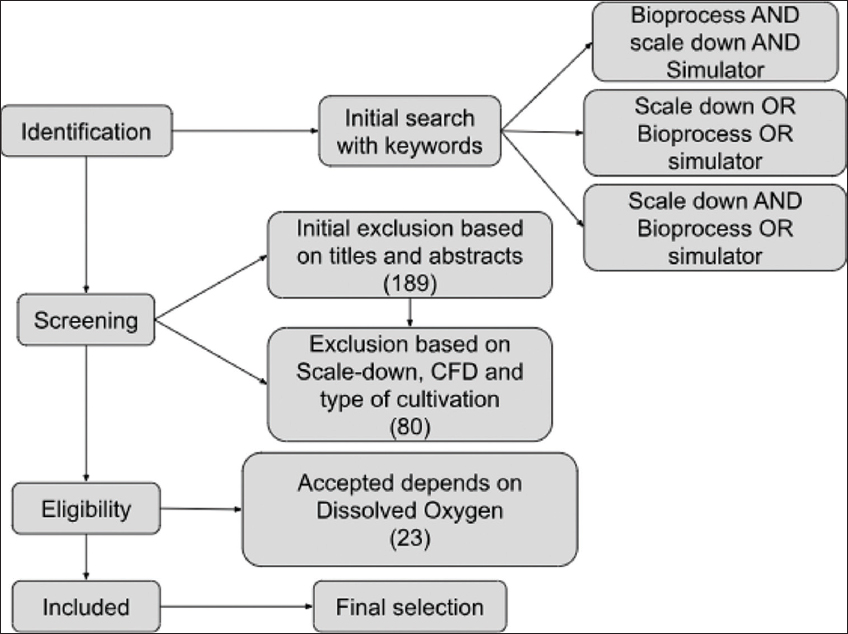 | Figure 2: Algorithm for article selection. [Click here to view] |
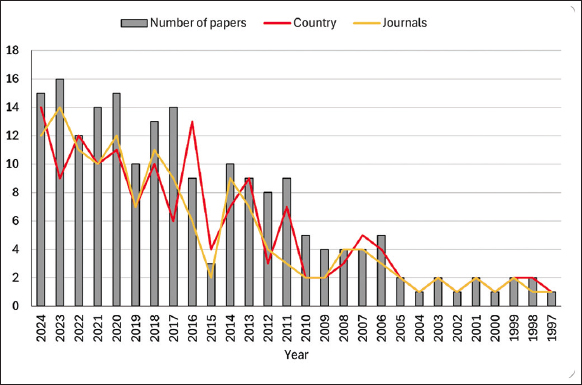 | Figure 3: Evolution of the number of issued papers, journals, and countries publishing on scale-down bioprocess or simulator between 1997 and 2024 according to the Scopus database. Chart generated in Microsoft Excel 16.0. [Click here to view] |
The observed upward trend in publications [Figure 3] reflects their relevance in bioprocess research as experimental platforms that replicate the heterogeneities of large-scale bioreactors are more valued in the bioprocess industry. The insights into the microbial responses to these dynamic environments, cellular physiology, metabolic robustness, and process limitations contribute for bridging the gap between laboratory-scale experiments and industrial-scale operations. Regarding this scientific output three periods can be identified: (i) Between 1997 and 2005, the ratio of papers per journal was 1.1, indicating that each journal publishing on the topic contained, on average, just a single article as the field was still emerging, with limited specialization and sporadic publication; (ii) During 2006–2015, this ratio grew up to 1.53, reflecting a period of consolidation of the research activity, with journals publishing multiple papers on the subject and (iii) In the 2016–2024 period, the ratio declined to 1.30 with a higher number of publications in the topic, showing the dispersion of the documents on a larger number of journals.
A similar trend is observed for the ratio of papers per country. In the first period, the ratio was exactly 1.00, meaning each participating country produced, on average, only one publication. By 2006–2015, the ratio increased to 1.33, showing that the countries involved were contributing more actively and publishing multiple documents and, in the 2016–2024 period, a slightly lower ratio of 1.27 reflected the entrance of new countries into the research landscape. Figure 4 depicts the percentage of contributions per country in the three mentioned periods, showing consistency for the main countries in the topic, namely, Germany, the United States, China, and the United Kingdom. Furthermore, a drastic increase in interest by Germany in the last period is notable. During the period from 1997 to 2005 [Figure 4a] only 8 countries authored papers on the scale-down topic. In the 2006-2015 period [Figure 4b], 26 countries participated and in the period 2016–2024 period [Figure 4c] appear 3 countries more, totaling 29 countries involved in bioreactors scale-down research. In all the periods, it is evident that the interest of Europe and Asia in the topic, while Latin America has a notable lag in the research field, with only 4 countries participating.
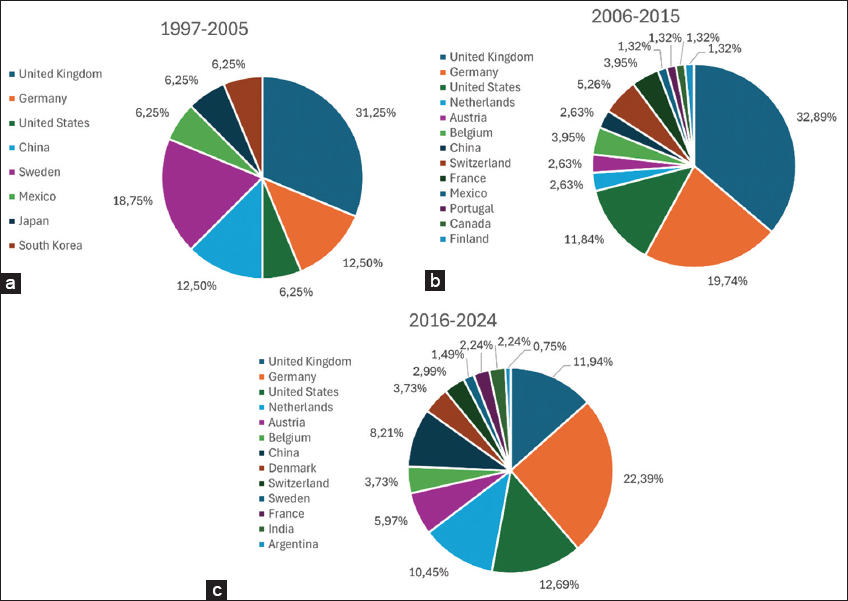 | Figure 4: Leading countries in terms of authorship of scientific papers related to scale-down bioprocess or simulator publish between 1997 and 2024 in Scopus-indexed journals. (a) 1997–2005, (b) 2006–2015, (c) 2016–2024. Charts generated in Microsoft Excel 16.0. [Click here to view] |
From the collaboration point of view, Figure 5a shows that Germany, the United Kingdom, and the United States dominate the collaboration network, acting as central hubs connecting all other participating countries. Germany has the broadest global reach, while the UK and the USA maintain links within Europe. The network is organized into seven clusters. Germany’s cluster (yellow) is strongly tied to Western Europe, Asia, and North America, while the UK–USA cluster (purple) connect partners in Europe, Asia, and Latin America. China, as the red cluster, links Asia with Europe and South America, whereas Denmark (green) connects Europe, Asia, and Oceania. The Netherlands (cyan) collaborates with European, Asian, and Middle Eastern countries. Figure 5b reveals the pronounced regional disparity in scale-down research output, with developed countries dominating the field. For instance, Germany and the UK contributed 57 and 51 publications, respectively, whereas Brazil produced only 3, exemplifying the concentration of research in advanced economies with strong funding structures for research and scientific cooperation. It is worth mentioning that the first scale-down studies emerged in Western Europe, which is clearly in connection to the size and importance of its biotechnological industry and the collaboration with the production sector. This imbalance in knowledge generation and access to resources hinder the equitable growth of the global bioeconomy, as innovation remains clustered in a few countries while others lag. Developing nations face limited research funding, infrastructure, and technical expertise, which exacerbates this gap and slows their bioeconomy development.
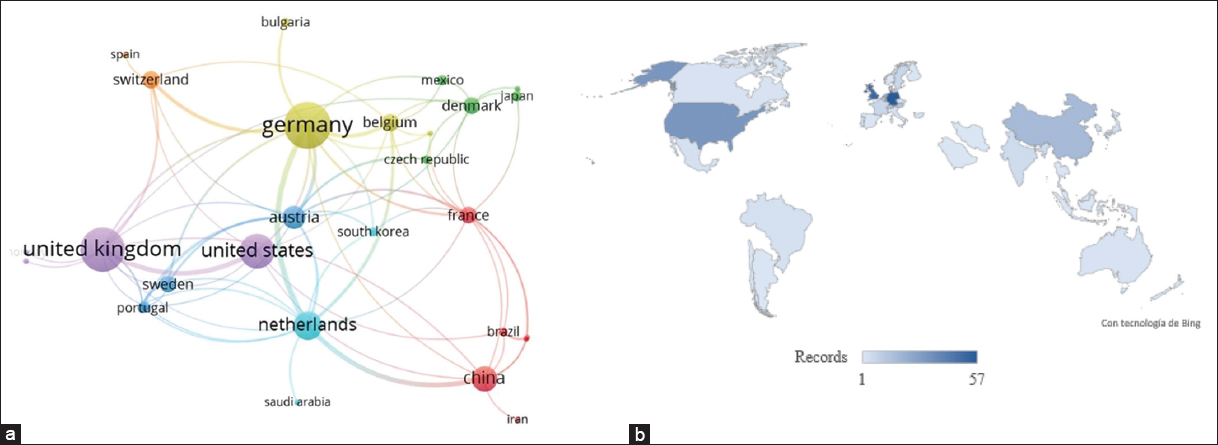 | Figure 5: Contributions per country on scale-down in bioprocesses in the period 1997–2024. (a) Overlapped visualization of collaboration networks among countries. studies indexed in the Scopus database. Network generated in VOSviewer 1.6.19. (b) Global distribution of contributions. Map generated in Microsoft Excel 16.0. [Click here to view] |
Notably, several emerging economies have outlined ambitious bioeconomy strategies, as the case of Brazil’s bioenergy initiatives and the recent National Bioeconomy Strategy are prime examples aimed at leveraging its biodiversity for sustainable growth. Although many countries have formulated policies for bioeconomy development, the implementation of such plans require greater scientific collaboration and capacity building to realize their full potential.
Table 1 presents the distribution of publications and citations among the top 10 countries contributing to research on scale-down bioprocesses and simulators from 1997 to 2024. Germany leads the field with 57 publications and the highest number of citations (1,555), reflecting both productivity and broad recognition, followed closely by the UK (51 publications, 1,091 citations) and the USA (31 publications, 618 citations). However, when impact is measured by citations per paper, smaller countries emerge as particularly influential. Sweden, despite producing only seven papers, ranks first with an average of 39.43 citations per paper, while the Netherlands follows with 37.57. Germany also performs strongly on this metric (27.77, ranked third), while China occupies middle position, ranking fifth in publications (17) and fourth in citations per paper (24.53), reflecting its rapid growth and increasing relevance in recent years.
Table 1: Number of total publications and citations for the top 10 leading countries in studies related to bioreactor scale-down, 1997 and 2024.
| Rank | Country | No. of publication | No. of citations | Citations per paper |
|---|---|---|---|---|
| 1 | Germany | 57 | 1555 (1) | 27.77 (3) |
| 2 | UK | 51 | 1091 (2) | 21.39 (5) |
| 3 | USA | 32 | 618 (4) | 19.94 (6) |
| 4 | Netherlands | 22 | 789 (3) | 37.57 (2) |
| 5 | China | 18 | 417 (5) | 24.53 (4) |
| 6 | Austria | 14 | 154 | 11 (10) |
| 7 | Belgium | 8 | 134 | 16.75 (8) |
| 8 | Switzerland | 8 | 140 | 17.50 (7) |
| 9 | France | 7 | 109 | 15.57 (9) |
| 10 | Sweden | 7 | 276 | 39.43 (1) |
*() The numbers in parentheses show the ranking in the citation categories
As mentioned, the patterns observed in Figures 2-4 and Tables 1-3 are closely linked to the economic capacity of countries to invest in research, development, and innovation. Since scale-down systems require specialized infrastructure and long-term investment, their development is often concentrated in regions with strong economies, where industrial biotechnology is a strategic priority. In contrast, many Latin American and Asian countries may allocate resources to more immediate societal needs, such as poverty reduction, food security, education, or healthcare, which limits sustained investment in bioprocess research. This imbalance restricts the expansion of scale-down studies in emerging economies with bioeconomy strategies that confer strategic value to bioprocessing, which limits the potential for exploiting their biodiversity and access to unique raw materials.
Table 2: Top-5 authors with the highest number of contributions to bioreactor scale-down.
| Authors | Documents | h-index | Affiliation |
|---|---|---|---|
| Peter Neubauer | 18 | 52 | Technische Universität Berlin. Berlin, Germany |
| Michael Hoare | 16 | 38 | University College London. London, United Kingdom |
| Cees Haringa | 11 | 19 | DSM Biotechnology Center. Delft, Netherlands |
| Ralf Takors | 11 | 36 | Universität Stuttgart. Stuttgart, Germany |
| Stefan G. Junne | 9 | 26 | Aalborg University. Aalborg, Denmark |
Table 3: Top-5 of the most cited publications on bioreactor scale-down.
| Publication | Citations | Year | Ref. |
|---|---|---|---|
| Scale-down simulators for metabolic analysis of large-scale bioprocesses | 172 | 2010 | [6] |
| Lab-scale photobioreactor systems: principles, applications, and scalability | 128 | 2022 | [38] |
| Monitoring of genes that respond to process-related stress in large- scale bioprocesses | 116 | 1999 | [39] |
| Euler-Lagrange computational fluid dynamics for (bio) reactor scale down: An analysis of organism lifelines | 114 | 2016 | [27] |
| An industrial perspective on bioreactor scale-down: What we can learn from combined large-scale bioprocess and model fluid studies | 101 | 2011 | [40] |
Table 2 displays the Top-5 most prolific authors in the scale-down topic. Neubauer (Technische Universität Berlin) emerges as the most prolific and influential, with 18 publications and a strong h-index of 52, followed by Michael Hoare (University College London), Cees Haringa (DSM Biotechnology Center, TU-Delft), Ralf Takors (Universität Stuttgart), and Stefan Junne. This is concordance with the geographic distribution of publications in Western Europe and its importance as a key academic and industrial hubs advancing in bioprocessing modeling and digitalization. Similarly, Table 3 shows the five most influential publications and three of them are authored by some of the most influential authors previously mentioned.
3.2. Model Microorganisms, Cultivation Conditions, and Physiological Insights of Bioreactor Inhomogeneities
Figure 6 illustrates the co-occurrence analysis of the most frequently used keywords in the index of published papers for the period under review (1997–2024). This figure represents the density of the words: As the color shifts to blue and green, there are more mentions; conversely, red or yellow indicates. As observed, the words with the highest density are “Bioprocess,” “scale-down,” and “bioreactors,” since these are the areas we focused on the most in our search. However, other notable words in the lower part include “fermentation,” “glucose,” “CFD,” and “oxygen”.
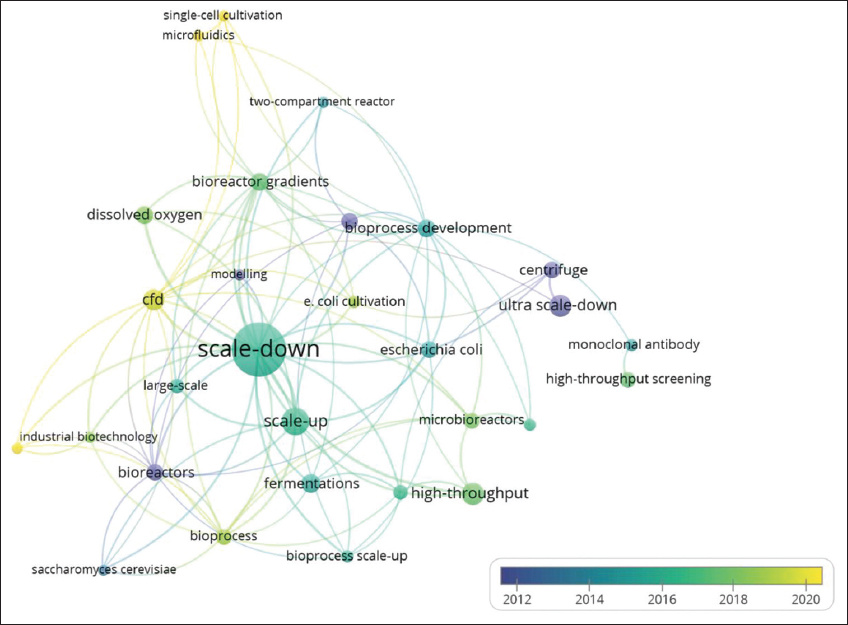 | Figure 6: Time overlay of keywords in bioreactor scale-down studies indexed in Scopus database. Network generated in VOSviewer 1.6.19. [Click here to view] |
In the implementation of scale-down systems, it is important to consider industrial conditions of the bioprocess because of the effect that cultivation regimes have on metabolism [16]. Table 4 presents details of the exclusively experimental setups employed in scale-down studies, that is, excluding simulation or in silico studies. Operating conditions, such as pH and temperature were typically aligned with the optimal ranges for each organism – near neutrality and mesophilic ranges (30–37°C) – but deviations were introduced in some cases to generate stress. Furthermore, the control of DO stands out as one of the parameters of most interest. While several studies maintained aerobic regimes (40–60% DO) to secure robust growth, others intentionally imposed oscillations or reductions to mimic mixing inefficiencies in large tanks in addition to enhance the understanding of metabolic trade-offs, altered flux distributions, overflow metabolism, or stress-induced metabolite production. More sophisticated experimental perturbations, such as glucose oscillations, high-density feeding regimes, or the application of residence-time variations, point to test the cell robustness, stress responses, and metabolic adaptability, even in plant cultures, where aeration and oxygen levels are usually less controlled.
Table 4: Experimental conditions in selected bioreactor scale-down studies.
| Microorganism | Response | Configuration | pH | T (°C) | % DO maz | Air/stir | Advantages/Limitations | Ref. |
|---|---|---|---|---|---|---|---|---|
| E. coli | Metabolite effect and biomass | STR-PFR | 7.0 | 37 | 40 | 1500 rpm | • Enables noninvasive, single-cell monitoring of key physiological states using a multi-reporter strain | [41] |
| C. glutamicum | Biomass | STR-PFR | 7.0 | 30 | 60 | 0.3 vvm | • Analysis detected neither proteomic, metabolomic, nor transcriptomic changes under inhomogeneous conditions, indicating excellent suitability for large-scale bioprocesses | [42] |
| CHO cells | Metabolite effect and biomass | STR | 6.9 | 36.5 | 30 | 0.012 vvm | • Automated disposable small-scale reactor enables high-throughput upstream development with performance comparable to lab and pilot scales | [43] |
| E. coli | 7.0 | 32 | 20 | 1.2 vvm | • Versatile across CHO, P. pastoris, and E. coli, supporting high-cell-density processes and complex feeding strategies, with robust operation across runs | |||
| P. pastoris | 6.5 | 24 | 20 | 1.5 vvm | • Currently at a proof-of-concept stage with limited industrial-scale validation | |||
| P. pastoris | Biomass | STR-PFR | 5.0 | 30 | 30 | 1.5 vvm | • Two-compartment STR–PFR system realistically mimics oxygen-limited zones found in large-scale bioreactors | [44] |
| E. coli | Metabolite effect | STR | 30 | 30 | • Uses constant kLa as a simple and practical scaling criterion, enabling easy tuning by adjusting impeller speed | [45] | ||
| E. coli | Metabolite effect | Fed-batch | 7.1 | 42 | 35 | 1.2 vvm | • Enables high-throughput, low-cost process development with real monitoring and control (DO, pH, temperature, OD) | [46] |
| E. coli | Metabolite effect and biomass | STR | 6.9 | 30-->25 | 80 63 | 100–7000 rpm | • Accurately reproduces 20-L performance when matching power to volume ratio, enabling reliable scale-down of high-cell-density E. coli fed-batch cultures | [47] |
| E. coli | Biomass | STR-PFR | 7.0 | 35 | 30 | • Captures transcriptional responses within seconds, revealing the impact of glucose and oxygen fluctuations | [39] | |
| P. putida | Metabolite effect and biomass | Microtiter STR STR-PFR | 7.0 | 30 | 5 | 25–1200 rpm | • Demonstrates high robustness of P. putida under repeated oxygen limitation | [48] |
| CHO cells | Biomass | STR-PFR | 7.2 | 37 | 40 | 500–1200 mL/min | • Introduces a multi-compartment scale-down model tailored to CHO cells and their shear sensitivity | [49] |
| C. glutamicum | Metabolite effect | STR-PFR | 7.0 | 30 | 40 | 1.5 vvm | • Links oxygen, glucose, and pH gradients to reduced cadaverine production. | [5] |
| E. coli | Biomass | MBR | 7.0 | 37 | 10 L/min | • More realistic scale-down by combining PFR residence time and entry frequency, improving prediction of large-scale gradient effects | [31] | |
| C. glutamicum | Biomass | STR-STR | 7.0 | 30 | - | 0.5–1.0 vvm | • Strong robustness mechanism identified: C. glutamicum rapidly reorganizes central metabolism to handle oxygen shortages and carbon excess | [17] |
| C. glutamicum | Biomass | STR-STR STR-PFR | 7.0 | 30 | 30 | 1.0 vvm | • Both STR–PFR and STR–STR models reliably reproduce key large-scale stresses (oxygen limitation and substrate excess) | [18] |
| P. chrysogenum | Biomass | STR | 6.5 | 25 | 60 10 | 2.0 L/min | • Identifies DO thresholds and redox shifts (higher NADH/NAD?) linked to product formation | [50] |
P. putida: Pseudomonas putida, P. pastoris: Pichia pastoris, C. glutamicum: Corynebacterium glutamicum, E. coli: Escherichia coli, P. chrysogenum: Penicillium chrysogenum, STR: Stirred-tank reactor, PFR: Plug-flow reactors, DO: Dissolved oxygen, CHO: Chinese Hamster ovary, CFD: Computational fluid dynamics, NAD+: Nicotinamide adenine dinucleotide, NADH: Nicotinamide adenine dinucleotide+Hydrogen, OD: Optical density
Regarding the microorganisms employed in scale-down studies, Figure 7 and Tables 4 and 5 show that Corynebacterium glutamicum, Escherichia coli, Penicillium chrysogenum, and mammalian cells have been the most used. These model organisms dominate due to their long-standing industrial relevance, extensive genetic characterization, and broad application across biopharmaceutical, biofuel, and amino acid production sectors. Their well-established cultivation protocols and predictable responses to environmental perturbations make them ideal candidates for validating scale-down strategies and computational models. However, several industrially significant organisms remain underexplored in this context. For instance, Pichia pastoris, widely used host for heterologous protein expression; Yarrowia lipolytica, important for lipid-based bioproducts; filamentous fungi, such as Aspergillus niger and Trichoderma reesei, and photosynthetic microalgae are absent in scale-down studies.
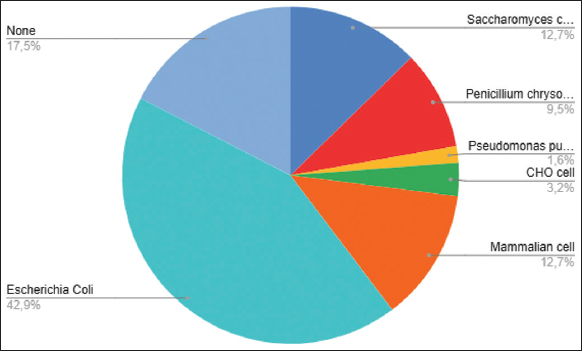 | Figure 7: Main microorganisms* studied in the Scale-down bioprocess or simulator area during the period 1997–2024. Those classified as “None” consisted in studies simulating distributions without performing cultivations directly. [Click here to view] |
Table 5: Computational approaches of selected bioreactor scale-down studies.
| Microorganism | Response | Compartment | Methodology | Advantages/Limitations | Ref |
|---|---|---|---|---|---|
| Bacillus subtilis | Metabolite effect and biomass | STR-PFR | • Stoichiometric and mass-balance model applied | • Enables real-time monitoring of growth and product formation under oscillating substrates using only standard industrial signals | [51] |
| Streptomyces fradiae | Metabolite effect | STR-PFR | • Heterogeneity simulated in the PFR compartment without agitation | • Realistically simulates microbial movement and circulation patterns in poorly mixed zones using the Brownian Random Walk Model | [52] |
| Saccharomyces cerevisiae | Metabolite effect | STR | • Scale-up analyzed via O2 and CO2 gradients using CFD | • CFD and mechanistic modeling safely predicts large-scale O2, glucose, ethanol, and CO2 gradients without needing risky full-scale runs | [53] |
| Corynebacterium glutamicum | Biomass | STR | • Eulerian multiphase model with turbulence and mixing dispersion | • CFD and lifeline analysis capture realistic large-scale mixing, gas holdup, and glucose/O2 fluctuations | [3] |
| Escherichia coli | Metabolite effect and biomass | STR-PFR | • Nonlinear differential equation model applied | • Mechanistic two-compartment pulse model simulates scale-down conditions realistically without complex multi-compartment hardware | [35] |
| Penicillium chrysogenum | Biomass | STR | • Euler–Lagrange applied to simulate the extracellular environment at an industrial scale | • Captures microorganism-level substrate fluctuations realistically using a lifeline framework | [27] |
STR: Stirred-tank reactor, PFR: Plug-flow reactors, DO: Dissolved oxygen, CO2: Carbon dioxide, CHO: Chinese Hamster ovary, CFD: Computational fluid dynamics, RANS: Reynolds-Averaged Navier-Stokes, O2: Oxygen
Specifically, the multi-omics analysis of C. glutamicum cultivated in a two-compartment STR system demonstrated metabolic flexibility in response to transient oxygen and glucose fluctuations [17,18]. Key enzymes involved in anaerobic nicotinamide adenine dinucleotide regeneration, such as lactate dehydrogenase, were upregulated, while non-essential pathways were suppressed. Following reoxygenation, overflow metabolites were rapidly re-assimilated, and product formation remained stable [17]. Similarly, in a cadaverine-producing C. glutamicum strain, scale-down experiments with combined DO, pH, and glucose gradients showed that prolonged residence in a PFR segment led to a 59% drop in cadaverine titer, a 3.1-fold increase in carbon dioxide (CO2) evolution, and increased numbers of viable but non-culturable cells, despite unaltered biomass [5]. Oscillations in pH between 6 and 7, simulated in both a two-compartment STR and a microfluidic platform, reduced C. glutamicum growth rates by 21–27%, indicating consistency across scale-down methods [19].
In E. coli, exposure to dynamic pH gradients led to decreased plasmid and biomass yields, with organic acid accumulation and distinct gene expression patterns [20]. Dual DO/glucose oscillations also reduced biomass and increased acetate production, inducing persistent stress responses [21]. CHO cells subjected to DO and pH perturbations in two-compartment systems displayed metabolic shifts like the accumulation of lactate and up to 15% drop in cell viability [22,23]. In P. chrysogenum, prolonged exposure to high-glucose/low-oxygen zones abolished penicillin production irreversibly, while high-oxygen zones preserved productivity. Periodic oscillations still led to a 50% titer reduction, highlighting DO gradients as a major risk factor [24].
3.3. Configurations Used in Scale-down Systems for the Study of Bioreactor Inhomogeneities
At the industrial scale, it is common to use a STR due to its reduced power-to-volume ratio as the reactor size increases [3]. However, when simulating the circulation between two or more environmental zones, a two-compartment system is preferred [17]. As observed in Table 4, the STR–PFR is the preferred combination to reproduce the gradients of oxygen, pH, and substrate concentration typically encountered in large-scale bioreactors. In contrast, single STR setups or STR–STR configurations, although simpler, were often used to introduce controlled oxygen limitations (e.g., microaerobic conditions with nitrogen/CO2 sparging) or oscillatory regimes [8,17]. Fed-batch strategies and membrane bioreactor configurations are of interest to study the dynamic substrate availability, reflecting industrial feeding strategies. Interestingly, studies that employed microtiter plates or small-scale disposable systems emphasized process control rather than cellular adaptation, highlighting the increasing role of high-throughput tools in early-stage investigations.
Comparative evaluations of scale-down bioreactor configurations have shown that system design significantly influences the physiological responses of microorganisms under oscillatory conditions. Using a L-lysine-producing strain of C. glutamicum, Limberg et al. [18] compared STR–PFR and STR–STR setups exposed to identical cycles of DO limitation and glucose excess. Both configurations induced a reduction in growth rate and stimulated by-product secretion (notably lactate and glutamate), while biomass accumulation and lysine yields remained largely unaffected. Despite differences in mixing mechanics, the physiological outcomes were strikingly similar, suggesting that oscillation frequency and magnitude may play a more critical role than configuration.
In contrast, Wang et al. [25] explored substrate gradient simulation in P. chrysogenum using two approaches: Intermittent feeding in a single STR and a two-compartment STR–STR system with a 6-minute recirculation loop, mimicking a 54 m [3] industrial fermenter. While both systems led to reduced penicillin production compared to constant-feed controls, they triggered distinct cellular responses. Intermittent feeding caused transient glucose accumulation, overflow metabolism, and stress activation, whereas the STR–STR configuration promoted metabolic stability through upregulation of high-affinity glucose transporters and lower intracellular glucose pools.
Although not extensively used, further complexity was introduced by Lemoine et al.,[26] who designed a three-compartment STR–PFR–PFR system to sequentially impose substrate-rich and oxygen-limited zones. This setup elicited more severe metabolic perturbations than two-compartment systems, including a ~2-fold increase in lactate and succinate accumulation without pyruvate buildup. Carbon was redirected toward fermentative pathways through lactate dehydrogenase activation under oxygen limitation, underscoring the heightened metabolic stress induced by simultaneous substrate and oxygen gradients.
3.4. Predictive Modeling in Bioreactors’ Scale-down
As shown in Figure 6, the application of CFD, predictive modeling, and high-throughput approaches started in 2018, becoming more active from 2020 onward. Such computational frameworks have recently supported digital twins implementations, highlighting their potential in improving the design and control of scale-down bioreactor experiments. These tools allow for the quantitative analysis of spatial and temporal gradients, the prediction of physiological outcomes under heterogeneity, and the implementation of virtual sensors that guide process optimization.
Table 5 summarizes research that integrates experimental setups with computational tools. As in the case of experimental scale-down studies, C. glutamicum and E. coli have been the cases with the most modeling applications, in addition to Saccharomyces cerevisiae. In two-compartment STR–PFR setups, virtual sensors based on stoichiometric and mass-balance models have monitored key physiological parameters, such as oxygen uptake, respiratory quotient, and glucose consumption, while stochastic approaches, such as Markov random walks have quantified residence-time variability and its impact on mixing efficiency. Nonlinear differential equation models further enabled the simulation of metabolic shifts across pseudo-reactor segments under oxygen limitation. In contrast, studies focusing on single-STR systems have predominantly applied CFD and simplified mechanistic models to analyze gas–liquid transfer and spatial nutrient gradients. Multiphase Eulerian and Euler–Lagrange frameworks, often paired with Lagrangian particle tracking and Reynolds-Averaged Navier-Stokes turbulence models, have revealed how local fluctuations in oxygen and substrate availability shape cellular productivity. Together, these methods highlight the strengths of stochastic modeling for simulating mixing dynamics, kinetic models for linking process conditions to metabolic responses, and CFD for resolving hydrodynamic complexity critical to large-scale bioprocess understanding.
In an effort for capturing microenvironmental heterogeneity, Euler-Lagrange CFD was coupled with microbial kinetics to simulate individual cellular trajectories in a turbulent flow field [27]. By tracking thousands of virtual P. chrysogenum cells, the model reconstructed their unique exposure histories to oxygen and substrates, suggesting that cells confined to poorly mixed regions frequently encountered oxygen dips, triggering fermentative shifts that aligned with experimentally observed byproduct formation [27].
Rather than relying solely on CFD, a hybrid modeling framework integrating mechanistic kinetics with simplified spatial segmentation was proposed to forecast large-scale fermentation performance of C. glutamicum [3]. The simulation divided the bioreactor into stirred segments and used tracer particles to model cell movement, substrate uptake, and metabolic behavior under dynamic oxygen and glucose conditions [3]. Predictions, such as reversible overflow metabolism under oxygen limitation were validated against real process data, providing a strong case for using digital twins to support scale translation [3].
Mayer et al. (2023) employed turbulence-based simulations to engineer a plug-flow STR-PFR that mimicked the mixing characteristics of a 4 m[3] production reactor for E. coli. The computational insights revealed oxygen and substrate gradients invisible to physical sensors but experimentally linked to biomass and product yield reductions. In the study, 11% lower biomass yield and 20% lower specific product yield was observed under the engineered gradient conditions, alongside increased intracellular product retention. In this case, CFD was implemented as a soft sensor for identifying hidden heterogeneity and guiding reactor optimization [28].
Using a combined CFD–kinetics digital twin, simulations of spatial gradients in oxygen, glucose, ethanol, and CO2 in S. cerevisiae large bioreactor, predicted that ethanol by-product is rapidly re-consumed in preventing cell starvation even as glucose depletes, but it also revealed cells’ long exposure to high dissolved CO2 levels [29]. At higher cell density, ~10% of ethanol accumulation was attributed to oxygen limitation rather than overflow metabolism. This validated CFD approach effectively served as a virtual sensor for large-scale conditions, allowing to anticipate gradient effects on yeast physiology that would be impossible to observe directly at scale [29]. Recently, Moser et al. introduced a flexible modeling framework that allows rapid assembly of digital twins using interchangeable kinetic, physico-chemical, and reactor models; the digital twin was further tested in S. cerevisiae cultivations. The model implementation time and computation time were reduced by 90% compared to conventional modeling approaches and enabled real-time coupling with control software [30].
3.5. Emerging Trends and Future Perspectives: High-throughput and Artificial Intelligence Integration
Recent advances in high-throughput systems and the integration of artificial intelligence in the design of experiments and data analysis have expanded the possibilities for scale-down studies, enabling more precise, efficient, and predictive modeling of large-scale heterogeneities. Robotic mini-bioreactor platforms now allow automated, parallel microbial or mammalian cell cultivation in sub-15 mL volumes with full online monitoring, e.g., DO, pH, optical density, emulating complex feed and environmental dynamics [16,31]. For instance, Anane et al. and Haby et al. demonstrated that parallel 10-mL bioreactors could accurately reproduce bench-scale feeding strategies and byproduct formation patterns, validating their use for rapid scale-down process screening. Similarly, Rafiq et al. [4] applied a 24-parallel mini-bioreactor setup to optimize stem cell microcarrier cultures, with performance metrics closely matching those of liter-scale reactors.
Validation of micro-scale systems as predictive tools for scale-down modeling showed that growth and titer rankings of 22 E. coli clones cultivated in BioLector microbioreactors mirrored those seen in 1–30 L stirred tanks [32]. This cross-scale fidelity reinforces the potential of micro-bioreactors as reliable platforms for early identification of optimal strains and process conditions in the face of heterogeneities. Previously, Täuber et al. introduced a microfluidic “organ-on-chip” device that exposed individual C. glutamicum cells to rapidly switching pH and substrate environments, simulating the fluctuating conditions encountered in industrial-scale reactors. This single-cell resolution tool revealed adaptive behaviors, such as transient growth pauses and rapid recovery post-shock, which are often masked in bulk assays, providing a validation tool for CFD-predicted lifeline stress patterns in scale-down experiments [19].
Moreover, incorporating machine learning into these platforms has further enhanced scale-down process optimization. Hashizume et al. [33] applied active learning to iteratively refine cell culture media in high-throughput plates, identifying improved formulations that enhanced Henrietta Lacks and CHO cell growth. The method minimized the number of experimental trials by focusing on the most informative formulation spaces, optimizing complex media under scale-down conditions where subtle nutrient limitations or excesses can mimic real bioreactor gradients. A combination of robotics with machine learning to predict optimal growth media exemplify how AI-driven design can extend beyond traditional parameters [34]. Although focused on strain isolation, the underlying strategy consisting on iterative learning from high-throughput culture outcomes is applicable to optimizing scale-down process variables, such as oscillation frequency, shear regimes, or residence times [16,31,35]. As data from these systems continue to grow, machine learning models become increasingly capable of identifying non-obvious correlations between scale-down perturbations and process performance outcomes. In this direction, Richter et al. [36] recently trained an artificial neural network on process data from CHO cell cultures to predict monoclonal antibody yields. The model used novel parameter combinations, such as the feed rate and the pH, which significantly increased productivity under simulated scale-down stress, using machine learning to navigate multidimensional design spaces more efficiently than conventional approaches.
These advances point toward a digitally integrated paradigm in bioprocesses development, known as Bioprocessing 4.0 [37]. This includes scale-down, wherein high-throughput experimentation is coupled with computational inference to replicate and analyze the dynamic fluctuations characteristic of large-scale bioreactors. Microbioreactor systems enable precise simulation of environmental gradients, while machine learning and artificial intelligence facilitates efficient exploration of complex design spaces and enhances predictive modeling capabilities. The convergence of these technologies improves the physiological relevance of scale-down studies and supports more rigorous, data-driven optimization of bioprocesses, offering a foundation for accelerated development and more reliable scale translation.
4. CONCLUSION
This study provides a comprehensive landscape of experimental and computational approaches used in scale-down bioreactor systems with a specific focus on environmental heterogeneities in DO, pH, and substrate availability. The present mapping suggests that oscillations and heterogeneities in parameters, such as pH, DO, and substrate concentration exert decisive effects on microbial physiology and process performance. Scale-down experiments consistently demonstrate that such fluctuations can reduce growth rates, trigger by-product formation, and compromise product quality, providing insights into the physiological trade-offs of large-scale bioprocesses, while serving as platforms for scalability.
Analysis of primary literature and bibliometric data from Scopus highlights the predominance of model organisms Escherichia coli, C. glutamicum, S. cerevisiae, P. chrysogenum, and CHO cells in experimental setups, but other industrially relevant hosts, such as filamentous fungi and emerging autotrophic platforms, remain underexplored. The comparative analysis of scale-down configurations highlights that STR–PFR systems are preferred for generating spatial gradients and residence-time distributions in studies of nutrient and oxygen limitations. Conversely, STR–STR setups are used for reproducing cyclic oscillations and complex, heterogeneous environments.
This bibliometric analysis highlights the growing interest in scale-down simulations, as bioprocesses are still increasing their participation in the global production chains, with research output expanding from 1997 to 2024. Leading contributions come from Germany, the UK, and the USA. The data also remark the need for a more intense collaboration, particularly in developing regions, such as Latin America and Asia with high potential in natural resources. Narrowing this disparity requires resource allocation and policy support in joint international research initiatives, technical training programs, and co-funded infrastructure. Such cooperation not only accelerates technology diffusion but also aligns with global frameworks of sustainability.
Recent trends indicate a shift toward hybrid strategies that integrate mechanistic simulations with data-driven methods. These advances enhance predictive capacity, reduce experimental load, and allow application on real-time process optimization. Moreover, high-throughput microbioreactors and microfluidic single-cell tools have proven increasingly effective in capturing the dynamics of scale-induced stress, improving the resolution at which heterogeneity is studied. Future work in this area should increase the integration of artificial intelligence, omics data, automation, and soft-sensing, extending the possibilities of high-throughput technologies and parallelized-miniaturized experimental models. Those advances, when coupled with experimental validation at metabolic, regulation, and genomic levels, would make possible reliable digital twins of industrial bioprocesses, enabling more predictive, cost-effective, and scalable process design.
5. AUTHOR’S CONTRIBUTIONS
All authors made substantial contributions to conception and design, acquisition of data, or analysis and interpretation of data; took part in drafting the article or revising it critically for important intellectual content; agreed to submit to the present journal; gave final approval of the version to be published; and agree to be accountable for all aspects of the work. All the authors are eligible to be an author as per the International Committee of Medical Journal Editors (ICMJE) requirements/guidelines.
6. FINANCIAL SUPPORT
Authors acknowledge the financial support of Universidad del Valle, grant CI 21258.
7. CONFLICTS OF INTEREST
The authors report no financial or any other conflicts of interest in this work.
8. ETHICAL APPROVALS
This article does not contain any studies with human participants or animals.
9. INFORMED CONSENT
For this type of study, formal consent is not required.
10. DATA AVAILABILITY
All data generated and analyzed are included in this research article.
11. USE OF ARTIFICIAL INTELLIGENCE (AI)-ASSISTED TECHNOLOGY
The authors declare that they have not used artificial intelligence (AI)-tools for writing and editing of the manuscript, and no images were manipulated using AI.
12. PUBLISHER’S NOTE
This journal remains neutral with regard to jurisdictional claims in published institutional affiliation.
REFERENCES
1. Deveci M, Isik M, Mishra AR, Rani P, Gokasar I, Liu Z. Evaluation of bioeconomic practices within structural changes using picture fuzzy decision-making model. Struct Chang Econ Dyn. 2025;75:369-90. [CrossRef]
2. Ziegler M, Zieringer J, Döring CL, Paul L, Schaal C, Takors R. Engineering of a robust Escherichia coli chassis and exploitation for large-scale production processes. Metab Eng. 2021;67:75-87. [CrossRef]
3. Kuschel M, Takors R. Simulated oxygen and glucose gradients as a prerequisite for predicting industrial scale performance a priori. Biotechnol Bioeng. 2020;117(9):2760-70. [CrossRef]
4. Rafiq QA, Hanga MP, Heathman TR, Coopman K, Nienow AW, Williams DJ, et al. Process development of human multipotent stromal cell microcarrier culture using an automated high-throughput microbioreactor. Biotechnol Bioeng. 2017;114(10):2253-66. [CrossRef]
5. Olughu W, Nienow A, Hewitt C, Rielly C. Scale-down studies for the scale-up of a recombinant Corynebacterium glutamicum fed-batch fermentation:Loss of homogeneity leads to lower levels of cadaverine production. J Chem Technol Biotechnol. 2020;95(3):675-85. [CrossRef]
6. Neubauer P, Junne S. Scale-down simulators for metabolic analysis of large-scale bioprocesses. Curr Opin Biotechnol. 2010;21(1):114-21. [CrossRef]
7. Moussa A. Scale up and Scale Down of Equipment. In:Systematic Process Development:From Idea to Value via Technology Readiness Levels. ACS Symposium Series. Vol. 1426. United States:American Chemical Society;2022. 117-55. [CrossRef]
8. Arulrajah P, Lievonen AE, Suba??D, Pagal S, Weuster-Botz D, Heins AL. Scale-down bioreactors—comparative analysis of configurations. Bioprocess Biosyst Eng. 2025;48:1619–1635. [CrossRef]
9. De Mello AF, De Souza Vandenberghe LP, Herrmann LW, Letti LA, Burgos WJ, Scapini T, et al. Strategies and engineering aspects on the scale-up of bioreactors for different bioprocesses. Syst Microbiol Biomanuf. 2024;4(2):365-85. [CrossRef]
10. Cardona-Galeano W, Ramirez-Malule H, Gómez-Ríos D. Hybrids based on coumarins and their anticancer activities:A bibliometric analysis. J Appl Pharm Sci. 2023;13(9):204-12. [CrossRef]
11. Cardona-Galeano W, Ramírez-Malule H, Gómez-Rios D. Anticancer activity of monastrol, hybrids and derivatives:A comprehensive bibliometric analysis of recent research. J Appl Pharm Sci. 2024;14(2):73-82. [CrossRef]
12. Galván ML, Agudelo VA, Ríos DG, Malule HR. A bibliometric landscape of polyhydroxyalkanoates production from low-cost substrates by Cupriavidus necator and its perspectives for the Latin American bioeconomy. J Appl Biol Biotechnol. 2024;12:48-61. [CrossRef]
13. Van Eck NJ, Waltman L. Software survey:VOSviewer, a computer program for bibliometric mapping. Scientometrics. 2010;84(2):523-38. [CrossRef]
14. Cardona-Galeano W, Yepes AF, Ramírez-Malule H. Triazole-based click chemistry as strategic for novel therapeutics treatments of cancer:A bibliometric analysis 20072024. J Appl Pharm Sci. 2025. [CrossRef]
15. López-Itas LD, Gómez-Ríos D, Ramírez-Malule H. Sustainable Aviation Fuels:Bibliometric Trends and Latin American Opportunities from a Chemical Engineering Perspective. Biomass. 2025 Dec 18;5(4):82. [CrossRef]
16. Haby B, Hans S, Anane E, Sawatzki A, Krausch N, Neubauer P, et al. Integrated robotic mini bioreactor platform for automated, parallel microbial cultivation with online data handling and process control. SLAS Technol. 2019;24(6):569-82. [CrossRef]
17. Limberg MH, Schulte J, Aryani T, Mahr R, Baumgart M, Bott M, et al. Metabolic profile of 1,5-diaminopentane producing Corynebacterium glutamicum under scale-down conditions:Blueprint for robustness to bioreactor inhomogeneities. Biotechnol Bioeng. 2017;114(3):560-75. [CrossRef]
18. Limberg MH, Pooth V, Wiechert W, Oldiges M. Plug flow versus stirred tank reactor flow characteristics in two-compartment scale-down bioreactor:Setup-specific influence on the metabolic phenotype and bioprocess performance of Corynebacterium glutamicum. Eng Life Sci. 2016;16(7):610-9. [CrossRef]
19. Täuber S, Blöbaum L, Steier V, Oldiges M, Grünberger A. Microfluidic single-cell scale-down bioreactors:A proof-of-concept for the growth of Corynebacterium glutamicum at oscillating pH values. Biotechnol Bioeng. 2022;119(11):3194-209. [CrossRef]
20. Cortés JT, Flores N, Bolívar F, Lara AR, Ramírez OT. Physiological effects of pH gradients on Escherichia coli during plasmid DNA production. Biotechnol Bioeng. 2016;113(3):598-611. [CrossRef]
21. Bafna-Rührer J, Orth JV, Sudarsan S. Combined oxygen and glucose oscillations distinctly change the transcriptional and physiological state of Escherichia coli. Microb Biotechnol. 2024;17(11):e70051. [CrossRef]
22. Gaugler L, Hofmann S, Schlüter M, Takors R. Mimicking CHO large-scale effects in the single multicompartment bioreactor:A new approach to access scale-up behavior. Biotechnol Bioeng. 2024;121(4):1243-55. [CrossRef]
23. Paul K, Böttinger K, Mitic BM, Scherfler G, Posch C, Behrens D, et al. Development, characterization, and application of a 2-Compartment system to investigate the impact of pH inhomogeneities in large-scale CHO-based processes. Eng Life Sci. 2020;20(8):368-78. [CrossRef]
24. Chen Y, Haringa C, Wang Z, Zhuang Y, Wang G. Physiological response of Penicillium chrysogenum to mimicked local and global perturbations of substrate and dissolved oxygen gradients at industrial-scale. Biotechnol Bioeng. 2025;122(6):1402-23. [CrossRef]
25. Wang G, Zhao J, Haringa C, Tang W, Xia J, Chu J, et al. Comparative performance of different scale-down simulators of substrate gradients in Penicillium chrysogenum cultures:The need of a biological systems response analysis. Microb Biotechnol. 2018;11(3):486-97. [CrossRef]
26. Lemoine A, Maya Mart?nez-Iturralde N, Spann R, Neubauer P, Junne S. Response of Corynebacterium glutamicum exposed to oscillating cultivation conditions in a two- and a novel three-compartment scale-down bioreactor. Biotechnol Bioeng. 2015;112(6):1220-31. [CrossRef]
27. Haringa C, Tang W, Deshmukh AT, Xia J, Reuss M, Heijnen JJ, et al. Euler-Lagrange computational fluid dynamics for (bio)reactor scale down:An analysis of organism lifelines. Eng Life Sci. 2016;16(7):652-63. [CrossRef]
28. Mayer F, Cserjan-Puschmann M, Haslinger B, Shpylovyi A, Sam C, Soos M, et al. Computational fluid dynamics simulation improves the design and characterization of a plug-flow-type scale-down reactor for microbial cultivation processes. Biotechnol J. 2023;18(1):e2200152. [CrossRef]
29. Hajian CS, Haringa C, Noorman H, Takors R. Predicting by-product gradients of baker's yeast production at industrial scale:A practical simulation approach. Processes. 2020;8(12):1554. [CrossRef]
30. Moser A, Appl C, Pörtner R, Baganz F, Hass VC. A new concept for the rapid development of digital twin core models for bioprocesses in various reactor designs. Fermentation. 2024;10(9):463. [CrossRef]
31. Anane E, García ÁC, Haby B, Hans S, Krausch N, Krewinkel M, et al. A model-based framework for parallel scale-down fed-batch cultivations in mini-bioreactors for accelerated phenotyping. Biotechnol Bioeng. 2019;116(11):2906-18. [CrossRef]
32. Fink M, Cserjan-Puschmann M, Reinisch D, Striedner G. High-throughput microbioreactor provides a capable tool for early stage bioprocess development. Sci Rep. 2021;11(1):2056. [CrossRef]
33. Hashizume T, Ozawa Y, Ying BW. Employing active learning in the optimization of culture medium for mammalian cells. NPJ Syst Biol Appl. 2023;9(1):20. [CrossRef]
34. Huang Y, Sheth RU, Zhao S, Cohen LA, Dabaghi K, Moody T, et al. High-throughput microbial culturomics using automation and machine learning. Nat Biotechnol. 2023;41(10):1424-33. [CrossRef]
35. Anane E, Sawatzki A, Neubauer P, Cruz-Bournazou MN. Modelling concentration gradients in fed-batch cultivations of E. coli towards the flexible design of scale-down experiments. J Chem Technol Biotechnol. 2019;94(2):516-26. [CrossRef]
36. Richter J, Wang Q, Lange F, Thiel P, Yilmaz N, Solle D, et al. Machine learning-powered optimization of a CHO cell cultivation process. Biotechnol Bioeng. 2025;122(5):1153-64. [CrossRef]
37. Gómez-Rios D, Ramírez-Malule H. Towards bioprocessing 4.0:Scaling sustainable innovation in the pharmaceutical bioeconomy. J Appl Pharm Sci. 2025;15(12):1-3. [CrossRef]
38. Benner P, Meier L, Pfeffer A, Krüger K, Oropeza Vargas JE, Weuster-Botz D. Lab-scale photobioreactor systems:Principles, applications, and scalability. Bioprocess Biosyst Eng. 2022;45(5):791-813. [CrossRef]
39. Schweder T, Krueger E, Xu B, Juergen B, Blomsten G, Enfors SO, et al. Monitoring of genes that respond to process-related stress in large-scale bioprocesses. Biotechnol Bioeng. 1999;65(2):151-9. [CrossRef]
40. Noorman H. An industrial perspective on bioreactor scale-down:What we can learn from combined large-scale bioprocess and model fluid studies. Biotechnol J. 2011;6(8):934-43. [CrossRef]
41. Hoang MD, Polte I, Frantzmann L, Von Den Eichen N, Heins AL, Weuster-Botz D. Impact of mixing insufficiencies on L-phenylalanine production with an Escherichia coli reporter strain in a novel two-compartment bioreactor. Microb Cell Fact. 2023;22(1):153. [CrossRef]
42. KäßF, Hariskos I, Michel A, Brandt HJ, Spann R, Junne S, et al. Assessment of robustness against dissolved oxygen/substrate oscillations for C. Glutamicum DM1933 in two-compartment bioreactor. Bioprocess Biosyst Eng. 2014;37(6):1151-62. [CrossRef]
43. Bareither R, Bargh N, Oakeshott R, Watts K, Pollard D. Automated disposable small scale reactor for high throughput bioprocess development:A proof of concept study. Biotechnol Bioeng. 2013;110(12):3126-38. [CrossRef]
44. Lorantfy B, Jazini M, Herwig C. Investigation of the physiological response to oxygen limited process conditions of Pichia pastoris Mut+strain using a two-compartment scale-down system. J Biosci Bioeng. 2013;116(3):371-9. [CrossRef]
45. Farrell P, Sun J, Gao M, Sun H, Pattara B, Zeiser A, et al. Development of a scaled-down aerobic fermentation model for scale-up in recombinant protein vaccine manufacturing. Vaccine. 2012;30(38):5695-8. [CrossRef]
46. Bower DM, Lee KS, Ram RJ, Prather KL. Fed-batch microbioreactor platform for scale down and analysis of a plasmid DNA production process. Biotechnol Bioeng. 2012;109(8):1976-86. [CrossRef]
47. Ali S, Perez-Pardo MA, Aucamp JP, Craig A, Bracewell DG, Baganz F. Characterization and feasibility of a miniaturized stirred tank bioreactor to perform E. Coli high cell density fed-batch fermentations. Biotechnol Prog. 2012;28(1):66-75. [CrossRef]
48. Demling P, Ankenbauer A, Klein B, Noack S, Tiso T, Takors R, et al. Pseudomonas putida KT2440 endures temporary oxygen limitations. Biotechnol Bioeng. 2021;118(12):4735-50. [CrossRef]
49. Anane E, Knudsen IM, Wilson GC. Scale-down cultivation in mammalian cell bioreactors-the effect of bioreactor mixing time on the response of CHO cells to dissolved oxygen gradients. Biochem Eng J. 2021;166:107870. [CrossRef]
50. Yang Q, Lin W, Xu J, Guo N, Zhao J, Wang G, et al. Changes in oxygen availability during glucose-limited chemostat cultivations of Penicillium chrysogenum lead to rapid metabolite, flux and productivity responses. Metabolites. 2022;12(1):45. [CrossRef]
51. Lyubenova V, Junne S, Ignatova M, Neubauer P. Software sensor design considering oscillating conditions as present in industrial scale fed-batch cultivations. Biotechnol Bioeng. 2013;110(7):1945-55. [CrossRef]
52. Delvigne F, Destain J, Thonart P. Elaboration of a biased random walk model with a high spatial resolution for the simulation of the microorganisms exposure to gradient stress in scale-down reactors. Biochem Eng J. 2008;39(1):105-14. [CrossRef]
53. Sarkizi Shams Hajian C, Haringa C, Noorman H, Takors R. Predicting by-product gradients of baker's yeast production at industrial scale:A practical simulation approach. Processes. 2020;8(12):1554. [CrossRef]