
1. INTRODUCTION
Snakebite envenomation is considered a neglected public health problem in many tropical countries, particularly in Africa, Latin America, and Asia [1]. According to the World Health Organization (WHO), it is estimated that five million people suffer from snake bites every year, i.e., 1.8–2.7 million cases of intoxication [2]. Snakebite results in 81,410–137,880 deaths annually, and many survivors suffer from amputations and permanent disabilities. Approximately two million cases of snakebite envenomation occur annually in Asia, whereas about 580,000 cases requiring medical treatment are reported in Africa [3]. Similarly, >3,00,000 snakebites are also detected in sub-Saharan Africa on an annual basis, which leads to >7000 deaths and nearly 10,000 amputations [4]. Therefore, snakebite and associated morbidities are considered one of the most neglected tropical diseases [Figure 1] [5]. Venomous snakebites before timely treatment can cause paralysis, fatal bleeding, kidney failure, and tissue damage, leading to amputation. Among agricultural workers, children are disproportionately affected and tend to experience more severe clinical outcomes [6]. However, data on snakebite cases in India are limited due to the low number of victims seeking healthcare, inadequate surveillance, and poor reporting systems. Similar issues exist in other countries with high envenomation rates. This paucity of data impacts critical areas such as funding, antivenom production, and distribution [7].
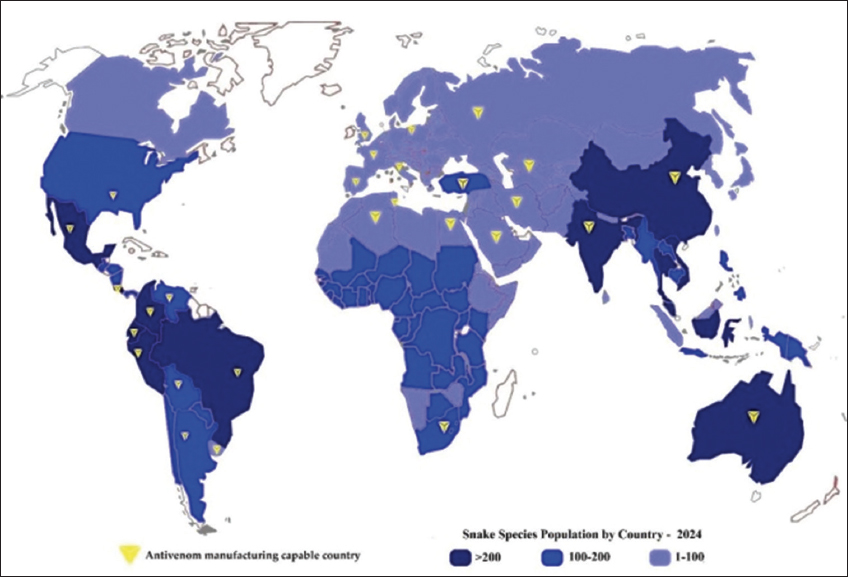 | Figure 1: Geographic distribution of local antivenom production capabilities and snake populations, including coral snakes. [Click here to view] |
Knowledge gaps in snakebite research arise from low investment in medical conditions, challenges in data collection, and limited access to medical care, leading to poor medical records [8]. Venom is a vital ecological adaptation in venomous snakes, as its composition and activity have frequently coevolved with the physiology of their prey. Venom can induce several pathological effects, including hemotoxicity, neurotoxicity, and cytotoxicity [9,10]. Antivenoms that neutralize toxins are currently used as treatments; however, new approaches are being developed, such as specific inhibitors targeting individual venom components. These advancements aim to enable more personalized therapies with improved efficacy [11].
These immunotherapeutic drug manufacturing techniques were developed over 50 years ago with only minor modifications [12]. However, several barriers hinder the availability of antivenoms from production to patient care. Globally, antivenom manufacturing falls short of clinical demand, particularly in regions with limited producers [13]. Antivenom operates at the molecular level by neutralizing venom toxins through the binding of polyclonal antibodies to their specific targets [14].
This strategy could enhance treatment efficacy by targeting venom components that evade conventional antivenom solutions [15]. Tribal communities primarily depend on various plant resources for their daily needs, serving as both primary food sources and remedies for various diseases, including snakebite [16]. For the development of novel antivenoms, small toxin inhibitors are engineered that can be combined with whole immunoglobulin G (IgG) antibodies, antibody fragments, or recombinant antibodies to neutralize snake venom toxins [9,17]. Low molecular weight nanobodies exhibit excellent tissue penetration, low immunogenicity, and high stability, and can also have broad-spectrum activity against the venoms of many snake species [4]. In this review, we focused on recent advancements in antivenom strategies, tracing the evolution from traditional serum therapies to next-generation molecular and bioengineered antidotes.
2. ARTICLE SEARCH STRATEGIES
A structured literature search was conducted using major electronic databases, including PubMed, Science Direct, Web of Science, Google Scholar, and AGRICOLA, covering publications from January 2000 to March 2025. The search included combinations of keywords such as “snakebite,” “snake venom,” “snakebite envenomation,” “antivenom,” “immunotherapy,” “nanobodies,” “small-molecule inhibitors,” “oligonucleotides,” “artificial intelligence,” “drug design,” and “snakebite management.” Boolean operators (AND, OR) were used to refine and combine search terms for improved relevance. Articles were included if they focused on snake venom, envenomation mechanisms, antivenom development, or emerging therapeutic strategies such as recombinant antibodies, nanotechnology, and artificial intelligence (AI)-based drug design. Only peer-reviewed, full-text articles published in English were considered for inclusion in this review, irrespective of the authors, journals, or country of publication. Studies unrelated to snakebite treatment, duplicate records, conference abstracts without full texts, and articles lacking adequate scientific detail but only containing keywords such as “snakebite” or “antivenom” were excluded from this review. In total, 6868 and 32,800 records were initially retrieved from PubMed and Google Scholar, respectively; however, after applying the defined search criteria and screening process, only 118 articles were considered eligible for inclusion. All selected papers were screened by title, abstract, and full text to ensure relevance to the scope of this review.
3. CHALLENGES IN SNAKEBITE MANAGEMENT AND ANTIVENOM PRODUCTION
The most common challenges in snakebite management include the production and supply of species-specific antivenoms, as well as the early identification of venom type and timely access to appropriate therapy. In addition, challenges remain in venom characterization and in understanding the immune responses to both venom and antivenom [12-14].
3.1. Challenges in Early Access and Production of Antivenom
Obtaining suitable snake venoms for use as immunogens remains a major challenge in antivenom production [13]. The number of countries capable of producing these venoms is very limited; therefore, many manufacturers rely on commercial venoms, which may not reflect regional variations in venom composition [14]. Moreover, insufficient regulatory oversight in countries where snakebite problems are severe makes it very difficult to check the quality of antivenoms [15]. Inaccurate data on snakebite incidence and improper distribution policies have led to reduced or discontinued antivenom production and increased prices. These factors have also resulted in declining trust in available antivenoms, ultimately lowering their demand [16,17]. Such limitations reduce the number of manufacturers, leading to a global shortage in the production and availability of antivenoms. Consequently, their utilization remains limited in regions where they are most needed [17]. Nevertheless, only a handful of countries, namely India, Australia, the USA, China, and some South American countries, are able to produce antivenoms. The main problem in effectively treating snakebite is the search for other means apart from the use of antivenom therapy.
According to a previous report, Zhang et al. [13,18], several challenges, such as long distances to well-equipped health facilities, lack of transport, and poor cold-chain storage in rural areas, hinder access to proper antivenom treatment in time. In addition to these problems, the continuous lack and high price of antivenoms are the main reasons that treatment is delayed for a long period of time. The lack of diagnostic tools and understanding further complicates the situation of giving the right antivenom, which emphasizes the necessity of providing more education, resources, and infrastructure for snakebite management.
3.2. Venom Characterization and Immunological Insights
The venoms of snakes consist of complex mixtures of peptides and proteins that produce diverse pharmacological effects. A major area of interest for scientists is the study of venom composition and its implications for antivenom. At the same time, performing experiments with Micropechis ikaheka venom both in vitro and in vivo, it is reported that the occurrence of severe hypotension, bradycardia, coagulopathy, fibrinogen depletion, and post-synaptic neurotoxicity, among other effects [19]. Together, these findings highlight the intricacy of envenomation syndromes and the consequent requirements for multitargeted therapeutic strategies. Similarly, studies in 545 cases of venom from European vipers have been done [20]. They discovered that although the majority of the cases were mild to moderate, Systemic complications, particularly hypotension and coagulopathy, were the most common manifestations of envenomation, The use of antivenoms in 30% of patients was recorded by a rapid recovery of symptoms and a low occurrence of side effects. The result was in line with the clinical advantage of the intervention, which was carried out promptly, thus revealing a good therapeutic window.
Liquid chromatography-tandem mass spectrometry proteomic studies of Crotalus molossus venom characterized the presence of major bioactive families such as P-III and P-I snake venom metalloproteinases (SVMPs), L-amino acid oxidase (LAAO), and phospholipase A2 (PLA2). P-III SVMPs, with their multidomain features, enzymatically break down extracellular matrix components and regulate newly formed blood vessels and cancer spread, whereas LAAO causes cell death via oxidative stress via the generation of one of the main radicals, hydrogen peroxide [21]. The venom profile is not fixed but rather changes according to developmental stage and other species-specific factors. The comparison of the efficiency of Indian polyvalent antivenoms against venoms from five Sri Lankan snake species via proteomic, biochemical, pharmacological, and immunological approaches is reported [22]. The antivenoms were effective against Naja naja, Echis carinatus, Bungarus caeruleus, and Daboia russelii but were less effective against Hypnale hypnale. The immunoblot results revealed little binding to low-molecular-weight proteins, especially the three-finger toxins (3FTx) and PLA2 recombinant variants; hence, region-specific immunogen addition is needed to increase performance. Moreover, Deka et al. [23] carried out a proteomics-based study on the venom of Indian Naja species (N. naja, Naja kaouthia, and Naja oxiana). Unigenes encoding the major protein families of venom were identified: 3FTx, PLA2, SVMPs, and other minor components. The Indian spectacled cobra (N. naja) from the Western Ghats was characterized at the proteomic level, and the venom gland transcriptome sequenced.
Researchers have also examined the role of endogenous inhibitors in snakes as a potential source for developing new antivenom strategies. Discovery of BJ46a reported a 46 kDa plasma glycoprotein from Bothrops jararaca. It binds to SVMPs, therefore, preventing degradation of the extracellular matrix and autotoxic damage [24]. This protein provides a natural model for the development of SVMP-targeted antivenoms with greater specificity, which is supported by evidence [25]. The above authors also reviewed in vitro techniques for the evaluation of antivenom efficacy, including enzymatic inhibition assays, immunoassays, and cell-based cytotoxicity models. These methods could lessen the necessity for animal testing, increase the reproducibility of assays, and allow toxin-specific neutralization profiling. Still, their predictive value must be linked to in vivo results. Moreover, Sánchez et al. [26] demonstrated the potential of paraspecific neutralization, highlighting that some commercial antivenoms exhibit high cross-reactivity beyond the species for which they are designed, although their effectiveness varies considerably depending on the product and snake species.
3.3. Production Methods and Quality Control
Manufacturing and quality control procedures in snake antivenom production are essential for ensuring safety, effectiveness, and product uniformity. Initially, research focused on ways to remove endotoxins and purify immunoglobulins to enhance antivenom formulation. It is reported that histidine poly(ethylene vinyl alcohol) hollow fiber membranes enable the removal of endotoxin from horse F(ab’)2 antivenom with a high antibody recovery rate depending on the buffer composition and flow rate [27]. The employment of a two-step depyrogenation procedure greatly improved the exclusion of endotoxins. Similarly, De Freitas et al. [28] stated that macroporous chitosan membranes could remove endotoxin by adsorption up to 97% from Bothrops F(ab’)2 antivenom and maintain the protein recovery rate at approximately 94%, indicating their promising potential for large-scale production.
For the purpose of ensuring complete endotoxin removal and increased protein yield, chromatographic methods have been improved and optimized. It is reported that affinity resin-based chromatography under acidic conditions led to the complete removal of bacterial lipopolysaccharides, hence achieving a protein recovery of 91.2% [29] . In their following research, Sheraba et al. [30] suggested that heat activation at 70–80°C together with endotoxin-specific buffers should be used so that the interference in the limulus amebocyte lysate assay caused by (1→3)-β-D-glucans is as minimal as possible. Therefore, further emphasizes the need for proper pH and ionic strength for endotoxin detection and removal.
A major concern in antivenom production is the need to standardize quality control protocols. Differences in venom and antivenom research methods remain insufficiently harmonized at the international level [31]. They suggested that while the potency of the antivenom remained stable, vigilance in the post-market surveillance is necessary to ensure uniform safety and efficacy across manufacturers [32]. They also assessed 19 samples of snake antivenom from different manufacturers. They reported that while most products complied with the endotoxin limits set by the pharmacopoeia, there were a few that exceeded these limits. It indicates that the antivenom might have become contaminated during the production process rather than during storage. Besides being a confirmation point for good manufacturing practices (GMP), it is also a reminder that testing for compliance with the WHO guidelines must be regular.
The advancements in antivenom manufacturing processes have also been the subject of process intensification. Traditional plasma processing in horses was optimized using a factorial design. This approach allowed pepsin digestion at pH 3.2 and 37°C, with an enzyme-to-protein ratio of 1:15 for 60 min, followed by ammonium sulfate precipitation (14 g/dL at 56°C or 16 g/dL at 30°C). It is the simplest method for obtaining the highest yield and purity of the product [33]. Similarly, Sánchez et al. [34] investigated the applicability of dynamic body feed filtration (DBF) for antivenoms obtained via caprylic acid precipitation. Pilot-scale studies have shown that DBF with C1000 diatomite at 90 g/L can remove 50 L of plasma batches from impure batches in a few minutes. This verifies that the technique is far superior to traditional open filtration in terms of time. It allowed immunoglobulin recovery/yield to be maintained at approximately 108% while minimizing the risk of microbial contamination.
Furthermore, the closed system that uses a single-use apparatus makes this particular method a promising, cost-effective, and GMP-compliant alternative for industrial antivenom production. Furthermore, antivenom production requires careful attention to minimize adverse effects associated with complement activation and endotoxin contamination. Patra et al. [35] tested polyclonal F(ab’)2 Pan Africa antivenom batches and reported that these were composed of approximately 92% IgG/F(ab’)2, over 60% venom-specific antibodies, with low endotoxin levels, and moderate complement activation as safe cytokine profiles in pre-clinical studies, allowing wide cross-reactivity. Collectively, the findings highlight the importance of robust quality assurance in developing antivenoms with enhanced efficacy and safety.
4. ADVANCES IN THERAPEUTIC PROSPECTS AGAINST SNAKEBITE
Conventional and modern antivenom therapies against snakebite include serum-based therapies, small-molecule inhibitors, oligonucleotides, small peptides, and nanomaterials. Each type of therapy has its own advantages and disadvantages.
4.1. Serum-based, Small Molecules and Oligonucleotide-mediated Therapy
Didelphis marsupialis (common opossum) serum protein DM43 binds explicitly to SVMPs, effectively inhibiting and neutralizing their activity. It inhibits venom-induced hemorrhage and tissue damage in pre-clinical models [36]. PO41 from the serum of Philander opossum, a metalloproteinase inhibitor of snake venom, results in binding with high specificity [37]. A novel α-type PLA2 myotoxin inhibitor, agkistrodon nummifer myotoxin inhibitory protein, has been reported in the plasma of the snake Atropoides nummifer (Mexican jumping pit viper) [38]. Another PLA2 inhibitor in the serum of Elaphe climacophora (Japanese rat snake) prevents venom-induced muscle damage [39]. A glycoprotein, gpMuc, from Mucuna pruriens seeds neutralizes venom-induced damage such as hemorrhage and coagulopathy [40]. Purification of an SVMP inhibitor (SVMPi) from Pichia pastoris was reported previously [41].
Recombinant alpha-type myotoxin inhibitors from Bothrops alternatus snake venom [42] and C60 (buckminsterfullerene) carbon nanomaterial have been used for the treatment of snakebite envenomation [43]. Pre-treatment with betulin (triterpenoid) significantly reduces muscle paralysis and enhances survival rates in mice exposed to Bothrops jararacussu venom [44]. Inhibitors of LY315920 (Varespladib), against Group I and II myotoxic PLAs2, are effective in envenomation. It potently diminishes the phospholipase activity as well as myotoxicity in both groups of PLAs2, thus indicating that its capacity as a drug to decrease venom-induced muscle injury can lead to snakebite envenomation [45-47]. An experiment to determine how LY333013 (methyl-Varespladib), a single oral dose of a PLA2 inhibitor, could save mice injected with neurotoxic venom of Oxyuranus scutellatus (common taipan) was carried out [48]. Even hours after envenomation, the mice treated with LY333013 successfully survived venom-induced paralysis and neurotoxicity. These results highlight the potential of LY333013 to counteract the lethal effects of venom. It is a promising therapeutic intervention, particularly as an effective oral therapy [49]. SVMPI, serpin A1, small serum protein α-type PLA2 inhibitor, β-type PLA2 inhibitor, and γ-type PLA2 inhibitor (hepatic inhibitors) have a dose-dependent effect on envenomation in Sinonatrix annularis [50]. Aqueous extracts and oils of Toona ciliata have antivenom/procoagulant activities and completely neutralize venom [51].
Researchers have discovered that deoxyribonucleic acid (DNA) aptamers might be great resources for the development of various types of antivenom therapy, as they can selectively bind to neurotoxins as well as the cardiotoxins present in snake venom. These aptamers may serve as adjuncts or enhance the efficacy of existing antibody-based antivenoms, as illustrated in Figure 3. The specific DNA aptamers were selected against α-bungarotoxin from Bungarus multicinctus (Taiwan Banded Krait) and cobra (Naja atra) through the systematic evolution of ligands by exponential enrichment (SELEX) method, using the SELEX, and they bound to target proteins with high affinity and specificity. In addition, cardiotoxins are recognized as diagnostic tools [52], whereas oligonucleotide-based therapies offer efficient and targeted strategies for neutralizing lethal peptide toxins [53]. Marimastat and the 2,3-dimercapto-1-propanesulfonic acid (DMPS) have shown good results as inducers of SVMP-driven coagulopathy, although only to a limited extent [54].
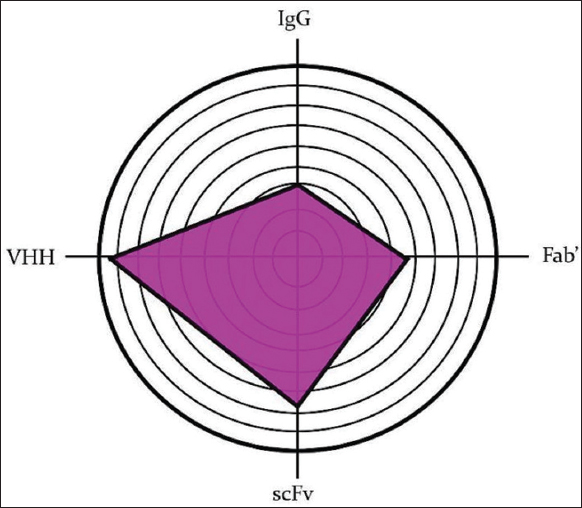 | Figure 2: Potential differences among antibody types against snake venom are based on tissue penetration, venom-binding specificity, immunogenicity, and stability. [Click here to view] |
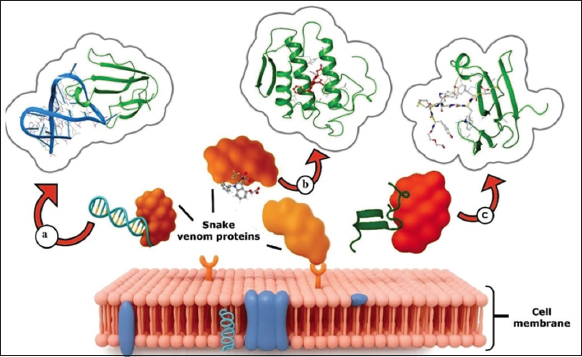 | Figure 3: Schematic illustration of the mechanisms of snake venom action and therapeutic diversion. (a) DNA aptamers adhere to toxin surfaces thus blocking receptor engagement (α-Bungarotoxin; PDB ID: 2BTX bound to the deoxyribonucleic acid aptamer sequence 5’-GCGAGGTGTTCGAGAGTTAGGGCGACATGACCAAACGTT-3’); (b) Small-molecule inhibitors direct venom enzymes such as phospholipase A2 or snake venom metalloproteinases to catalytic pockets, hence blocking their enzymatic activity (Bothrops pirajai Piratoxin-I (PrTX-I); PDB ID: 8DND in complex with the synthetic inhibitor Varespladib); (c) Peptide antagonists locate toxin epitopes to neutralize binding to membrane receptors (α-Cobratoxin; PDB ID: 6ZFM complexed with a peptide inhibitor). The combination of these modalities prevents venom constituents from wreaking havoc on cellular integrity. [Click here to view] |
High-resolution crystallographic analysis (1.7 Å) revealed that aristolochic acid (AA) binds to D. russelii PLA2, illustrating competitive inhibition (Ki ≈ 1.18 μM) through hydrogen bonding with the catalytic residues His48 and Asp49, whereas Trp31 acts as a gate controlling ligand access [55]. Afterward, González Rodríguez et al. [56] confirmed that AA is the strongest inhibitor of PLA2, i.e., the enzyme leading to venom-induced myotoxicity and hemolysis. According to test results on Bothrops spp. venom and isolated myotoxins, the maximum protective effect (85%) was achieved without protein secondary structure changes; however, nephrotoxicity still limits safe therapeutic use. Ascoët and De Waard [57] and Alomran et al. [58] demonstrated through their experiments with aptamers that these inhibitors inactivate venom serine proteases and α-neurotoxins, resulting in the restoration of clotting and partial toxin neutralization both in vitro and ex vivo. An optimized DNA aptamer, referred to as BB3, was developed to specifically bind to β-bungarotoxin, the primary toxic component of the venom of B. multicinctus [59]. By SELEX for 14 cycles and chemical alterations (cutting, 2′-O-methylation, 3’-inverted-dT), BB3 showed high binding ability, resistance to nucleases in plasma, and extended survival time in mice injected with lethal doses of the toxin. This highlights the potential of the aptamer as a new and effective recombinant antivenom solution.
4.2. Peptide Engineering and Functional Optimization
An advance in venom peptide delivery has been the rational engineering of these peptides, which in turn has had a positive impact on drug development. CyLoP-1, a cysteine-rich peptide derived from the nuclear localization sequence of crotamine, was introduced. It was found to be capable of both penetrating mammalian and plant cells and selectively killing methicillin-resistant Staphylococcus aureus. Both direct membrane translocation and endocytosis, which are dual uptake pathways of disulfide-stabilized peptide folding, depend on which fibrillogenic region is involved [60]. This phenomenon was further explained by the identification of nucleolar-targeting peptides, which are capable of delivering large macromolecular cargos, such as β-galactosidase, into cells without loss of enzymatic activity [61,62]. These peptides have a strong affinity for anionic lipid membranes through which they form transient pores, as a result of which the cargo could move over and at the same time maintain cell viability. The mechanistic studies of Sieber et al. [63] revealed that crotamine integrates weakly cation-selective pores in lipid bilayers; therefore, a mechanistic theory for antimicrobial activity is given. This study contributes to the understanding of the biological features of Crotalus. It highlights the continued therapeutic prospects of truncated peptide fragments by showing that the derivatives of Crotalicidin (Crotalus durissus) not only exhibit antibacterial and anticancer activities but also have better selectivity and serum stability. These results led to recognition as potential therapeutics or diagnostic tools [64-66]. Short peptides capable of inhibiting PLA2 activity in Western cottonmouth venom in vitro were identified using the phage display technique [67].
The classification of venoms as ‘mini drug libraries’ is justified by successful therapeutics including captopril, eptifibatide, and tirofiban [68]. These results revealed the potential of venom derivatives, both enzymatic and non-enzymatic, as new pharmacological agents. The “serpentides,” a short synthetic peptide with the capability of binding and neutralizing the effect of α-cobratoxin on nicotinic acetylcholine receptors [69]. Data on co-crystallization revealed that these peptides had properties that allowed them to mimic receptor binding motifs. An experiment was performed on peptide-enzyme-linked immunosorbent assays that involved the use of epitopes from α-bungarotoxin and cardiotoxin A3 [70]. The results showed that the results of the assays correctly correlated the antibody titers with the neutralization of N. atra neurotoxic and cytotoxic effects.
Similarly, Camperi et al. [71] demonstrated that synthetic peptides can replace crude venom as safe and effective immunogens. Rodríguez et al. [72] designed δ-ctenitoxin Pn2a-derived peptides that promoted immune activation and had good cytotoxicity profiles; these peptides could be used as real immunogens. In parallel, Saladini et al. [73] developed CDR3 loop peptides from a monoclonal antibody against Bothrops serine proteases, identifying inhibitors that neutralized venom thrombin-like enzymes more effectively, with stability and safety. Chanda et al. [74] advanced this concept by integrating antibodies against 17 synthetic peptide “epitope strings,” significantly enhancing the neutralization of enzymatic activity against B. caeruleus. Hence, guaranteeing that they would form the basis of synthetic peptide-based antivenoms that have high specificity, and therefore, are less immunogenic than regular serum therapies. Peptide-based neutralization of the snake venom proteins is shown in Figure 3.
4.3. Nanomaterial-based Therapy
Engineered nanoparticles, which are designed to mimic cell membranes, efficiently bind and sequester venom components, thereby diminishing their ability to interact with cellular targets and neutralize their toxic effects [75]. Montanide adjuvants – IMS 3012 (nanoparticle-based), ISA 35, and ISA 206 (emulsion-based) have been shown to effectively hyper-immunize equines, facilitating the production of biocompatible polyvalent snake antivenoms [76]. The development of polymer-based antidotes (Melittin) is aimed at efficiently sequestering toxins by binding and neutralizing them in the bloodstream, thereby mitigating their harmful effects. These polymers show strong potential as alternative or complementary approaches to conventional antivenom therapies for toxin neutralization [77].
Synthetic polymer nanoparticles from corona proteins enable broad-spectrum sequestration and neutralization of venomous biomacromolecules (PLA2) by modifying the surface properties of these nanoparticles [78]. Hydrogel nanoparticles were designed with high affinity for binding toxic venom components (PLA2 and 3FTX) and successfully inhibited Naja nigricollis venom-induced cell death and tissue damage, significantly reducing dermonecrosis [14]. Venom-loaded chitosan nanoparticles induced a potent antibody response against C. durissus cascavella venom in mice and thus acted as an immune-adjuvant [79]. Nano-hydroxyapatite pickering emulsions used as adjuvants to increase the antibody response against Bothrops asper venom exhibit excellent physical properties, including uniform particle distribution and high stability [80].
These findings demonstrated that chitosan nanoparticles could be effective immune-adjuvants for antivenom production by Bothrops. It has a high venom encapsulation efficiency, stability, and high antibody titers in mice similar to aluminium hydroxide, but with lower antigen doses and minimal inflammatory responses [81]. These findings indicate that chitosan nanoparticles are a safer, controlled-release system with the possibility of being used in the production of antivenom on a large scale. Delving into futuristic antivenom creation through nano-fractionation methods is a strategy that allows one to be very specific when identifying venom toxins, especially those disrupting blood coagulation [82]. Singh et al. [83] can be considered another source that is in good harmony with these results, as they revealed the environmentally friendly synthesis of ~35 nm silver nanoparticles (AgNPs) with Dryopteris cochleata extract, which dramatically improved both PLA2 inhibition and venoms; therefore, these nanoparticles can significantly facilitate the delivery of phytochemical-based antivenom formulations. Furthermore, this approach, which uses molecules with better pharmacokinetic properties, becomes the rationale for making antivenom therapies more selective, efficient, and hence leads to the alleviation of snakebite victims. The AgNPs-mediated bark extract of Alstonia scholaris demonstrated promising venom neutralization potential [84]. Curcumin-based AgNPs were employed to counteract the toxic effects of Philodryas olfersii venom [85].
The utilization of cationic nanoparticles as biocompatible immune-adjuvants has been shown to increase serum production and strengthen the immune response against B. jararaca venom [86]. AgNPs-mediated saponins derived from Quillaja saponaria bark extract demonstrated significant venom-neutralizing efficacy against Vipera russelli [87]. Hence, nanobody-based drugs are more potent than conventional antivenom, as recently reported [5]. A nano-formulation of an oligoclonal mixture of eight polyvalent recombinant antivenoms was able to neutralize the venom of 18 snakes, including Jameson’s mambas (Dendroaspis jamesoni, Dendroaspis viridis, and Dendroaspis polylepis), rinkhals (Hemachatus haemachatus), and Naja spp. (species of anchietae, annulifera, ashei, haje, katiensis, melanoleuca, mossambica, nigricincta, nigricollis, nivea, nubiae, pallida, and senegalensis under the genus Naja). This study highlights the promising potential effects of nano-antivenoms for snakebite management. The list of various globally available antivenoms is given in Table 1.
Table 1: Physiochemical properties of some available commercial global antivenoms.
| S. No. | Name of the antivenom | Formulation | Snake species covered | Type | Country | References |
|---|---|---|---|---|---|---|
| 1 | EchiTAb-Plus-ICP | IgG | West African vipers (Echis spp., Bitis spp., and Naja spp.) | Monovalent | Africa | [88] |
| 2 | Antivipmyn Africa | F (ab’)2 | African vipers | Polyvalent | Africa | [89] |
| 3 | CSL antivenoms | IgG | Australian snakes (brown, tiger, taipan) | Polyvalent | Australia | [90] |
| 4 | Bothropic-crotalic antivenom | IgG/F (ab’)2 | Bothrops, Crotalus, Micrurus, Lachesis | Polyvalent | Brazil | [91] |
| 5 | Antivipmyn TRI | F (ab’ 2 | Bothrops, Lachesis, Crotalus species | Polyvalent | Central/South America | [92] |
| 6 | PoliVal-ICP (Costa Rica) | IgG | Bothropic, crotalic, lachesic | Polyvalent | Costa Rica, Central America | [93] |
| 7 | Snake antivenin | F (ab’)2 | Cobra, Krait, Russell’s viper, Saw-scaled viper | Polyvalent | India | [94] |
| 8 | Snake venom antiserum | F (ab’)2 | Cobra, Krait, Russell’s viper, Saw-scaled viper | Polyvalent | India | [95] |
| 9 | Sii polyvalent anti-snake | F (ab’)2 | Indian cobra, Russell’s viper, saw-scaled viper | Polyvalent | India | [96] |
| 10 | ASVS (Snake Venom Antiserum) | F (ab’)2 | Cobra, Krait, Russell’s viper, Saw-scaled viper | Polyvalent | India | [97] |
| 11 | SL PAV B1, B2 | F (ab’)2 | South Asian vipers, cobras (PoliVal-ICP) | Polyvalent | Sri Lanka | [98] |
| 12 | Neuro polyvalent snake antivenin | F (ab’)2 | Neurotoxic snake species (Kraits, Cobras) | Polyvalent | India, South Asia | [99] |
| 13 | Antivipmyn | Fab fragments | Latin American pit vipers | Polyvalent | Latin America | [100] |
| 14 | SAIMR polyvalent antivenom | F (ab’)2 | Black mamba, Green mamba, Puff adder | Polyvalent | South Africa | [101] |
| 15 | Serum Bisa Ular Antivenom | F (ab’)2 | Southeast Asian venomous snakes | Polyvalent | Southeast Asia | [102] |
| 16 | Fav-Afrique | F (ab’)2 | African vipers, elapids, cobras | Polyvalent | Sub-Saharan Africa | [103] |
| 17 | CroFab | Fab | Cottonmouth, rattlesnake, diamondback | Polyvalent | United States of America | [104] |
IgG: Immunoglobulin G.
The immune-protective effects of synthetic epitopes encapsulated in synthetic peptides trapped in liposomes against the lethal venom of C. durissus. It showed that the synthetic epitopes successfully elicited a strong immune response and provided significant protection against the lethal effects of the venom for snakebite immunotherapy [105]. Encapsulation of antivenom components in nanoparticles improves their stability, controlled release, and pharmacokinetics [106]. Furthermore, squalene oil-in-water emulsions have demonstrated better efficacy against viperid venoms than other agents [107].
5. CHALLENGES IN AI-BASED PROTEINS AND NEXT-GENERATION ANTIVENOMS
Moreover, the use of machine learning and AI-based modeling, as in the case of mini-protein binders, can be a source of rapid generation and optimization of therapeutic molecules. Using this approach to design proteins that neutralize snake venoms provides a faster, cheaper, and more efficient alternative to traditional animal-derived antivenoms. AI recently contributed to the invention of synthetic antivenom in the form of computationally designed mini-proteins, or “binders,” which were fabricated with the RFdiffusion (RoseTTAFold Diffusion) tool [108]. These binders are designed to neutralize key venom toxins, including three-finger toxins, neurotoxins, and tissue-damaging enzymes. They provide protection in murine models and exhibit heat stability, which is important for use in hot, resource-limited regions affected by snakebites. However, their effectiveness decreases when tested with whole venom, and tissue protection remains limited in some species, such as N. nigricollis. Thus, binder cocktails designed for local snake fauna may provide a more practical solution [109,110]. Figure 5 shows the methodology used for AI-based antivenom protein design and synthesis.
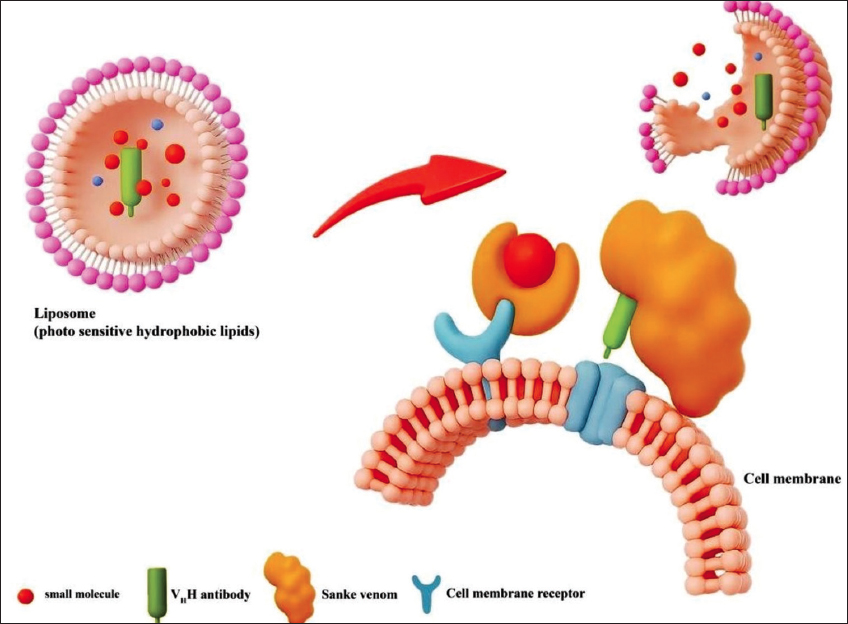 | Figure 4: Graphical representation of liposome-mediated antivenom drug delivery [Click here to view] |
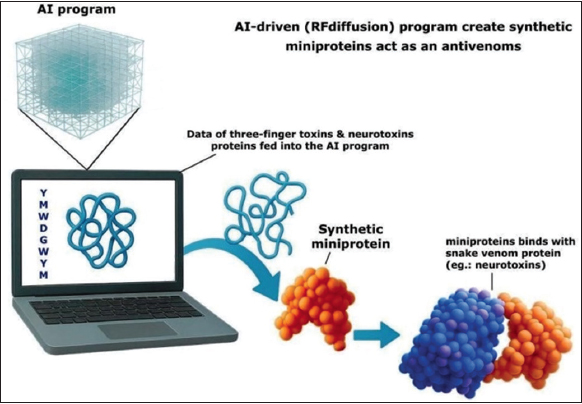 | Figure 5: Schematic workflow of artificial intelligence-driven protein design (RFdiffusion), which utilizes structural and sequence data from three-finger snake toxins and α-neurotoxins to generate compact synthetic miniproteins. These designed binders neutralize venom toxins, representing a promising next-generation strategy for antivenom development and victim protection. [Click here to view] |
This methodology was further extended by implementing deep learning-guided de novo protein design (RFdiffusion + ProteinMPNN/AlphaFold2 [AF2]) for the production of highly stable binders that target three-finger toxin subfamilies, i.e., short and long-chain α-neurotoxins, and cytotoxins. The neurotoxin binders (SHRT and LNG; Kd ~0.7–6.7 nM) were able to efficiently block nAChR inhibition by α-cobratoxin and ScNtx at almost stoichiometric ratios efficiently, and hence mice challenged with 3 × LD50 toxins were provided with 100% survival, whereas the cytotoxin binder (CYTX; Kd ~271–740 nM) only managed to prevent keratinocytes in vitro from being attacked by the toxin but was of a minor extent in vivo against dermonecrosis, thereby, mainly used to indicate the necessity of affinity and pharmacokinetic optimization [111]. Structural analysis has validated the interactions between the computationally designed binder and toxin with almost atomic precision. In essence, these results indicate the possibility of an affordable, stable, and usable antivenom in the field being synthesized from the next generation, with further development relying on increasing the binder range, improving combinations, verifying safety and effectiveness through clinical trials [112-117]. Among the in silico tools, only two, namely AF2 and ColabFold, while the former was better than the latter, were found to yield appropriate results for antivenom development in the case of snake bites. Kalogeropoulos et al. [118] described the above two tools after screening approximately 1000 toxins. While this approach can generate highly precise drug molecules, it offers limited options for antivenom development. This finding indicates that such AI-based tools also have limitations and challenges. AI-based development of the next generation of antivenoms is strongly believed to minimize and tackle the deadly snake venoms.
6. ADVANTAGES AND CHALLENGES FOR NEXT-GENERATION ANTIVENOMS
Small molecules, serum proteins, and recombinant inhibitors are the agents that selectively block the venom enzymes such as PLAs2 and metalloproteinases in order to stop bleeding, neurotoxicity, and tissue necrosis. Compounds such as varespladib and its oral analog LY333013, along with serum inhibitors such as DM43 and PO41, show high selectivity, cross-species activity, and stability, and in some cases can be administered orally as first-aid treatments. However, their function is typically confined to specific toxin groups, and consequently, they offer less systemic protection than polyclonal antivenoms. Recombinant antibodies can partially solve the problem of limited spectrum coverage by having wider and adjustable toxin coverage. Still, they are more complex and expensive to produce.
Oligonucleotide-based methods, such as DNA aptamers, short peptides, and small-molecule inhibitors, offer more accuracy to the extent that they selectively bind to neurotoxins, cardiotoxins, and PLA2. For instance, aptamers manufactured by SELEX exhibit strong binding to α-bungarotoxin and are used in diagnostic devices for quick toxin detection. Peptides from phage display, inhibitors such as Marimastat or DMPS, and nanoparticle-assisted phytochemicals are a few examples of the additional potential that these can demonstrate for targeted neutralization. Although these approaches provide high selectivity, reproducibility, and low immunogenicity, they are limited by a narrow toxin range, short half-life in circulation, and potential toxicity risks such as AA-induced nephrotoxicity. Similar to small molecules, these oligonucleotide-based drugs are the most suitable as a complement to the therapeutic arsenal to widen it, instead of being substitutes only.
In addition to these next-generation innovations, liposome, nanomaterial, peptide, and AI-based strategies are also the ones to come. Nanoparticles such as liposomes and polymers are capable of not only stabilizing drugs but also controlling release and enhancing immune response. At the same time, engineered nanomaterials could be very effective in venom sequestration or in co-injection forming as they are good adjuvants. Peptides created through a rational design (e.g., crotalicidin derivatives, “serpentides”) and aptamer-peptide hybrids exhibit extremely high toxin-binding activity and low immunogenicity. The newest breakthroughs in AI have given the ability to create synthetic mini-protein “binders” that are very selective in the deactivation of the conserved venom toxins and possess thermal stability and scalability. The main benefit of these methods is specificity, stability, and delivery potential, to which limitations in terms of narrow toxin coverage, occasional nanomaterial toxicity, and lack of clinical validation are added. Similar to the other alternatives, they can be seen as complementary platforms that have the potential not only to become one step further but also to make the therapy of snakebite, based on antibodies, more effective.
To ensure that cases treated with traditional or recombinant antivenom are not left out, combinations with adjunctive therapies are now the major sources of patients’ chances increasing, especially in very distant places or where resources are limited. The combination of omics technologies and computational platforms is rapidly developing venom research and antivenom design. Antivenomics driven by proteomics allows the mapping of the detailed antivenom cross-reactivity, thereby guiding a rational immunogen formulation and improving toxin coverage [Figure 6].
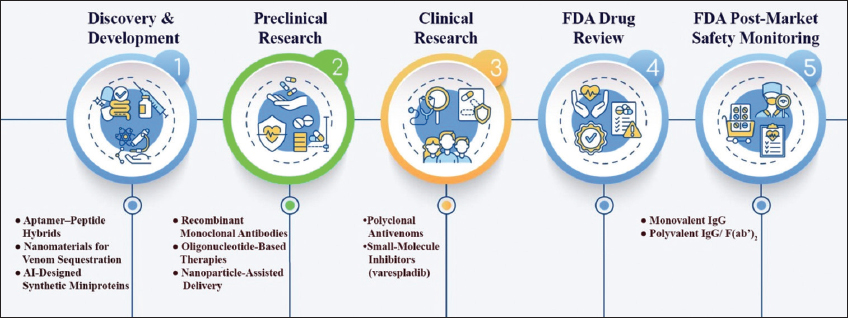 | Figure 6: Schematic representation of antivenom research and the developmental landscape of next-generation antivenom strategies across translational stages. [Click here to view] |
7. FUTURE ASPECTS OF SNAKEBITE MANAGEMENT AND DRUG DESIGN
Snake venom is a highly adaptive ecological trait that changes with age, diet, habitat, and geography, thus reflecting the evolutionary strategies that snakes use for predation. It is not uncommon for juvenile and adult snakes to have different feeding behaviors, in which molecular adjustments in venom composition are affected correspondingly. Local variations, which are influenced by the diversity of ecology and evolutionary pressures, among other factors, also highlight the necessity of precise and adaptable treatment approaches. Changes in genomic and proteomic technologies have greatly contributed to our knowledge of venom diversity and have enabled the creation of personalized immunotherapies that are tailored to species-specific venoms and patient responses. First region-specific antivenoms are the best option because they are more effective and safer than polyvalent formulations. Therefore, establishing reliable stockpiles and well-coordinated distribution systems, particularly in high-risk and underserved regions, will be essential to reducing delays in treatment. In general, these measures, including molecular innovations and improvements in healthcare infrastructure, are expected to transform snakebite management by reducing mortality and improving recovery outcomes.
The recent developments in therapeutic methods include monoclonal antibodies, nanobodies, DNA aptamers, and peptide therapies, which all provide more specificity and fewer side effects than conventional antivenoms do. Furthermore, research into small molecules, adjuvant drugs, and nanoparticle-based delivery systems is gaining momentum as they provide increased stability, accuracy, and controlled release. Moreover, the research results related to heparin and other similar substances reveal their role in diminishing venom- induced tissue suffering, thus they constitute an important group of novel adjunctive treatments. One key factor behind the development of effective antivenoms is the collaboration among researchers, medical practitioners, and the pharmaceutical industry. First, standardizing venom extraction and production processes, along with the use of more sustainable methods such as recombinant DNA technology, would contribute to both the quality and availability of antivenoms. Moreover, at the health care level, the implementation of training programs and the design of rapid diagnostic kits adapted to local snake species will guarantee more timely and correct interventions.
Envenomation caused by snakebite remains a major public health concern in tropical and subtropical regions. Challenges related to the production, availability, accessibility, and cold-chain maintenance of antivenoms persist globally, and the increasing diversity of snake venoms further complicates effective treatment. To address the limitations of conventional snakebite therapies, recent advances in AI-based screening and peptide prediction, along with nano-biotechnological approaches for antivenom development, are being extensively explored. In this review, we highlight the latest progress in antivenom research, from traditional serum-based therapies to cutting-edge strategies such as nanobody-based antivenoms, liposomal delivery systems, natural compound-derived nanomaterials, DNA-based interventions, and AI-driven protein and peptide therapeutics.
8. CONCLUSION
To successfully fight against snake envenomation, a complete strategy that combines more than just scientific research but also traditional knowledge is needed. Many studies have periodically analyzed the composition of snake venom and created corresponding antidotes; however, many obstacles remain regarding the production, distribution, and accessibility of effective treatments. New therapies such as oligonucleotides (messenger ribonucleic acids), recombinant engineered antibodies, nanobodies with or without encapsulation, and targeted small molecule inhibitors are expected to contribute significantly to the efficiency of snake antivenoms. In addition, improved surveillance, the enactment of more stringent regulatory measures, and more vigorous public health initiatives are vital in overcoming the difficulties in snakebite management that the present data gaps represent. Collaboration among healthcare professionals, researchers, and policymakers is essential to ensure timely and accessible treatment, reduce snakebite incidence, and improve recovery outcomes in affected communities. Sustained funding for research and the development of accessible therapeutic options will play a crucial role in addressing this neglected public health crisis and protecting vulnerable populations worldwide.
9. AUTHORS’ CONTRIBUTIONS
All authors made substantial contributions to conception and design, acquisition of data, or analysis and interpretation of data; took part in drafting the article or revising it critically for important intellectual content; agreed to submit to the current journal; gave final approval of the version to be published; and agree to be accountable for all aspects of the work. All the authors are eligible to be author as per the International Committee of Medical Journal Editors (ICMJE) requirements/guidelines.
10. FUNDING
DBT Star College Schemes (HRD-11011/33/2022-HRD-DBT), Department of Biotechnology, Government of India, New Delhi, to BRP are acknowledged. Department of Science and Technology under Science and Heritage Research Initiative (DST/SHRIC/SHRI-04/2023(G) dated January 09, 2024).
11. ACKNOWLEDGMENT
PPK, PS, SG and SRV declares that all figures were created by the authors based on the concepts and data presented in this study. The world map incorporated in the graphical illustration was obtained from the World Health Organization (WHO) webpage (https://www.who.int/teams/control-of-neglected-tropical-diseases/snakebite-envenoming/antivenoms) under Creative Common (CC) license. Graphical elements and layouts were designed using Adobe Illustrator and Adobe Photoshop. DALL·E was utilized to assist in generating three-dimensional vector representations from two-dimensional elements during the image preparation process.
12. CONFLICTS OF INTEREST
The authors report no financial or any other conflicts of interest in this work.
13. ETHICAL APPROVALS
This study does not involve experiments on animals or human subjects.
14. DATA AVAILABILITY
All data generated are published with this article.
15. PUBLISHER’S NOTE
All claims expressed in this article are solely those of the authors and do not necessarily represent those of the publisher, the editors and the reviewers. This journal remains neutral with regard to jurisdictional claims in published institutional affiliation.
16. USE OF ARTIFICIAL INTELLIGENCE (AI)-ASSISTED TECHNOLOGY
The authors declare that no artificial intelligence (AI)-assisted tools were used for writing, editing, data analysis, interpretation, or scientific content generation of this manuscript. DALL·E was used only to assist in preparing graphical/illustrative elements by generating three-dimensional vector representations from two-dimensional elements during figure preparation. All AI-assisted graphical outputs were reviewed, edited, and verified by the authors to ensure accuracy and appropriateness. No AI tool was used to generate or alter experimental data, results, or conclusions.
REFERENCES
1. Ammouch K, Mesmoudi N, Hammani N, Galan J, Moustaghfir A, Stöcklin R, et al. Tackling the burden of envenomation in Africa: Advances, challenges, and strategic priorities for enhanced diagnosis and treatment. Front Trop Dis. 2025;6:1. [CrossRef]
2. World Health Organization. Guidelines for the Management of Snakebite. 2nd ed. Geneva:World Health Organization;2016. 140.
3. Snakebite Envenoming. Available from: https://www.who.int/news-room/fact-sheets/detail/snakebite-envenoming [Last accessed on 2025 Nov 11].
4. Kasturiratne A, Wickremasinghe AR, de Silva N, Gunawardena NK, Pathmeswaran A, Premaratna R, et al. The global burden of snakebite:A literature analysis and modelling based on regional estimates of envenoming and deaths. Winkel K, editor. PLoS Medicine. 2008;5(11):e218. [CrossRef]
5. Control of Neglected Tropical Diseases [Internet]. [cited 2025 November 11]. Available from: https://www.who.int/teams/control-of-neglected-tropical-diseases/snakebite-envenoming/prevention-and-control
6. Oliveira IS, Pucca MB, Cerni FA, Vieira S, Sachett J, de Farias AS, et al. Snakebite envenoming in Brazilian children:clinical aspects, management and outcomes. J Trop Pediatr. 2023;69(2):fmad010. [CrossRef]
7. Munshi H, Gajbhiye RK. Strengthening global snakebite data for WHO's goal for 2030. Lancet. 2024;403:907-8. [CrossRef]
8. Pintor AF, Ray N, Longbottom J, Bravo-Vega CA, Yousefi M, Murray KA, et al. Addressing the global snakebite crisis with geo-spatial analyses - recent advances and future direction. Toxicon X. 2021;11:100076. [CrossRef]
9. Casewell NR, Jackson TN, Laustsen AH, Sunagar K. Causes and consequences of snake venom variation. Trends Pharmacol Sci. 2020;41:570-81. [CrossRef]
10. Gutiérrez J, Escalante T, Rucavado A, Herrera C, Fox JW. Acomprehensive view of the structural and functional alterations of extracellular matrix by snake venom metalloproteinases (SVMPs):Novel perspectives on the pathophysiology of envenoming. Toxins (Basel). 2016;8:304. [CrossRef]
11. Bittenbinder MA, Van Thiel J, Cardoso FC, Casewell NR, Gutiérrez JM, Kool J, et al. Tissue damaging toxins in snake venoms:Mechanisms of action, pathophysiology and treatment strategies. Commun Biol. 2024;7:358. [CrossRef]
12. Blanch NB, Cascone O, Fingermann M. Selective immunoglobulin aggregates removal in antivenoms by a simple chromatographic step based on a monolithic stationary phase. J Chromatogr B Analyt Technol Biomed Life Sci. 2024;1232:123978. [CrossRef]
13. Potet J, Beran D, Ray N, Alcoba G, Habib AG, Iliyasu G, et al. Access to antivenoms in the developing world:A multidisciplinary analysis. Toxicon X. 2021;12:100086. [CrossRef]
14. O'Brien J, Lee SH, Gutiérrez JM, Shea KJ. Engineered nanoparticles bind elapid snake venom toxins and inhibit venom-induced dermonecrosis. PLoS Negl Trop Dis. 2018;12:e0006736. [CrossRef]
15. World Health Organization. WHO Expert Committee on Biological Standardization. Guidelines for the production, control and regulation of snake antivenom immunoglobulins [Internet]. 2012 [cited 2025 November 11];(964):591. Available from: https://cdn.who.int/media/docs/default-source/biologicals/blood-products/document-migration/resriskgl_who_trs_1004_web_annex_4.pdf?sfvrsn=55dd09d3_3&download=true
16. Puzari U, Fernandes PA, Mukherjee AK. Pharmacological re-assessment of traditional medicinal plants-derived inhibitors as antidotes against snakebite envenoming:A critical review. J Ethnopharmacol. 2022;292:115208. [CrossRef]
17. Laustsen AH, María Gutiérrez J, Knudsen C, Johansen KH, Bermúdez-Méndez E, Cerni FA, et al. Pros and cons of different therapeutic antibody formats for recombinant antivenom development. Toxicon. 2018;146:151-75. [CrossRef]
18. Mohapatra B, Warrell DA, Suraweera W, Bhatia P, Dhingra N, Jotkar RM, et al. The timing is right to end snakebite deaths in South Asia. BMJ. 2019;364:k5317. [CrossRef]
19. Tibballs J, Kuruppu S, Hodgson WC, Carroll T, Hawdon G, Sourial M, et al. Cardiovascular, haematological and neurological effects of the venom of the Papua New Guinean small-eyed snake (Micropechis ikaheka) and their neutralisation with CSL polyvalent and black snake antivenoms. Toxicon. 2003;42:647-55. [CrossRef]
20. Boels D, Hamel JF, Le Roux G, Labadie M, Paret N, Delcourt N, et al. Snake bites by European vipers in Mainland France in 2017-2018:Comparison of two antivenoms Viperfav®and Viperatab®. Clin Toxicol (Phila). 2020;58:1050-7. [CrossRef]
21. Jimenez-Canale J, Fernández-Quiroz D, Teran-Saavedra NG, Diaz-Galvez KR, Gallegos-Tabanico A, Burgara-Estrella AJ, et al. Cytotoxic activity of Crotalus molossus molossus snake venom-loaded in chitosan nanoparticles against T-47D breast carcinoma cells. Acta Biochim Pol. 2022;69:233-43.
22. Maduwage K, Silva A, O'Leary MA, Hodgson WC, Isbister GK. Efficacy of Indian polyvalent snake antivenoms against Sri Lankan snake venoms:Lethality studies or clinically focussed in vitro studies. Sci Rep. 2016;6:26778. [CrossRef]
23. Deka A, Bhatia S, Santra V, Bharti OK, Lalremsanga HT, Martin G, et al. Multilevel comparison of Indian Naja venoms and their cross-reactivity with Indian polyvalent antivenoms. Toxins (Basel). 2023;15:258. [CrossRef]
24. Valente RH, Dragulev B, Perales J, Fox JW, Domont GB. BJ46a, a snake venom metalloproteinase inhibitor. Isolation, characterization, cloning and insights into its mechanism of action. Eur J Biochem. 2001;268:3042-52. [CrossRef]
25. Gutiérrez JM, Vargas M, Segura Á, Herrera M, Villalta M, Solano G, et al. In vitro tests for assessing the neutralizing ability of snake antivenoms:Toward the 3Rs principles. Front Immunol. 2021;11:1-13. [CrossRef]
26. Sánchez M, Solano G, Vargas M, Reta-Mares F, Neri-Castro É, Alagón A, et al. Toxicological profile of medically relevant Crotalus species from Mexico and their neutralization by a Crotalus basiliscus/Bothrops asper antivenom. Toxicon. 2020;179:92-100. [CrossRef]
27. Acconci C, Legallais C, Vijayalakshmi M, Bueno SM. Depyrogenation of snake antivenom serum solutions by hollow fiber-based pseudobioaffinity filtration. J Memb Sci. 2000;173:235-45. [CrossRef]
28. De Freitas SS, MacHado RL, De Arruda EJ, Santana CC, Bueno SM. Endotoxin removal from solutions of F(ab′)2 fragments of equine antibodies against snake venom using macroporous chitosan membrane. J Memb Sci. 2004;234:67-73. [CrossRef]
29. Sheraba NS, Diab MR, Yassin AS, Amin MA, Alhamhoom Y. An efficient method for endotoxin removal from snake antivenoms. Chromatographia. 2020;83:779-87. [CrossRef]
30. Sheraba NS, Hesham A, Fawzy M, Diab E, Basuony ME, Yassin AS, et al. Advanced approaches for endotoxin detection and removal from snake antivenoms. Toxicon. 2023;222:107003. [CrossRef]
31. Wespel M, Geiss M, Nägele M, CombéS, Reich J, Studts J, et al. The impact of endotoxin masking on the removal of endotoxin during manufacturing of a biopharmaceutical drug product. J Chromatogr A. 2022;1671:462995. [CrossRef]
32. Solano G, Ainsworth S, Sánchez A, Villalta M, Sánchez P, Durán G, et al. Analysis of commercially available snake antivenoms reveals high contents of endotoxins in some products. Toxicon X. 2024;21:100187. [CrossRef]
33. Zurbano BN, Tavarone E, Viacava BG, Dokmetjian JC, Cascone O, Fingermann M. Critical aspects on traditional antivenom production processes and their optimization by factorial analysis. Biologicals. 2020;68:65-73. [CrossRef]
34. Sánchez A, Cerdas M, Gutiérrez J, Vargas M, Segura Á, Herrera M, et al. Pilot-scale evaluation of a dynamic body-feed filtration system for primary clarification of snake antivenoms produced by the caprylic acid method. Toxicon X. 2024;23:100202. [CrossRef]
35. Patra A, Kalita B, Mukherjee AK. Assessment of Quality, Safety, and Pre-Clinical Toxicity of an Equine Polyvalent Anti-Snake Venom (Pan Africa):Determination of Immunological Cross-Reactivity of Antivenom Against Venom Samples of Elapidae and Viperidae snakes of Africa. Netherlands:Elsevier Ltd.;2018. [CrossRef]
36. Neves-Ferreira AG, Perales J, Fox JW, Shannon JD, Makino DL, Garratt RC, et al. Structural and functional analyses of DM43, a snake venom metalloproteinase inhibitor from Didelphis marsupialis serum. J Biol Chem. 2002;277:13129-37. [CrossRef]
37. Jurgilas PB, Neves-Ferreira AG, Domont GB, Perales J. PO41, a snake venom metalloproteinase inhibitor isolated from Philander opossum serum. Toxicon. 2003;42:621-8. [CrossRef]
38. Quirós S, Alape-Girón A, Angulo Y, Lomonte B. Isolation, characterization and molecular cloning of AnMIP, a new a-type phospholipase A2 myotoxin inhibitor from the plasma of the snake Atropoides nummifer (Viperidae:Crotalinae). Comp Biochem Physiol B Biochem Mol Biol. 2007;146:60-8. [CrossRef]
39. Shirai R, Toriba M, Hayashi K, Ikeda K, Inoue S. Identification and characterization of phospholipase A2 inhibitors from the serum of the Japanese rat snake, Elaphe climacophora. Toxicon. 2009;53:685-92. [CrossRef]
40. Scir A, Tanfani F, Bertoli E, Furlani E, Nadozie HO, Cerutti H, et al. The belonging of gpMuc, a glycoprotein from Mucuna pruriens seeds, to the Kunitz-type trypsin inhibitor family explains its direct anti-snake venom activity. Phytomedicine. 2011;18:887-95. [CrossRef]
41. Shi Y, Ji MK, Xu JW, Lin X, Lin JY. High-level expression, purification, characterization and structural prediction of a snake venom metalloproteinase inhibitor in Pichia pastoris. Protein J. 2012;31:212-21. [CrossRef]
42. Santos-Filho NA, Sousa TS, Boldrini-França J, Santos-Silva LK, Menaldo DL, Henrique-Silva F, et al. rBaltMIP, a recombinant alpha-type myotoxin inhibitor from Bothrops alternatus (Rhinocerophis alternatus) snake, as a potential candidate to complement the antivenom therapy. Toxicon. 2016;124:53-62. [CrossRef]
43. Karain BD, Lee MK, Hayes WK. C60fullerenes as a novel treatment for poisoning and envenomation:A proof-of-concept study for snakebite. J Nanosci Nanotechnol. 2016;16:7764-71. [CrossRef]
44. Ferraz MC, De Oliveira JL, De Oliveira Junior JR, Cogo JC, Dos Santos MG, Franco LM, et al. The triterpenoid betulin protects against the neuromuscular effects of Bothrops jararacussu snake venom in vivo. Evid Based Complement Alternat Med. 2015;2015:939523. [CrossRef]
45. Bryan-Quirós W, Fernández J, Gutiérrez JM, Lewin MR, Lomonte B. Neutralizing properties of LY315920 toward snake venom group I and II myotoxic phospholipases A2. Toxicon. 2019;157:1-7. [CrossRef]
46. Lewin M, Samuel S, Merkel J, Bickler P. Varespladib (LY315920) appears to be a potent, broad-spectrum, inhibitor of snake venom phospholipase A2 and a possible pre-referral treatment for envenomation. Toxins (Basel). 2016;8:248. [CrossRef]
47. Wang Y, Zhang J, Zhang D, Xiao H, Xiong S, Huang C. Exploration of the inhibitory potential of varespladib for snakebite envenomation. Molecules. 2018;23:391. [CrossRef]
48. Lewin M, Gutiérrez J, Samuel SP, Herrera M, Bryan-Quirós W, Lomonte B, et al. Delayed oral LY333013 rescues mice from highly neurotoxic, lethal doses of Papuan Taipan (Oxyuranus scutellatus) Venom. Toxins (Basel). 2018;10:380. [CrossRef]
49. Arias AS, Rucavado A, Gutiérrez JM. Peptidomimetic hydroxamate metalloproteinase inhibitors abrogate local and systemic toxicity induced by Echis ocellatus (saw-scaled) snake venom. Toxicon. 2017;132:40-9. [CrossRef]
50. Lian Q, Zhong L, Fu K, Ji Y, Zhang X, Liu C, et al. Hepatic inhibitors expression profiling of venom-challenged Sinonatrix annularis and antidotal activities. Biomed Pharmacother. 2022;156:113900. [CrossRef]
51. Okot DF, Namukobe J, Vudriko P, Anywar G, Heydenreich M, Omowumi OA, et al. In vitro anti-venom potentials of aqueous extract and oils of Toona ciliata M. Roem against cobra venom and chemical constituents of oils. Molecules. 2023;28:3089. [CrossRef]
52. Chen YJ, Tsai CY, Hu WP, Chang LS. DNA Aptamers against Taiwan banded Krait a-bungarotoxin recognize Taiwan cobra cardiotoxins. Toxins (Basel). 2016;8:66. [CrossRef]
53. El-Aziz TM, Ravelet C, Molgo J, Fiore E, Pale S, Amar M, et al. Efficient functional neutralization of lethal peptide toxins in vivo by oligonucleotides. Sci Rep. 2017;7:7202. [CrossRef]
54. Menzies SK, Clare RH, Xie C, Westhorpe A, Hall SR, Edge RJ, et al. In vitro and in vivo preclinical venom inhibition assays identify metalloproteinase inhibiting drugs as potential future treatments for snakebite envenoming by Dispholidus typus. Toxicon. 2022;14:100118. [CrossRef]
55. Chandra V, Jasti J, Kaur P, Srinivasan A, Betzel CH, Singh TP. Structural basis of phospholipase A2 inhibition for the synthesis of prostaglandins by the plant alkaloid aristolochic acid from a 1.7 Åcrystal structure. Biochemistry. 2002;41:10914-19. [CrossRef]
56. González Rodríguez II, Francisco AF, Moreira-Dill LS, Quintero A, Guimarães CL, Fernandes CA, et al. Isolation and structural characterization of bioactive compound from Aristolochia sprucei aqueous extract with anti-myotoxic activity. Toxicon X. 2020;7:100049. [CrossRef]
57. Ascoët S, De Waard M. Diagnostic and therapeutic value of aptamers in envenomation cases. Int J Mol Sci. 2020;21:3565. [CrossRef]
58. Alomran N, Chinnappan R, Alsolaiss J, Casewell NR, Zourob M. Exploring the utility of ssDNA aptamers directed against snake venom toxins as new therapeutics for snakebite envenoming. Toxins (Basel). 2022;14:469. [CrossRef]
59. Liu CC, Hsiao YC, Lai WJ, Chiou CC, Chu LJ, Lin YT, et al. Development and optimization of a DNA aptamer to delay b-bungarotoxin-induced lethality in a rodent model. Int J Biol Macromol. 2024;270:132240. [CrossRef]
60. Ponnappan N, Budagavi DP, Chugh A. CyLoP-1:Membrane-active peptide with cell-penetrating and antimicrobial properties. Biochim Biophys Acta Biomembr. 2017;1859:167-76. [CrossRef]
61. Rodrigues M, De La Torre BG, Rádis-Baptista G, Santos NC, Andreu D. Efficient cellular delivery of b-galactosidase mediated by NrTPs, a new family of cell-penetrating peptides. Bioconjug Chem. 2011;22:2339-44. [CrossRef]
62. Rodrigues M, Santos A, De La Torre BG, Rádis-Baptista G, Andreu D, Santos NC. Molecular characterization of the interaction of crotamine-derived nucleolar targeting peptides with lipid membranes. Biochim Biophys Acta Biomembr. 2012;1818:2707-17. [CrossRef]
63. Sieber M, Bosch B, Hanke W, De Lima VM. Membrane-modifying properties of crotamine, a small peptide-toxin from Crotalus durissus terifficus venom. Biochim Biophys Acta. 2014;1840:945-50. [CrossRef]
64. Falcao CB, Radis-Baptista G. Crotamine and crotalicidin, membrane active peptides from Crotalus durissus terrificus rattlesnake venom, and their structurally-minimized fragments for applications in medicine and biotechnology. Peptides (NY). 2020;126:170234. [CrossRef]
65. Pérez-Peinado C, Dias SA, Domingues MM, Benfield AH, Freire JM, Rádis-Baptista G, et al. Mechanisms of bacterial membrane permeabilization by crotalicidin (Ctn) and its fragment Ctn(15-34), antimicrobial peptides from rattlesnake venom. J Biol Chem. 2018;293:1536-49. [CrossRef]
66. Pérez-Peinado C, Defaus S, Andreu D. Hitchhiking with nature:Snake venom peptides to fight cancer and superbugs. Toxins (Basel). 2020 ;12(4):255. [CrossRef]
67. Titus JK, Kay MK, Glaser JJ, Hwang YY. Application of phage display for the development of a novel inhibitor of PLA2 activity in western cottonmouth venom. Toxicon. 2019;158:S35. [CrossRef]
68. El-Aziz TM, Soares AG, Stockand JD. Snake venoms in drug discovery:Valuable therapeutic tools for life saving. Toxins (Basel). 2019;11:564. [CrossRef]
69. Lynagh T, Kiontke S, Meyhoff-Madsen M, Gless BH, Johannesen J, Kattelmann S, et al. Peptide inhibitors of the a-cobratoxin-nicotinic acetylcholine receptor interaction. J Med Chem. 2020;63:13709-18. [CrossRef]
70. Liu BS, Wu WG, Lin MH, Li CH, Jiang BR, Wu SC, et al. Identification of immunoreactive peptides of toxins to simultaneously assess the neutralization potency of antivenoms against neurotoxicity and cytotoxicity of Naja atra venom. Toxins (Basel). 2018;10:10. [CrossRef]
71. Camperi SA, Acosta G, Barredo GR, Iglesias-García LC, Alves Da Silva Caldeira C, Martínez-Ceron MC, et al. Synthetic peptides to produce antivenoms against the Cys-rich toxins of arachnids. Toxicon X. 2020;6:100038. [CrossRef]
72. Rodríguez JA, Barredo-Vacchelli GR, Iglesias-García LC, Birocco AM, Blachman A, Acosta G, et al. Design and synthesis of peptides from Phoneutria nigriventer d-ctenitoxin-Pn2a for antivenom production. Int J Pept Res Ther. 2023;29:1-11. [CrossRef]
73. Saladini LY, Magalhães-Junior MJ, Da Silva CC, Oliveira PG, Kodama RT, Gomes L, et al. Evaluation of the inhibitory potential of synthetic peptides homologous to CDR3 regions of a monoclonal antibody against bothropic venom serine proteases. Int J Mol Sci. 2024;25:5181. [CrossRef]
74. Chanda A, Salvi NC, Shelke PV, Kalita B, Patra A, Puzari U, et al. Supplementation of polyclonal antibodies, developed against epitope-string toxin-specific peptide immunogens, to commercial polyvalent antivenom, shows improved neutralization of Indian Big Four and Naja kaouthia snake venoms. Toxicon X. 2024;24:100210. [CrossRef]
75. Fang RH, Luk BT, Hu CM, Zhang L. Engineered nanoparticles mimicking cell membranes for toxin neutralization. Adv Drug Deliv Rev. 2015;90:69-80. [CrossRef]
76. Waghmare AB, Salvi NC, Deopurkar RL, Shenoy PA, Sonpetkar JM. Evaluation of health status of horses immunized with snake venom and montanide adjuvants, IMS 3012 (nanoparticle), ISA 206 and ISA 35 (emulsion based) during polyvalent snake antivenom production:Hematological and biochemical assessment. Toxicon. 2014;82:83-92. [CrossRef]
77. Weisman A, Chou B, O'Brien J, Shea KJ. Polymer antidotes for toxin sequestration. Adv Drug Deliv Rev. 2015;90:81-100. [CrossRef]
78. O'Brien J, Lee SH, Onogi S, Shea KJ. Engineering the protein corona of a synthetic polymer nanoparticle for broad-spectrum sequestration and neutralization of venomous biomacromolecules. J Am Chem Soc. 2016;138:16604-7. [CrossRef]
79. Gláucia-Silva F, Torres-Rêgo M, Rocha Soares KS, Damasceno IZ, Tambourgi DV, Silva-Júnior AA, et al. Abiotechnological approach to immunotherapy:Antivenom against Crotalus durissus cascavella snake venom produced from biodegradable nanoparticles. Int J Biol Macromol. 2018;120:1917-24. [CrossRef]
80. Rodríguez K, Villalta M, Marín E, Briceño M, León G, Montero ML. Physical characteristics of nano-hydroxyapatite pickering-emulsions and their adjuvant activity on the antibody response towards the Bothros asper snake venom. Mater Sci Eng. 2019;100:23-9. [CrossRef]
81. Soares KS, Gláucia-Silva F, Daniele-Silva A, Torres-Rêgo M, Araújo NK, Menezes YA, et al. Antivenom production against Bothrops jararaca and Bothrops erythromelas snake venoms using cross-linked chitosan nanoparticles as an immunoadjuvant. Toxins (Basel). 2018;10:158. [CrossRef]
82. Xie C, Slagboom J, Albulescu LO, Bruyneel B, Still KB, Vonk FJ, et al. Antivenom neutralization of coagulopathic snake venom toxins assessed by bioactivity profiling using nanofractionation analytics. Toxins (Basel). 2020;12:53. [CrossRef]
83. Singh P, Yasir M, Khare R, Shrivastava R. Green synthesis of silver nanoparticles using Indian male fern (Dryopteris Cochleata), operational parameters, characterization and bioactivity on Naja naja venom neutralization. Toxicol Res (Camb). 2020;9:706-13. [CrossRef]
84. Ghosh R, Sarkhel S, Saha K, Parua P, Chatterjee U, Mana K, et al. Synthesis, characterization &evaluation of venom neutralization potential of silver nanoparticles mediated Alstonia scholaris Linn bark extract. Toxicol Rep. 2021;8:888-95. [CrossRef]
85. Proença-Assunção JD, Farias-De-França AP, Tribuiani N, Cogo JC, Collaço RC, Randazzo-Moura P, et al. The influence of silver nanoparticles against toxic effects of Philodryas olfersii venom. Int J Nanomed. 2021;16:3555-64.[CrossRef]
86. Santos-Silva ED, Dos, Torres-Rêgo M, Gláucia-Silva F, Feitosa RC, Lacerda AF, Rocha HA, et al. Cationic PLGA nanoparticle formulations as biocompatible immunoadjuvant for serum production and immune response against Bothrops jararaca venom. Toxins (Basel). 2022;14:888. [CrossRef]
87. Parua P, Saha K, Sarkhel S, Chatterjee U, Jamal NA, Pradhan SM. Synthesis of silver nanoparticles using Quillaja saponaria Molina bark extract and its antivenom activities. Indian J Exp Biol. 2023;61:753-60. [CrossRef]
88. Sánchez A, Segura Á, Vargas M, Herrera M, Villalta M, Estrada R, et al. Expanding the neutralization scope of the EchiTAb-plus-ICP antivenom to include venoms of elapids from Southern Africa. Toxicon. 2017;125:59-64. [CrossRef]
89. Ramos-Cerrillo B, De Roodt AR, Chippaux JP, Olguín L, Casasola A, Guzmán G, et al. Characterization of a new polyvalent antivenom (Antivipmyn Africa) against African vipers and elapids. Toxicon. 2008;52:881-8. [CrossRef]
90. Herrera M, Paiva OK, Pagotto AH, Segura A, Serrano SM, Vargas M, et al. Antivenomic characterization of two antivenoms against the venom of the Taipan, Oxyuranus scutellatus, from papua new guinea and Australia. Am J Trop Med Hyg. 2014;91:887-94. [CrossRef]
91. Muniz EG, Sano-Martins IS, Saraiva MD, Magno ES, Oliveira SS. Ability of brazilian Bothrops-Lachesis-Crotalus antivenom in neutralizing some biological activities of Crotalus durissus ruruima rattlesnake venom. Toxicon. 2025;254:108211. [CrossRef]
92. Lajoye Q, Bouaoud M, Le Roux G, Weinmann L, Labadie M, LarréchéS. Paraspecificity of Mexican antivipmyn TRI antivenom in envenomation by Chinese Protobothrops mangshanensis (Mangshan pit viper) in France:A case report and experimental neutralization of venom procoagulant effect. Toxicon. 2024;247:107826. [CrossRef]
93. Alfaro-Chinchilla A, Segura Á, Gómez A, Díaz C, Corrales G, Chacón D, et al. Expanding the neutralization scope of the Central American antivenom (PoliVal-ICP) to include the venom of Crotalus durissus pifanorum. J Proteomics. 2021;246:104315. [CrossRef]
94. Antitoxins and Sera?:SNAKE ANTIVENIN. Available from: https://www.vaccinehaffkine.com/products/antitoxins/sera/snake/antivenin/detail.html [Last accessed on 2025 Dec 16].
95. Premium Serums and Vaccines Pvt Ltd. Available from: https://www.premiumserums.com/products.html [Last accessed on 2025 Dec 16].
96. Serum Institute of India. Available from: https://www.seruminstitute.com/product_ind_antisnake.php [Last accessed on 2025 Dec 16].
97. Anti Venom - ViNS Bio. Available from: https://vinsbio.in/anti-venom [Last accessed 2025 Dec 16].
98. Patra A, Kalita B, Khadilkar MV, Salvi NC, Shelke PV, Mukherjee AK. Assessment of quality and pre-clinical efficacy of a newly developed polyvalent antivenom against the medically important snakes of Sri Lanka. Sci Rep. 2021;11:18238. [CrossRef]
99. Queen Saovabha Memorial Institute - DCVMN. Available from: https://dcvmn.org/member/qsmi [Last accessed on 2025 Dec 16].
100. Antivipmyn - Drug Targets, Indications, Patents - Synapse. Available from: https://synapse.patsnap.com/drug/c96248bdb2b4407bb3b302fa0bca6626 [Last accessed on 2025 Dec16].
101. Solano G, Cunningham S, Edge RJ, Duran G, Sanchez A, Villalta M, et al. African polyvalent antivenom can maintain pharmacological stability and ability to neutralise murine venom lethality for decades post-expiry:Evidence for increasing antivenom shelf life to aid in alleviating chronic shortages. BMJ Glob Health. 2024;9:e014813. [CrossRef]
102. Tan CH, Liew JL, Tan KY, Tan NH. Assessing SABU (Serum Anti Bisa Ular), the sole Indonesian antivenom:A proteomic analysis and neutralization efficacy study. Sci Rep. 2016;6:37299. [CrossRef]
103. Potet J, Singh S, Ritmeijer K, Sisay K, Alcoba G, Jouberton F, et al. Snakebite envenoming at MSF:A decade of clinical challenges and antivenom access issues. Toxicon X. 2023;17:100146. [CrossRef]
104. CroFab. Copperhead, Cottonmouth, and Rattlesnake Antivenom. Available from: https://crofab.com [Last accessed on 2025 Dec 17].
105. D Vaz De Melo P, De Almeida Lima S, Araújo P, Medina Santos R, Gonzalez E, Alves Belo A, et al. Immunoprotection against lethal effects of Crotalus durissus snake venom elicited by synthetic epitopes trapped in liposomes. Int J Biol Macromol. 2020;161:299-307. [CrossRef]
106. Hamzaoui A, Laraba-Djebari F. Development and evaluation of polymeric nanoparticles as a delivery system for snake envenoming prevention. Biologicals. 2021;70:44-52. [CrossRef]
107. Fox CB, Khandhar AP, Khuu L, Phan T, Kinsey R, Cordero D, et al. Physicochemical and immunological effects of adjuvant formulations with snake venom antigens for immunization of horses for antivenom production. Toxicon. 2023;232:107229. [CrossRef]
108. Watson JL, Juergens D, Bennett NR, Trippe BL, Yim J, Eisenach HE, et al. De novo design of protein structure and function with RFdiffusion. Nature. 2023;620:1089-100. [CrossRef]
109. Callaway E. AI-designed proteins tackle century-old problem - making snake antivenoms. Nature. 2025;637:776. [CrossRef]
110. Wilcox C. AI-designed miniproteins neutralize snake toxins. Science. 2025;387:237. [CrossRef]
111. Vázquez Torres S, Benard Valle M, Mackessy SP, Menzies SK, Casewell NR, Ahmadi S, et al. De novo designed proteins neutralize lethal snake venom toxins. Nature. 2025;639:225-31. [CrossRef]
112. Bedraoui A, Suntravat M, El Mejjad S, Enezari S, Oukkache N, Galan JA, et al. Therapeutic potential of snake venom:Toxin distribution and opportunities in deep learning for novel drug discovery. Med Drug Discov. 2024;21:100175. [CrossRef]
113. Brewer MS, Cole TJ. TOXIFY: A deep learning approach to classify animal venom proteins. PeerJ. 2019;7:e7200. [CrossRef]
114. Gutiérrez JM. Novel proteins to neutralize venom toxins. N Engl J Med. 2025;392:2065-8. [CrossRef]
115. Using AI to Design Proteins Against Deadly Snake Venom Future Medicine AI. Available from: https://www.fmai-hub.com/using-ai-to-design-proteins-against-deadly-snake-venom [Last accessed on 2025 Dec 17].
116. AI-designed Proteins Neutralise Snake Toxins. Available from: https://www.dtu.dk/english/newsarchive/2025/01/ai-designed-proteins-neutralise-snake-toxins [Last accessed on 2025 Dec 17].
117. AI-Designed Proteins Neutralize Toxins Found in Snake Venom. Available from: https://phys.org/news/2025-01-ai-proteins-neutralize-toxins-snake.html [Last accessed on 2025 Dec 17].
118. Kalogeropoulos K, Rosca V, O'brien C, Christensen CR, Grahadi R, Sørensen CV, et al. V-ToCs (Venom Toxin Clustering):A tool for the investigation of sequence and structure similarities in snake venom toxins. Toxicon. 2024;250:108088. [CrossRef]