
1. INTRODUCTION
Sweet potato Ipomoea batatas (L.) Lam, a perennial root crop belonging to the family Convolvulaceae, originated in tropical regions of South America and is valued for its high productivity and nutritional composition [1]. The crop provides essential vitamins, minerals, β-carotene, and anthocyanins, which are associated with various health benefits including anti-cancer, anti-diabetic, and anti-inflammatory activities [2,3]. Both storage roots and leaves can be used as a staple food, vegetable, animal feed, and raw materials for processed products such as chips, flour, and starch [4]. In Vietnam, favorable climatic conditions support its cultivation, with a cultivation area of approximately 116,698 ha and an annual production of 1.4 million tonnes [5]. However, sweet potato storage roots are highly perishable and susceptible to significant postharvest losses during harvesting, transportation, storage, and distribution [4]. Mechanical injuries, combined with warm temperature and high humidity, create suitable conditions for microbial invasion and fungal attacks [6]. Many fungal agents cause postharvest diseases in sweet potato, leading to severe quality deterioration and economic losses [7], including Ceratocystis fimbriata, Fusarium oxysporum Schltdl, Fusarium solani, Plenodomus destruens, and Rhizopus stolonifer [8-12]. Among them, Rhizopus soft rot, primarily caused by R. stolonifer, is considered one of the most serious postharvest diseases, with reported incidence rates of up to 36.8% [3]. The pathogen usually infects through wounds and rapidly develops into water-soaked rot, which can lead to complete root rot within 3 days [3].
Despite the economic importance of sweet potato, information regarding the biological and physiological characteristics of R. stolonifer associated with sweet potato storage roots in Vietnam remains limited. Therefore, the present study evaluated the pathogenicity, morphological and molecular identification, physiological characteristics, and extracellular enzyme activity of a locally isolated strain. This approach may provide new insights into the growth behavior and pathogenic potential of the pathogen under environmental conditions commonly encountered during postharvest storage in tropical regions, contributing to a better understanding of disease development and its management.
2. MATERIALS AND METHODS
2.1. Sample Collection
Twelve sweet potato storage roots showing typical symptoms of Rhizopus soft rot were collected from three different markets in Hanoi, Vietnam. Each sample was placed in a sterile polyethylene bag, properly labeled, and transported to the laboratory for pathogen isolation [13].
2.2. Fungal Isolation
The samples were thoroughly washed, surface sterilized with 1% (v/v) sodium hypochlorite solution for 5 min, rinsed 3 times with sterile distilled water, and dried on sterile filter paper. Diseased tissues were aseptically cut into 5 × 5 mm pieces and transferred onto potato dextrose agar (PDA) medium supplemented with Chloramphenicol 0.05 g.L−1. The inoculated plates were incubated at 30°C for 72 h and monitored every 24 h. Emerging fungal hyphae were continuously sub-cultured to obtain pure cultures and stored at 4°C for further experiments [13].
2.3. Pathogenicity Test
The pathogenicity test of the isolate was performed on healthy sweet potato. The isolated fungi were cultured on PDA medium for 5 days, and then 5-mm mycelial plugs were used to inoculate onto sweet potato. Two artificial inoculation methods were employed: (i) Wound inoculation with 5-mm mycelial plugs placed on surface-sterilized roots and (ii) slice inoculation with 5-mm mycelial plugs placed on sterilized root slices. Controls in the two methods were treated similarly but sterile PDA agar plugs without fungus [10,14]. The storage roots in two experiments were kept in clean, humid boxes at 30°C for 5 days and checked daily for symptom development. The fungus was re-isolated from symptomatic tissues on PDA media to fulfill Koch’s postulates.
2.4. Morphological and Molecular Identification
Colony morphology was evaluated by culturing on PDA medium at 30°C for 5 days. Microscopic observation was performed using slide culture at 4, 8, 12, 24, and 48 h to detect hyphae, sporangiophores, sporangia, spores, and other diagnostic structures [15].
Genomic DNA was extracted from mycelia obtained from 5-day-old colonies grown previously on PDA at 30°C using the cetyltrimethylammonium bromide method [16]. The internal transcribed spacer (ITS) region was amplified using the primer pair ITS1 (5’-TCCGTAGGTGAACCTGCGG-3’) and ITS4 (5’-TCCTCCGCTTATTGATATGC-3’). Polymerase chain reaction (PCR) was carried out under the following conditions: initial denaturation at 95°C for 5 min, followed by 29 cycles of denaturation at 95°C for 30 s, annealing at 54°C for 30 s, extension at 72°C for 30s and a final extension at 72°C for 10 min. PCR products were sequenced by Singapore 1st BASE. The obtained sequences were compared with reference sequences in the GenBank database, and phylogenetic analysis was conducted using the maximum likelihood (ML) in the MEGA X program [13].
2.5. Evaluation of the Effects of Culture Medium, Temperature, pH, and Carbon Sources on Fungal Growth
Fungal growth was evaluated on different media such as PDA, Sabouraud Dextrose agar (SDA), International Streptomyces Project 2 (ISP2), Czapek Dox agar (CDA), Malt Extract agar (MEA), and Water agar (WA) at 30°C. The influence of pH (4–10), temperature (20, 25, 30, 35, 40, and 45°C), and carbon sources (glucose, fructose, sucrose, xylose, dextrin, and lactose) were evaluated on PDA. Colony diameter was recorded daily, and hyphal morphology was observed under a light microscope [17].
2.6. Screening of Extracellular Enzyme Production
Extracellular enzyme activity (amylase, cellulase, protease, and pectinase) was determined using the agar well diffusion method, with starch, carboxymethyl cellulose (CMC), gelatin, and pectin substrates, respectively. Crude enzyme extracts were obtained from potato dextrose broth cultures by centrifugation (10,000 rpm, 15 min, 4°C). Subsequently, an aliquot of 0.1 mL of the supernatant was added into each well of the plates. The plates were placed in a refrigerator at 4°C for 2 h to allow enzyme diffusion and incubated at 30°C for 24 h. After incubation, the plates were stained with 0.1% amino black dye solution for gelatin-containing media and with Lugol’s iodine solution for starch-, pectin-, and CMC-containing media. Enzyme activity was evaluated by the presence of clear zones around the wells [18].
2.7. Statistical Analysis
All experiments were performed using a completely randomized design with three replicates. Data were expressed as mean ± standard deviation. For comparisons between 2 time points (24 h and 48 h), statistical differences were determined using Student’s t-test, and differences were considered statistically significant at P < 0.05.
3. RESULTS
3.1. Isolation of Fungal Pathogens Causing Rhizopus Soft Rot of Post–Harvest Sweet Potatoes Storage Root
In this study, two distinct fungal colony types were isolated from the sweet potato samples collected from three different markets in Hanoi, Vietnam. The representative isolates, RS01 and RS02, exhibited clear differences in colony characteristics such as surface appearance, colony margin, and pigmentation. Their cultural characteristics were summarized in Figure 1 and Table 1. Although these two strains exhibited filamentous growth and filiform margins, strain RS02 formed a denser, cottony colony compared with the RS01 strain. To determine their pathogenic potential, both isolates were subsequently subjected to pathogenicity assays on sweet potato roots.
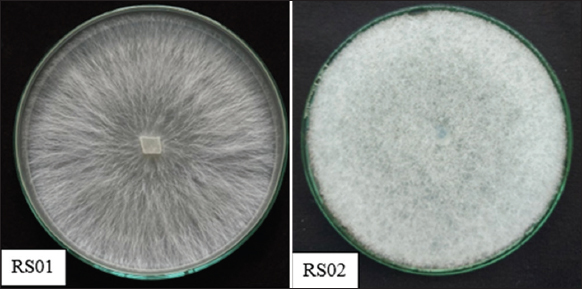 | Figure 1: Colony morphology of fungal isolated RS01 and RS02 obtained from diseased sweet potato storage roots. [Click here to view] |
Table 1: Morphological characteristics of fungal isolates RS01 and RS02.
| Characteristics | Strain RS01 | Strain RS02 |
|---|---|---|
| Form | Filamentous | Filamentous |
| Margin | Filiform | Filiform |
| Elevation | Umbonate | Umbonate |
| Surface | Filamentous | Cottony |
| Front colour | White | White to grey |
| Back colour | White | White |
3.2. Pathogenicity Tests
Two isolates (RS01 and RS02) were evaluated for their ability to cause soft rot on healthy sweet potato storage roots. Soft rot symptoms developed on storage roots inoculated with strain RS02 after 3 days of incubation. Infected tissues became soft and water-soaked, followed by the appearance of greyish-white mycelia with black sporangia on the periderm [Figure 2a]. Although the periderm initially remained largely intact, wounding of the roots revealed severe soft rot in the internal tissues [Figure 2b]; In contrast, no symptoms were observed on roots inoculated with the RS01 strain or on control treatment [Figure 2a].
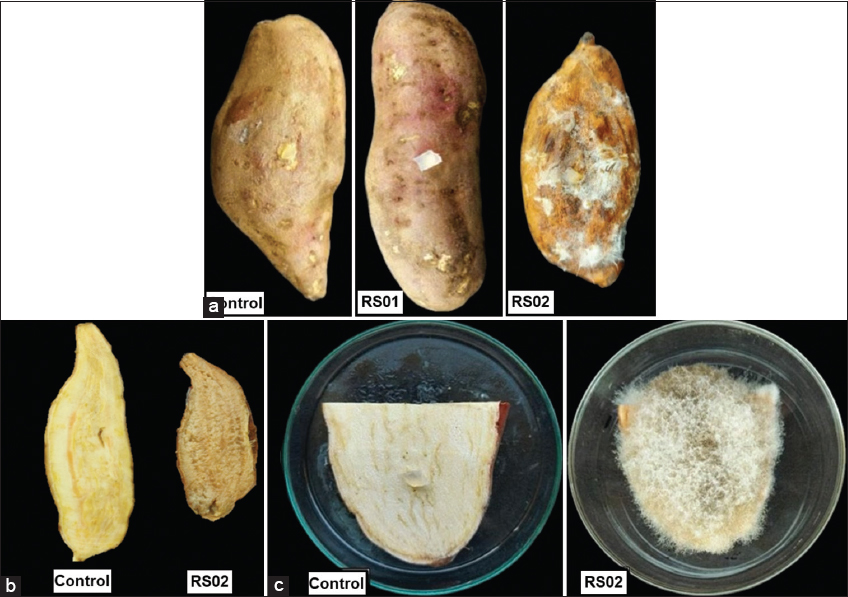 | Figure 2: Pathogenicity assay of RS01 and RS02 isolates after the 5th day of inoculation. (a) External symptoms on whole roots, (b) internal symptoms of roots, and (c) disease development on slices. [Click here to view] |
To further assess pathogenicity, re-inoculation experiments were also conducted on sweet potato slices. Initial lesions became visible after 24 h, ranging from light brown to dark brown. By the 3rd day, abundant greyish-white mycelia and black sporangia emerged from the brown lesions and rapidly expanded. By the 5th day, all inoculated tissues were completely rotted, whereas control slices remained symptomless [Figure 2c].
Both whole roots and slices emitted a strong fermented odor on the 3rd day, indicating active metabolic activity. The fungus was successfully re-isolated from diseased tissues, and the recovered strain displayed morphological characteristics identical to those of strain RS02, thereby fulfilling Koch’s postulates and confirming its pathogenicity on sweet potato.
Notably, disease symptoms appeared earlier and spread more rapidly on sweet potato slices than on intact roots.
3.3. Morphological Characteristics of Strain RS02
RS02 colonies were initially white, cottony on PDA and later became densely covered with sporangia after 48 h of incubation [Figure 3a]. Microscopic observation revealed that the fungal mycelium consisted of three hyphal types: Stolons, rhizoids, and predominantly unbranched sporangiophores, arising from stolons opposite rhizoids [Figure 3b-e]. Sporangia were globose to subglobose. Mature sporangia were black, whereas immature sporangia were light-colored [Figure 3f-i]. Columellae varied from hemispherical to ovoid or ellipsoid. After sporangial dehiscence, columella frequently appeared enlarged and umbrella-like [Figure 3j-m]. Sporangiospores were globose to ellipsoid [Figure 3n-o]. Zygospores were not observed.
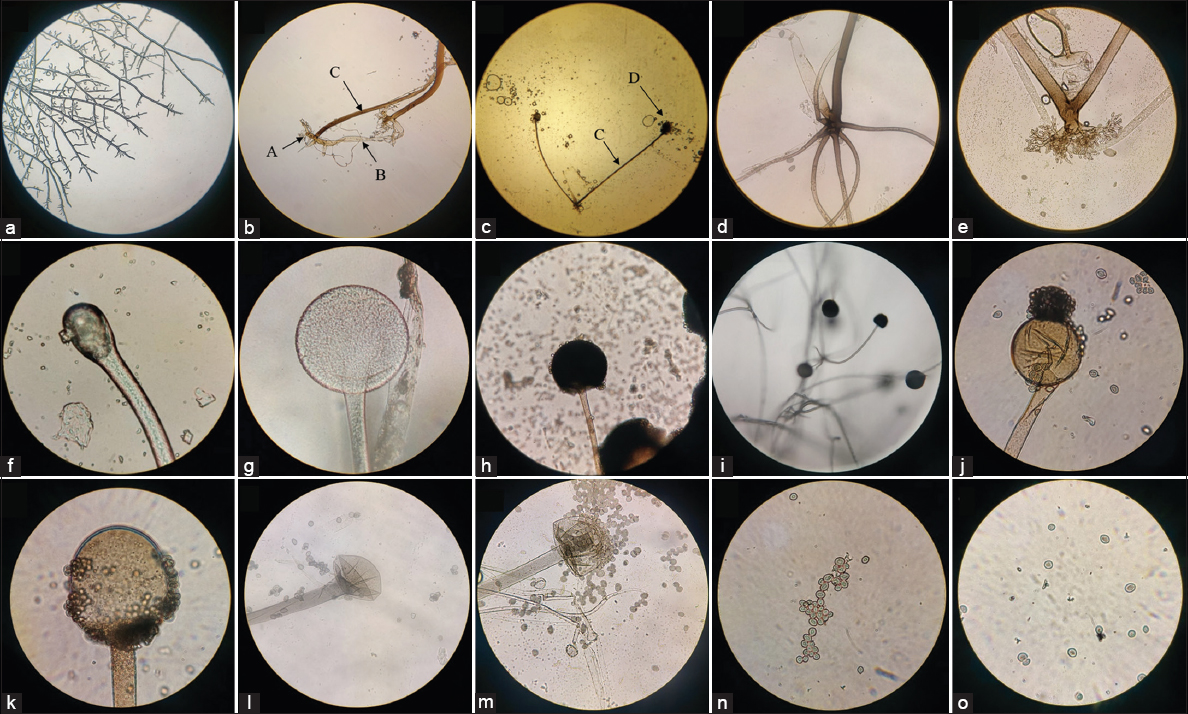 | Figure 3: Morphological characteristics of strain RS02. (a) Fungal mycelia, (b and c) fungal structure after 48 h: Rhizoids (a), stolons (b), sporangiophore (c), sporangia (d), (d and e) rhizoids, (f and g) immature sporangia, (h and i) mature sporangia, (j and m) columella, (n and o) sporangiospores. Observed under ×4 (a-c), ×10 (i), and ×40 (d-o) objectives. [Click here to view] |
These morphological characteristics strongly support the identification of the RS02 strain as R. stolonifer [Table 2].
Table 2: Microscopic characteristics of strain RS02 compared with reference Rhizopus stolonifer strains.
| Characteristics | RS02 strain | R. stolonifer1 | R. stolonifer2 |
|---|---|---|---|
| Colony color | White initially, turning black with age | White to yellow | Whitish, becoming blackish with mature sporangia |
| Sporangiophores color | Hyaline to light brown | Light brown | Brown |
| Sporangia shape | Globose to subglobose | Globose to subglobose | Globose |
| Sporangiospores shape | Globose to ovoid/ellipsoid | Globose, ellipsoid | Subglobose to ellipsoid |
| Columella shape | Hemispherical to ovoid/ellipsoid, often enlarged or umbrella-shaped after dehiscence | Conical to cylindrical | Hemispherical to conical |
| Zygospores size | Not observed | Not observed | Not observed |
3.4. Molecular Identification of Fungi
Phylogenetic analysis based on ITS rDNA sequences showed that strain RS02 clustered within the R. stolonifer clade and was closely related to R. stolonifer isolate AHU6584, showing 99.49% similarity with maximal bootstrap support (97%) in ML phylogenetic tree [Figure 4]. The combined evidence of pathogenicity, morphology, and molecular data confirmed that strain RS02 is R. stolonifer, designated as R. stolonifer isolate RS02, and is the causal agent of soft rot in sweet potato.
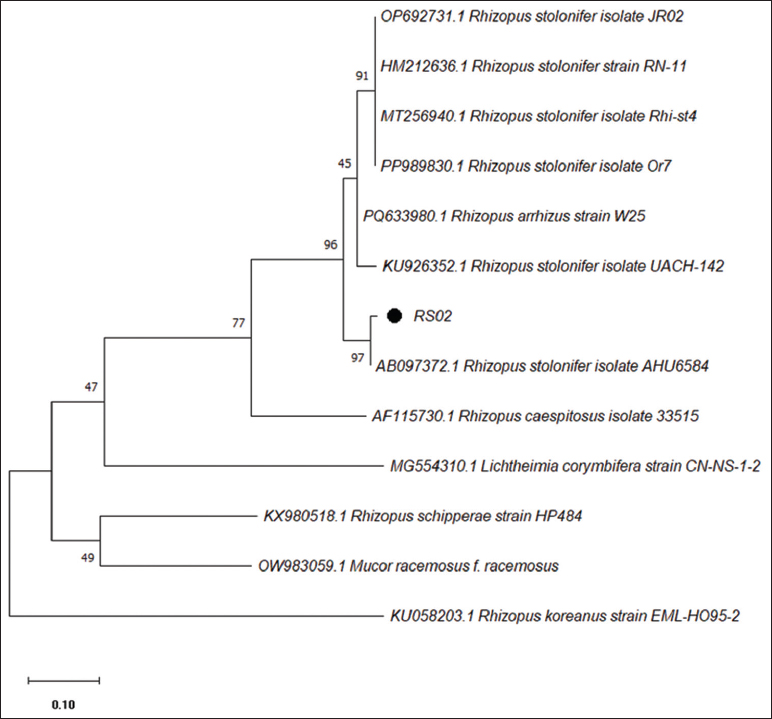 | Figure 4: Phylogenetic tree of strain RS02 based on internal transcribed spacer rDNA sequences. Bootstrap values (>45%) from 1000 replicates are shown at the nodes. The selected isolate in this study is indicated by a black circle. [Click here to view] |
3.5. Effect of Some Factors on Fungal Growth Ability
3.5.1. Effect of culture medium
Growth of strain RS02 varied markedly among the six tested culture medium (PDA, SDA, MEA, ISP2, WA, and CDA) in terms of colony diameter, mycelial density, and sporulation [Figure 5a]. Strain RS02 exhibited rapid mycelial growth on PDA, with colonies nearly covering the Petri plate within 24 h and remaining similar at 48 h. However, no significant increase in colony diameter was observed between 24 h and 48 h on PDA (P > 0.05), indicating that the colony had already reached near complete coverage at 24 h. Similarly, SDA and MEA media also supported rapid growth, with significant increases between 2 time points. In contrast, colonies grown on WA and CDA media were thin, with limited aerial hyphae, although moderate enlargement still occurred from 24 h to 48 h (P < 0.05). ISP2 produced intermediate growth compared with the other media.
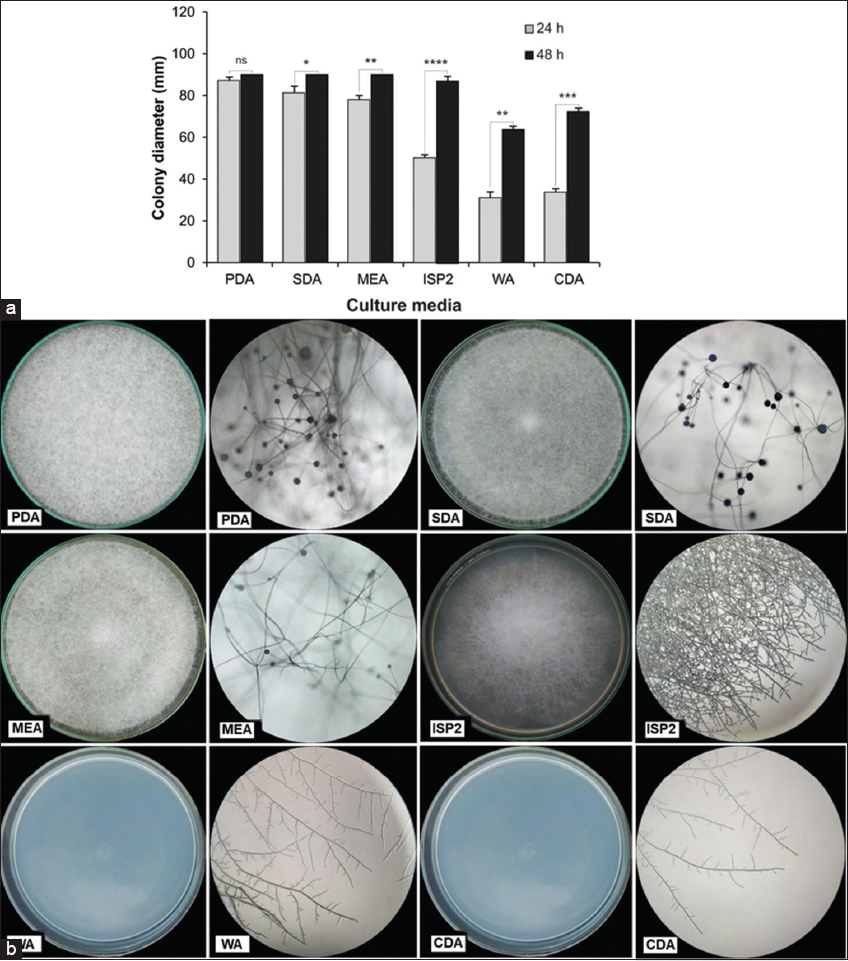 | Figure 5: Growth of strain RS02 on different culture media. (a) Colony diameter measured after 24 h and 48 h of incubation. Data are presented as mean ± standard deviation (n = 3). Differences between 24 h and 48 h were analyzed using paired t-test. *P < 0.05; **P < 0.01; ***P < 0.001; ****P < 0.0001; not significant (ns): P > 0.05, (b) Colony morphology and microscopic characteristics observed after at 48 h of incubation. [Click here to view] |
Microscopic observations were consistent with macroscopic findings [Figure 5b]. PDA supported the formation of a dense, compact mycelial network with abundant black sporangia. Although the growth on SDA and MEA remained strong, the mycelial density was lightly less compact than on PDA, with more loosely arranged and fewer sporangiophores than on PDA. These results highlight that PDA is a suitable medium for rapid vegetative growth and morphological characterization of strain RS02.
3.5.2. Effect of temperature on the growth of strain RS02
Temperature strongly influenced the growth of strain RS02 [Figure 6]. After 48 h of incubation, the largest colony diameter was noted at 25°C, followed closely by 30°C. Although colonies also developed at 20°C, growth was slower than 25°C and 30°C. Within the range (25–30°C), colonies were thick, cottony aerial mycelia with abundant sporangia. In contrast, colony expansion at 35°C and 40°C was markedly reduced at this early stage but later increased to fill the plates by 48 h. However, mycelial density remained thinner and less compact than that observed at 25–30°C. The growth was completely suppressed at 45°C.
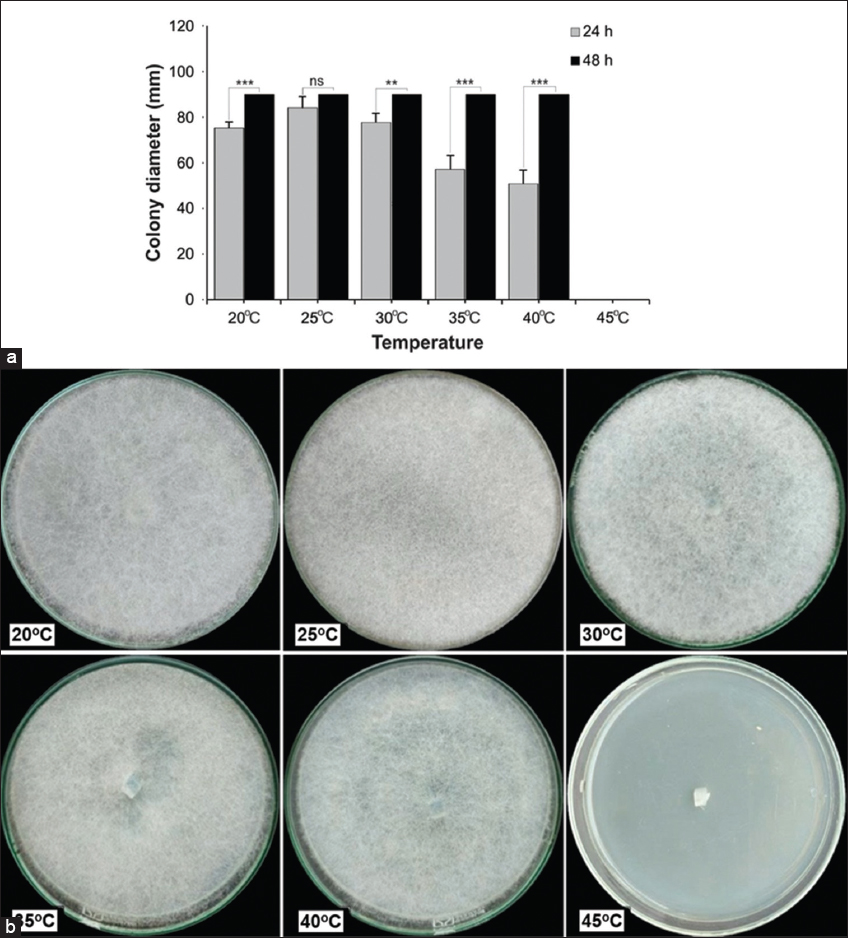 | Figure 6: Growth of strain RS02 at different temperatures (20, 25, 30, 35, 40, and 45°C). (a) Colony diameter measured after 24 h and 48 h of incubation. Data are presented as mean ± standard deviation (n = 3). Differences between 24 h and 48 h were analyzed using paired t-test. *P < 0.05; **P < 0.01; ***P < 0.001; not significant (ns): P > 0.05. (b) Colony morphology observed after 48 h of incubation. [Click here to view] |
Comparison of colony diameters between 24 h and 48 h revealed significant increases at 20, 30, 35, and 40°C (P < 0.05), whereas no significant change was detected at 25°C (P > 0.05) because the colony had already approached near-full plate coverage within the first 24 h of incubation. No fungal growth was observed at 45°C. These results indicate that strain RS02 exhibited rapid radial expansion at temperatures ranging from 20 to 40°C. Notably, at 25°C, mycelial growth and colony development occurred extensively during the initial stages of incubation.
3.5.3. Effect of pH on fungal growth
Colony development of strain RS02 on PDA was significantly affected by environmental pH [Figure 7]. After 24 h and 48 h of incubation, the largest colony diameters were recorded at pH 4 and pH 5. These pH values also facilitated rapid mycelial expansion and dense aerial hyphae. Statistical comparisons were conducted between 24 h and 48 h within each pH treatment. At pH 4, although the fungal growth and mycelial density measured at 48 h were higher than those at 24 h, the difference was not statistically significant (P > 0.05). This indicates that substantial radial growth had already occurred by 24 h. At pH 5 and most other pH values, fungal development increased over time, and the difference between both time points was significant (P < 0.05). Nevertheless, growth at neutral to alkaline pH (6–10) was comparatively reduced, and colonies appeared thinner with lower mycelial density. Although the fungus tolerated a wide pH range, its development was clearly favored in an acidic environment.
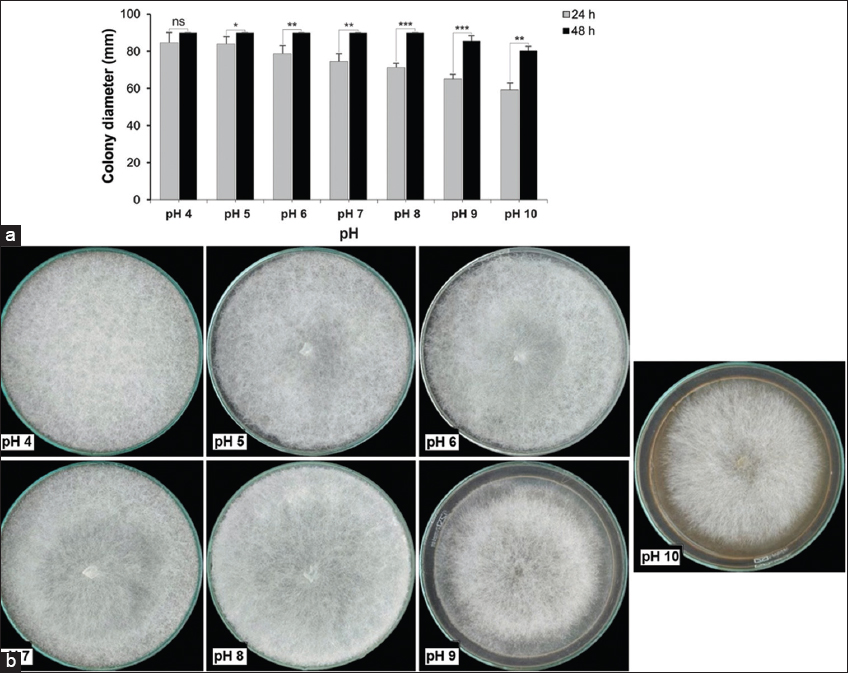 | Figure 7: Growth of strain RS02 on potato dextrose agar at different pH values. (a) Colony diameter measured after 24 h and 48 h of incubation. Data are presented as mean ± standard deviation (n = 3). Differences between 24 h and 48 h were analyzed using paired t-test. *P < 0.05; **P < 0.01; ***P < 0.001; not significant (ns): P > 0.05. (b) Colony morphology observed after 48 h of incubation. [Click here to view] |
3.5.4. Effect of carbon sources on fungal growth
The growth of the RS02 varied according to the carbon sources supplied in PDA [Figure 8]. Considerable variation in mycelial expansion was observed at 24 h, whereas colony diameters among most carbon sources became comparable after 48 h. Media supplemented with glucose, fructose, sucrose, and xylose supported rapid radial expansion, with colonies reaching near maximum plate coverage after 48 h. Macroscopically, the strain produced dense, uniform, and cottony colonies, with extensive aerial mycelium under these treatments. Growth on media supplemented with lactose was moderate, exhibiting slightly reduced colony diameter and a less compact mycelial network. In contrast, colonies grown on medium with dextrin showed markedly restricted mycelial expansion and sparse mycelial density.
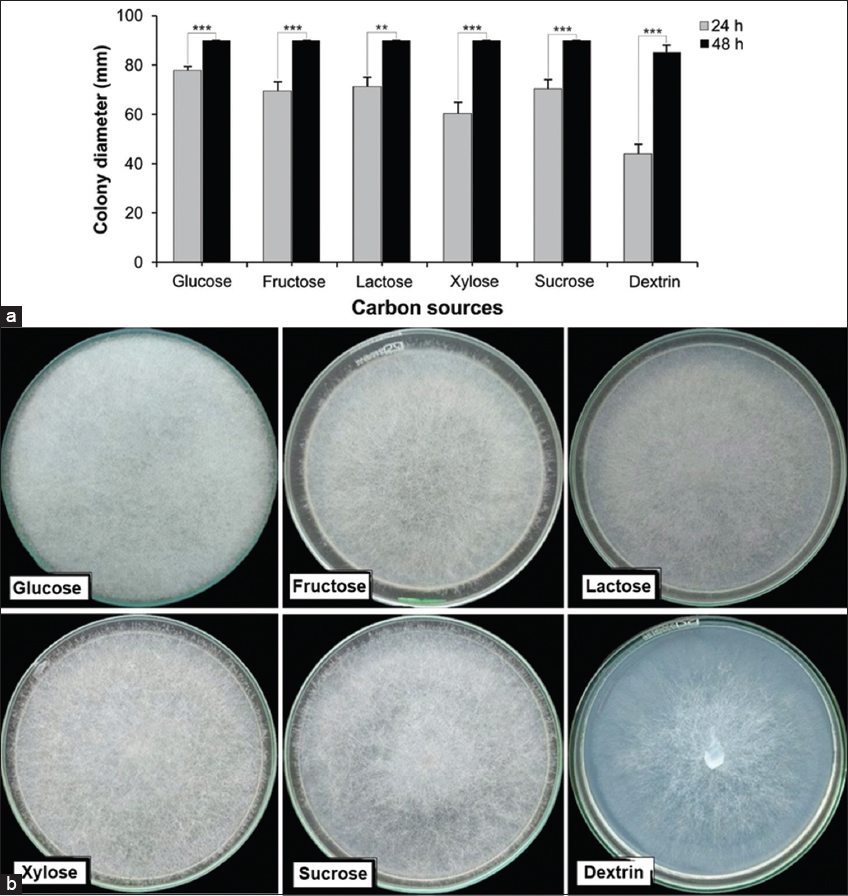 | Figure 8: Growth of strain RS02 on potato dextrose agar supplemented with different carbon sources. (a) Colony diameter measured after 24 h and 48 h of incubation. Data are presented as mean ± standard deviation (n = 3). Differences between 24 h and 48 h were analyzed using a paired t-test. *P < 0.05; **P < 0.01; ***P < 0.001. (b) Colony morphology at 48 h of incubation. [Click here to view] |
Importantly, statistical comparisons between 24 h and 48 h within each carbon treatment exhibited that colony diameter increased significantly over time (P < 0.05) for most carbon sources. Although glucose, fructose, sucrose, and xylose supported rapid growth, colony morphology suggested that glucose may favor more uniform radial expansion and compact mycelial growth. Overall, glucose appeared to support growth of strain RS02; however, differences in final colony diameter among most simple sugars were not pronounced at 48 h.
3.5.5. Extracellular enzyme activity
Extracellular enzyme production of strain RS02 was assessed after 24 h of incubation using the agar diffusion method. Clear hydrolysis halos were observed for cellulase and pectinase [Figure 9]. In contrast, amylase or protease activities were not detected under the tested conditions.
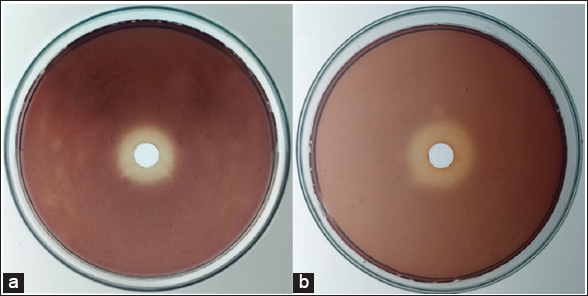 | Figure 9: Extracellular enzyme activities of strain RS02. (a) Cellulase activity and (b) Pectinase activity. [Click here to view] |
4. DISCUSSION
This present study characterized R. stolonifer associated with sweet potato soft rot in Hanoi, Vietnam. Pathogenicity assays confirmed the virulence of the isolate and fulfillment of Koch’s postulates. The more rapid disease progression observed on sweet potato slices compared with intact roots likely reflects increased exposure of nutrient-rich parenchymal tissues, thereby facilitating rapid fungal invasion. A similar approach using sweet potato slices has been widely applied in previous study to ensure uniform infection and reliable assessment of pathogen virulence [19].
The morphological features observed in strain RS02, including well-developed stolons, rhizoids positioned opposite sporangiophores, globose sporangia, and umbrella-shaped columellae, are consistent with description of R. stolonifer in previous taxonomic studies [20,21]. Furthermore, phylogenetic analysis based on the ITS region strongly supported species-level identification with high bootstrap confidence, confirming the taxonomic placement of the isolate. Amplification of the ITS rDNA region using universal primers ITS1 and ITS4 is widely accepted as a reliable method for fungal identification and phylogenetic analysis [22].
Environmental and nutritional factors significantly influenced fungal growth. Favorable development was observed on PDA at 25–30°C and pH 4–5, conditions commonly encountered during postharvest storage in tropical regions. These findings align with previous reports describing rapid mycelial growth, sporulation, and rhizoid formation of R. stolonifer on PDA [23,24]. The fungus is known to prefer slightly acidic environments [25,26], and favorable growth at moderate temperatures (25–30°C) [27,28]. The inability of the isolate to grow at 45°C indicates a clear upper thermal tolerance limit. Previous studies have shown that high temperature stress may affect protein stability, membrane integrity, and cellular metabolism in fungi, thereby inhibiting fungal growth [29-31]. This thermal sensitivity may have practical implications for postharvest disease management strategies.
The strong growth of strain RS02 on media supplemented with glucose highlights its efficient carbohydrate assimilation and metabolic adaptability. Glucose can be readily transported across the cell membrane and directly enter central metabolic pathways, thereby supporting biomass production and sporulation [26]. Similarly, R. stolonifer has been reported to efficiently utilize glucose, which is rapidly consumed under in vitro conditions and associated with enhanced organic acid production [28]. Glucose has also been shown to effectively support mycelial growth of R. stolonifer [32]. Comparable patterns observed in other filamentous fungi further reinforce that simple sugars such as glucose generally promote higher mycelial growth rates than more complex carbon sources [33].
The detection of cellulase and pectinase activities supports the involvement of cell wall–degrading enzymes in host tissue maceration. These findings agree with earlier reports demonstrating that R. stolonifer is capable of producing extracellular enzymes involved in plant cell wall degradation, such as cellulase [34,35] and pectinase [36], which facilitate tissue maceration during infection. Although amylase and protease activities were not detected under the tested conditions, enzyme production in fungi is known to be highly dependent on environmental and nutritional factors.
In conclusion, this study offers integrated morphological, pathogenic, physiological, and molecular insights of R. stolonifer associated with sweet potato soft rot in Hanoi, Vietnam. These findings enhance understanding of the ecological adaptability and infection strategy of this pathogen and may provide valuable information for modulating the growth behavior of RS02 and provide a foundation for both applied disease management and future functional studies.
5. CONCLUSION
Among the isolated strains, only strain RS02 produced typical soft rot symptoms and satisfied Koch’s postulates, thereby confirming its pathogenic role. Morphological features, together with ITS rDNA sequence analysis, identified strain RS02 as R. stolonifer.
The growth of strain RS02 was strongly influenced by environmental and nutritional factors. The fungus grew rapidly on PDA at 25–30°C under slightly acidic conditions (pH 4–5), with glucose as the most favorable carbon source. The production of cellulase and pectinase indicated the important role of cell wall–degrading enzymes in host tissue maceration and disease progression during storage. These findings contribute to a better understanding of the pathogenic mechanism of R. stolonifer and its ability to adapt to postharvest storage conditions in tropical environments.
Overall, this study provides integrated morphological, physiological, and pathogenic data linking fungal growth characteristics with postharvest infection biology of R. stolonifer. The results improve the understanding of pathogen adaptation under tropical storage conditions and provide a scientific basis for future studies on postharvest disease management and biocontrol strategies.
6. ACKNOWLEDGMENT
We sincerely thank our colleagues at the Faculty of Biotechnology, Vietnam National University of Agriculture, for their cooperation and valuable support throughout this study.
7. AUTHORS’ CONTRIBUTIONS
All authors made substantial contributions to conception and design, acquisition of data, or analysis and interpretation of data; took part in drafting the article or revising it critically for important intellectual content; agreed to submit to the current journal; gave final approval of the version to be published; and agree to be accountable for all aspects of the work. All the authors are eligible to be author as per the International Committee of Medical Journal Editors (ICMJE) requirements/guidelines.
8. FUNDING
This study was conducted without any external funding.
9. CONFLICTS OF INTEREST
The authors report no financial or any other conflicts of interest in this work.
10. ETHICAL APPROVALS
This study does not involve experiments on animals or human subjects.
11. DATA AVAILABILITY
All data supporting the findings of this study are included in this article.
12. PUBLISHER’S NOTE
All claims expressed in this article are solely those of the authors and do not necessarily represent those of the publisher, the editors and the reviewers. This journal remains neutral with regard to jurisdictional claims in published institutional affiliation.
13. USE OF ARTIFICIAL INTELLIGENCE (AI)-ASSISTED TECHNOLOGY
The authors declare that they have not used artificial intelligence (AI)-tools for writing and editing of the manuscript, and no images were manipulated using AI.
REFERENCES
1. Jiang L, Jeong JC, Lee JS, Park JM, Yang JW, Lee MH, et al. Potential of Pantoea dispersa as an effective biocontrol agent for black rot in sweet potato. Sci Rep. 2019;9(1):16354. [CrossRef]
2. Alam MK. A comprehensive review of sweet potato (Ipomoea batatas [L.] Lam):Revisiting the associated health benefits. Trends Food Sci Technol. 2021;115:512-29. [CrossRef]
3. Sameya G, HaoJie S. Screening and application of effective agents for controlling sweet potato soft rot disease. Int J Adv Res. 2025;13:872-906. [CrossRef]
4. Agu CK, Nweke GU, Awah N, Okeke B, Mgbemena IC, Okigbo RN, et al. Fungi associated with the post-harvest loss of sweet potato. Int J Res Stud Biosci. 2015;3:32-7.
5. Food and Agriculture Organization of the United Nations. Statistical Database Sweet Potatoes Production. FAO;2019. Available from: https://data.un.org/data.aspx?d=fao&f=itemcode%3a122 [Last accessed on 2025 Dec 25].
6. Workineh M, Enyew M. Review the extent and cause of post harvest loss of fruits and vegetables in Ethiopia. J Biol Agric Healthc. 2021;11:1-22.
7. De Mello JF, Brito AC, Vieira JC, Camara MP, Michereff SJ, De Souza-Motta CM, et al. Identification and pathogenicity of Botryosphaeriaceae species associated with root and stem rot of sweet potato in Brazil. Plant Pathol. 2021;70(7):1601-15. [CrossRef]
8. Paul NC, Nam SS, Kachroo A, Kim YH, Yang JW. Characterization and pathogenicity of sweet potato (Ipomoea batatas) black rot caused by Ceratocystis fimbriata in Korea. Eur J Plant Pathol. 2018;152(3):833-40. [CrossRef]
9. Paul NC, Park W, Lee S, Chung MN, Lee HU, Yang JW. Occurrence of sweetpotato (Ipomoea batatas) wilt and surface rot disease and determining resistance of selected varieties to the pathogen in Korea. Plants (Basel). 2020;9:497. [CrossRef]
10. Yang JW, Nam SS, Lee HU, Choi KH, Hwang SG, Paul NC. Fusarium root rot caused by Fusarium solani on sweet potato (Ipomoea batatas) in South Korea. Can J Plant Pathol. 2018;40(1):90-5. [CrossRef]
11. Narasako Y, Setoguchi Y, Fukutome H, Hirano T, Otani M, Takeshita M, et al. Evaluation of stem polyphenol content as a potential marker for selecting foot-rot-resistant sweet potato (Ipomoea batatas (L.) Lam.) hybrids. Horticulturae. 2025;11(12):1439. [CrossRef]
12. Chen C, Xue Z, Pristijono P, Golding JB, Chen G, Li Y, et al. Effect of cinnamaldehyde on Rhizopus stolonifer and on the conservation of sweet potato. Food Qual Saf. 2024;8:fyad072. [CrossRef]
13. Paul NC, Park S, Liu H, Lee JG, Han GH, Kim H, et al. Fungi associated with postharvest diseases of sweet potato storage roots and in vitro antagonistic assay of Trichoderma harzianum against the diseases. J Fungi (Basel). 2021;7(11):927. [CrossRef]
14. Da Silva WL, Clark CA. Infection of sweetpotato by Fusarium solani and Macrophomina phaseolina prior to harvest. Plant Dis. 2013;97(12):1636-44. https://doi.org/10.1094/pdis-05-13-0514-re [CrossRef]
15. Tafinta I, Shehu K, Abdulganiyyu H, Rabe AM, Usman A. Isolation and identification of fungi associated with the spoilage of sweet orange (Citrus sinensis) fruits in Sokoto State. Niger J Basic Appl Sci. 2014;21:193-6. [CrossRef]
16. Masoomi-Aladizgeh F, Jabbari L, Nekouei R, Aalami A. A Simple and Rapid System for DNA and RNA Isolation from Diverse Plants using Handmade Kit. Protocol Exchange [Preprint];2016. [CrossRef]
17. Amiri A, Chai W, Schnabel G. Effect of nutrient status, pH, temperature and water potential on germination and growth of Rhizopus stolonifer and Gilbertella persicaria. J Plant Pathol. 2011;93:603-12.
18. Sopalun K, Iamtham S. Isolation and screening of extracellular enzymatic activity of endophytic fungi isolated from Thai orchids. S Afr J Bot. 2020;134:273-9. [CrossRef]
19. Pan C, Yang K, Erhunmwunsee F, Wang B, Yang D, Lu G, et al. Antifungal activity of perillaldehyde on Fusarium solani and its control effect on postharvest decay of sweet potatoes. J Fungi (Basel). 2023;9(2):257. [CrossRef]
20. Liu Q, Chen Q, Liu H, Du Y, Jiao W, Sun F, et al. Rhizopus stolonifer and related control strategies in postharvest fruit:A review. Heliyon. 2024;10(8):e29522. [CrossRef]
21. Ghuffar S, Irshad G, Gondal AS, Ahmad R, Rosli H, Zhang X, et al. First report of Rhizopus stolonifer causing Rhizopus bunch rot on grapes in Pakistan. Int J Phytopathol. 2019;8:29-30. [CrossRef]
22. Xu J. Fungal DNA barcoding. Genome. 2016;59(11):913-32. [CrossRef]
23. Hernández-Lauzardo A, Bautista-Baños S, Velázquez M, Trejo-Espino J. Identification of Rhizopus stolonifer (Ehrenb.:Fr.) Vuill., causal agent of Rhizopus rot disease of fruits and vegetables. Rev Mex Fitopatol. 2006;24:65-9.
24. Sandya MB, Karigar C. Rhizopus stolonifer:A resilient postharvest invader and its growth dynamics on varied media. J Adv Microbiol Res. 2025;6:287-92. [CrossRef]
25. Garuba I, Fadahunsi E, Elutade O. Physico-chemical studies on the growth of an Ochratoxin A-degrading Rhizopus sp. Nat Sci. 2011;9(7):240-4.
26. Odeniyi OA, Onilude AA, Ayodele MA. Growth and substrate utilization patterns of a Rhizopus stolonifer strain isolated from depolymerising rice husk. World Appl Sci J. 2009;6:595-9.
27. Sandoval Contreras TD, Iñiguez-Moreno M, Garrido-Sánchez L, Ragazzo-Sanchez J, Zapata J, Calderon-Santoyo M. Effect of temperature on the interaction between Rhizopus stolonifer and Colletotrichum sp., postharvest pathogens of jackfruit (Artocarpus heterophyllus Lam.). Nova Sci. 2022;14:1-15. [CrossRef]
28. Zaveri A, Edwards J, Rochfort S. Production of primary metabolites by Rhizopus stolonifer, causal agent of almond hull rot disease. Molecules. 2022;27(21):7199. [CrossRef]
29. Abu Bakar N, Karsani SA, Alias SA. Fungal survival under temperature stress:A proteomic perspective. PeerJ. 2020;8:e10423. [CrossRef]
30. Qiu Z, Wu X, Gao W, Zhang J, Huang C. High temperature induced disruption of the cell wall integrity and structure in Pleurotus ostreatus mycelia. Appl Microbiol Biotechnol. 2018;102(15):6627-36. [CrossRef]
31. Cao Z, Wang T, He H, Li Y, Li X. Multiomics provides a new understanding of the effect of temperature change on the fermentation quality of Ophiocordyceps sinensis. J Fungi (Basel). 2025;11(6):403. [CrossRef]
32. Ibrahim M, Shehu K. Effects of various carbohydrates on the growth of Rhizopus stolonifer. Int J Multidiscip Res Dev. 2015;2(5):306-8.
33. Bhat S, Yousuf S, Rasool F, Gupta V. Physiological studies of pathogens of genus Botryosphaeria isolated from Blue Pine (Pinus wallichiana) with respect to their carbon and nitrogen requirements. Int J Curr Microbiol Appl Sci. 2018;7(7):3099-104. [CrossRef]
34. Tang B, Pan H, Tang W, Zhang Q, Ding L, Zhang F. Fermentation and purification of cellulase from a novel strain Rhizopus stolonifer var. Reflexus TP-02. Biomass Bioenergy. 2012;36:366-72. [CrossRef]
35. Zhang Y, Tang B, Du G. Self-induction system for cellulase production by cellobiose produced from glucose in Rhizopus stolonifer. Sci Rep. 2017;7(1):10161. [CrossRef]
36. Sari S, Tanjung W, Amilia K, Setyaningsih R, Pangastuti A. Pectinase production by Rhizopus stolonifer A3 isolated from apple peels. Caraka Tani J Sustain Agric. 2023;39:10. [CrossRef]
37. Schipper MA. A revision of the genus Rhizopus. I. The Rhizopus stolonifer-group and Rhizopus oryzae. Stud Mycol. 1984;25:1-19.